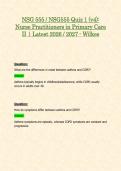
NSG 555 / NSG555 Quiz 1 (v4):
Nurse Practitioners in Primary Care
II | Latest - Wilkes
Question:
What are the differences in onset between asthma and COPD?
Answer:
Asthma typically begins in childhood/adolescence, while COPD usually
occurs in adults over 40.
Question:
How do symptoms differ between asthma and COPD?
Answer:
Asthma symptoms are episodic, whereas COPD symptoms are constant and
progressive.
,Question:
What is the first line treatment for asthma compared to COPD?
Answer:
Asthma is treated with inhaled corticosteroids (ICS), while COPD is
managed with bronchodilators.
Question:
What associated conditions are linked to asthma and COPD?
Answer:
Asthma is associated with eczema and allergies; COPD is associated with
smoking.
Question:
How is asthma diagnosed?
Answer:
Through a history of variable symptoms (wheeze, shortness of breath,
chest tightness, cough) and spirometry showing significant improvement
after bronchodilator use.
,Question:
How does the post-bronchodilation response in asthma differ from COPD?
Answer:
In asthma, the post-bronchodilation response is usually marked, while
COPD shows little change.
Question:
What is the recommended medication for asthma symptoms less than 4-5
days a week?
Answer:
Low-dose ICS-formoterol as-needed.
Question:
What treatment is suggested for asthma symptoms occurring most days or
waking with asthma once a week?
Answer:
Low-dose maintenance ICS-formoterol and low-dose ICS-formoterol
reliever.
, Question:
What is the treatment for asthma with daily symptoms or low lung
function?
Answer:
Medium-dose maintenance ICS-formoterol and low-dose ICS-formoterol
reliever.
Question:
What additional treatment is recommended for severe asthma cases?
Answer:
Add-on LAMA and consider referral for phenotype assessment; may include
high-dose ICS-formoterol and biologics like anti-IgE, anti-IL5/5R, anti-ILRx,
or anti-TSLP.
Question:
When should oral corticosteroids be considered for asthma patients?
Answer:
In Steps 4 and 5, for patients presenting with severely uncontrolled
asthma.
Nurse Practitioners in Primary Care
II | Latest - Wilkes
Question:
What are the differences in onset between asthma and COPD?
Answer:
Asthma typically begins in childhood/adolescence, while COPD usually
occurs in adults over 40.
Question:
How do symptoms differ between asthma and COPD?
Answer:
Asthma symptoms are episodic, whereas COPD symptoms are constant and
progressive.
,Question:
What is the first line treatment for asthma compared to COPD?
Answer:
Asthma is treated with inhaled corticosteroids (ICS), while COPD is
managed with bronchodilators.
Question:
What associated conditions are linked to asthma and COPD?
Answer:
Asthma is associated with eczema and allergies; COPD is associated with
smoking.
Question:
How is asthma diagnosed?
Answer:
Through a history of variable symptoms (wheeze, shortness of breath,
chest tightness, cough) and spirometry showing significant improvement
after bronchodilator use.
,Question:
How does the post-bronchodilation response in asthma differ from COPD?
Answer:
In asthma, the post-bronchodilation response is usually marked, while
COPD shows little change.
Question:
What is the recommended medication for asthma symptoms less than 4-5
days a week?
Answer:
Low-dose ICS-formoterol as-needed.
Question:
What treatment is suggested for asthma symptoms occurring most days or
waking with asthma once a week?
Answer:
Low-dose maintenance ICS-formoterol and low-dose ICS-formoterol
reliever.
, Question:
What is the treatment for asthma with daily symptoms or low lung
function?
Answer:
Medium-dose maintenance ICS-formoterol and low-dose ICS-formoterol
reliever.
Question:
What additional treatment is recommended for severe asthma cases?
Answer:
Add-on LAMA and consider referral for phenotype assessment; may include
high-dose ICS-formoterol and biologics like anti-IgE, anti-IL5/5R, anti-ILRx,
or anti-TSLP.
Question:
When should oral corticosteroids be considered for asthma patients?
Answer:
In Steps 4 and 5, for patients presenting with severely uncontrolled
asthma.