
• Wrong document? Swap it for free
  • Written by students who passed
  • Immediately available after payment
  • Read online or as PDF
Sell
Where do you study
Your language
Document preview thumbnail
Preview 2 out of 14 pages
Exam (elaborations)

PSL 250 UNIT THREE QUESTIONS WITH VERIFIED ANSWERS LATEST UPDATE 2026

Document preview thumbnail
Preview 2 out of 14 pages

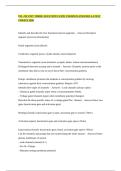
PSL 250 UNIT THREE QUESTIONS WITH VERIFIED ANSWERS LATEST UPDATE 2026 Identify and describe the four functional neuron segments - Answers Receptive segment (receives information) Initial segment (axon hillock) Conductive segment (axon, myelin sheath, neural impulse) Transmissive segment (axon terminals, synaptic knobs, release neurotransmitters) Distinguish between a pump and a channel - Answers Channels: protein pores in the membrane that allows ions to move down their concentration gradient. Pumps: membrane proteins that maintain a concentration gradient by moving substances against their concentration gradient. Require ATP Identify three types of channels - Answers - Leak channels (always open) - Chemical gated channels (open when a neurotransmitter binds) - Voltage gated channels (open when membrane potential changes) Describe the three specific states of a voltage-gated Na+ channel - Answers Have two gates (inactivation gate and activation gate) Resting (closed): inactivation gate is open, activation gate is closed (-70mv) Activation (open): Inactivation gate and activation gate open (-55mv) Inactivation (closed): Inactivation gate closed, activation gate open (+30mv) List the channels and pumps that are located along the entire neuron - Answers Entire plasma membrane of neuron - Leak channels (mainly K+) - Na+/K+ Pumps - Maintain resting membrane potential List the channels and pumps that are located in the receptive segment of the neuron - Answers Receptive segment - Chemically gated ion channels (cation, K+, Cl-) List the channels and pumps that are located in the initial segment of the neuron - Answers Initial segment -Voltage gated ion channels (Na+ open first, then K+) List the channels and pumps that are located in the conductive segment of the neuron - Answers Conductive segment: - Voltage gated ion channels (Na+ goes inside, K+ goes outside) List the channels and pumps that are located in the transmissive segment of the neuron - Answers Transmissive segment: - Voltage gated calcium channels and pumps (channel lets Ca+2 in, pumps bring Ca+2 out) Briefly describe the physiological events that occur at the different segments of the neuron - Answers Receptive segment: binding of neurotransmitter released from presynaptic neurons; production of graded potentials Initial segment: Summation of graded potentials, initiation of action potential Conductive segment: propagation of action potential Transmissive segment: action potential causes release of neurotransmitter Describe the features of an excitatory post-synaptic potential and how it is generated - Answers - Neurotransmitter binds to ligand-gated ion channel -Open a non-specific ion channels, lets Na+ in and K+ out (preferential to Na+) - Moves the membrane potential closer to the threshold (depolarization) - Small in amplitude (1mv-4mv) and lasts 15ms-20ms - Referred to as graded potential and can vary in amplitude Describe the features of an inhibitory post-synaptic potential and how it is generated - Answers - Neurotransmitter binds to ligand-gated ion channel - Opens a Cl- channel; Cl- enters the cell and the cell becomes more negative - Moves the membrane potential away from the threshold (polarization) - Small in amplitude (1mv-4mv) and lasts 15ms-20ms - Referred to as graded potential and can vary in amplitude Describe the general arrangement of pre-synaptic inhibitory and excitatory neurons and how they influence the activity of the neuron - Answers Several presynaptic neurons with a postsynaptic neuron Describe how spatial and temporal stimulation occur - Answers - Spatial: Many synapses sum to bring the membrane potential to threshold - Temporal: One synapse occurs rapidly to bring the membrane potential to threshold - Any individual EPSP would not bring the membrane to potential threshold Describe what happens in the initial segment during an action potential (All or none law) - Answers - If threshold reached, action potential generated and propagated down axon without any loss in intensity - If threshold not reached, voltage-gated channels stay closed; no action potential - The axon shows the same intensity of response to values greater than threshold Describe what happens in the conductive segment during an action potential - Answers - Axon conducts action potentials - Depolarization is gain of positive charge as Na+ enters through voltage-gated Na+ channels - Depolarization is return to negative potential as K+ exits through voltage gated K+ channels -Action potential is propagated down axon to synaptic knob Describe the seven steps of an action potential - Answers 1. Membrane potential is at -70mv 2. Membrane reaches threshold (-55mv) which causes the voltage gated Na+ channels to open 3. Na+ flows into the neurons. Depolarization. Membranes potential is +30mv 4. At +30mv, the Na+ inactivation gate closes, Na+ movement stops 5. Voltage gated K+ channels open; K+ exits the cell; repolarization 6. K+ continues to exit cell; hyperpolarization 7. Voltage gated K+ channels close; Na+/K+ pumps and leak channels restore resting membrane potential Define the refractory period and explain the difference between the absolute and the relative refractory periods associated with transmitting an action potential - Answers Absolute refractory period: during depolarization and repolarization. An action potential cannot be produced Relative refractory period: during hyperpolarization. An action potential can only be produced with a strong stimulus Explain propagation of an action potential in both unmyelinated and myelinated axons - Answers Unmyelinated: - Continuous conduction - Channels and pumps not concentrated - Slow Myelinated: - Saltatory conduction - Channels and pumps are concentrated at nodes (diffusion is faster) - Fast Describe the events that occur when an action potential reaches the transmissive segment - Answers - Action potential reaches synaptic knob - Voltage gated Ca+2 channels open - Ca+2 enters the cell and binds with proteins associated with synaptic vesicles - Synaptic vesicles fuse with the synaptic knob plasma membrane and neurotransmitter is exocytosed - Neurotransmitter diffuses across synaptic cleft and attaches to receptors on a muscle or receptors of a neuron/gland Describe the general role of calcium in neurotransmitter release - Answers Ca+2 triggers fusion of the synaptic vesicle with the membrane and exocytosis of the neurotransmitter Describe how botox inhibits neurotransmission - Answers Inhibits the production and release of acetylcholine Distinguish the difference between acetylcholine acting directly and indirectly on effectors - Answers Direct -Nicotinic receptor -Acetylcholine attaches and Na+ diffuses into the neuron to cause EPSP Indirect - Muscarinic receptor - Acetylcholine attaches and a second messenger detaches to cause EPSP or IPSP Describe the relationship between action potential velocity and axon size - Answers Action potential velocity increases as axon size increases due to lower resistance Describe the anatomical features of the brain - Answers - The adult brain is about the size of a grapefruit and weighs about three pounds - Gyri (ridges) and sulci (depressions between ridges) - cerebrum is separated into two hemispheres and has five lobes (frontal, parietal, temporal, occipital, insula) Describe the relationship between brain activity and brain blood flow - Answers Increased activity in the brain results in increased flow of blood to the brain to support the increased neural activity Describe the general functions of the frontal lobe - Answers - Primary motor cortex: in pre central gyrus, voluntary motor control of skeletal muscles - Motor speech area (Broca area) - Prefrontal cortex: decision making and planning, personality, higher intellectual functioning Describe the general functions of the parietal lobe - Answers - Somatosensory cortex: post-central gyrus, cutaneous and muscular sensing - Understanding speech and formulating words to express thoughts and emotions -Interpretation of textures and shapes Describe the general functions of the temporal lobe - Answers - Interpretation of auditory sensations - Storage (memory) of auditory and some visual experiences Describe the general functions of the occipital lobe - Answers - Integration of movements in focusing the eye - Conscious perception of vision - Storing visual memory Describe the general functions of the insulates - Answers - Memory -Interpretation of taste - Sensory (mainly pain) and visceral integration Describe the composition of gray and white matter and compare the distribution of gray and white matter throughout the brain divisions - Answers Gray matter - Made of neuron cell bodies, dendrites, and unmyelinated axons - Cerebral cortex (gray matter surface of cerebrum) - Cerebral nuclei (regions of gray matter found in cerebrum) White matter - Consists of myelinated axons - inner parts of cerebrum On average, how many hours of sleep does the average adult need? - Answers 7 hours Identify the four major regions of the brain - Answers 1. Cerebrum: largest region 2. Diencephalon: deep into the cerebrum 3. Brainstem: inferior to the diencephalon 4. Cerebellum: second largest region of the brain State some important things that happen during sleep - Answers - Consolidate memory - Resynthesize glycogen - Grow muscle - Repair tissue - Synthesize hormones State some of the negative consequences of sleep deprivation - Answers - Impaired cognition - Higher levels of anxiety - Increases symptoms of depression How does brain activity vary from REM and the different stages of sleep - Answers Stages 1-4 are good for memory, synthesizing hormones, growth, repairing tissue, resynthesizing glycogen How does the amount of sleep we get change during the lifecycle? - Answers As age increases, sleep decreases Describe the anatomical features of the cerebrum - Answers - Consists of hemispheres

Content preview

PSL 250 UNIT THREE QUESTIONS WITH VERIFIED ANSWERS LATEST
UPDATE 2026


Identify and describe the four functional neuron segments - Answers Receptive
segment (receives information)


Initial segment (axon hillock)


Conductive segment (axon, myelin sheath, neural impulse)


Transmissive segment (axon terminals, synaptic knobs, release neurotransmitters)
Distinguish between a pump and a channel - Answers Channels: protein pores in the
membrane that allows ions to move down their concentration gradient.


Pumps: membrane proteins that maintain a concentration gradient by moving
substances against their concentration gradient. Require ATP
Identify three types of channels - Answers - Leak channels (always open)
- Chemical gated channels (open when a neurotransmitter binds)
- Voltage gated channels (open when membrane potential changes)
Describe the three specific states of a voltage-gated Na+ channel - Answers Have two
gates (inactivation gate and activation gate)


Resting (closed): inactivation gate is open, activation gate is closed (-70mv)


Activation (open): Inactivation gate and activation gate open (-55mv)


Inactivation (closed): Inactivation gate closed, activation gate open (+30mv)
List the channels and pumps that are located along the entire neuron - Answers Entire
plasma membrane of neuron
- Leak channels (mainly K+)
- Na+/K+ Pumps
- Maintain resting membrane potential

, List the channels and pumps that are located in the receptive segment of the neuron -
Answers Receptive segment
- Chemically gated ion channels (cation, K+, Cl-)
List the channels and pumps that are located in the initial segment of the neuron -
Answers Initial segment
-Voltage gated ion channels (Na+ open first, then K+)
List the channels and pumps that are located in the conductive segment of the neuron
- Answers Conductive segment:
- Voltage gated ion channels (Na+ goes inside, K+ goes outside)
List the channels and pumps that are located in the transmissive segment of the
neuron - Answers Transmissive segment:
- Voltage gated calcium channels and pumps (channel lets Ca+2 in, pumps bring
Ca+2 out)
Briefly describe the physiological events that occur at the different segments of the
neuron - Answers Receptive segment: binding of neurotransmitter released from
presynaptic neurons; production of graded potentials


Initial segment: Summation of graded potentials, initiation of action potential


Conductive segment: propagation of action potential


Transmissive segment: action potential causes release of neurotransmitter
Describe the features of an excitatory post-synaptic potential and how it is generated -
Answers - Neurotransmitter binds to ligand-gated ion channel
-Open a non-specific ion channels, lets Na+ in and K+ out (preferential to Na+)
- Moves the membrane potential closer to the threshold (depolarization)
- Small in amplitude (1mv-4mv) and lasts 15ms-20ms
- Referred to as graded potential and can vary in amplitude

Describe the features of an inhibitory post-synaptic potential and how it is generated -
Answers - Neurotransmitter binds to ligand-gated ion channel
- Opens a Cl- channel; Cl- enters the cell and the cell becomes more negative
- Moves the membrane potential away from the threshold (polarization)
- Small in amplitude (1mv-4mv) and lasts 15ms-20ms
- Referred to as graded potential and can vary in amplitude


Document information

Uploaded on
September 23, 2026
Number of pages
14
Written in
2026/2027
Type
Exam (elaborations)
Contains
Questions & answers
$12.49

Wrong document? Swap it for free Within 14 days of purchase and before downloading, you can choose a different document. You can simply spend the amount again.
Written by students who passed
Immediately available after payment
Read online or as PDF

Seller avatar
Reputation scores are based on the amount of documents a seller has sold for a fee and the reviews they have received for those documents. There are three levels: Bronze, Silver and Gold. The better the reputation, the more your can rely on the quality of the sellers work.
joshuawesonga22
3.5
(14)
Sold
130
Followers
2
Items
15381
Last sold
1 day ago


Why students choose Stuvia

Created by fellow students, verified by reviews

Quality you can trust: written by students who passed their tests and reviewed by others who've used these notes.

Didn't get what you expected? Choose another document

No worries! You can instantly pick a different document that better fits what you're looking for.

Pay as you like, start learning right away

No subscription, no commitments. Pay the way you're used to via credit card and download your PDF document instantly.

Student with book image

“Bought, downloaded, and aced it. It really can be that simple.”

Alisha Student

Working on your references?

Create accurate citations in APA, MLA and Harvard with our free citation generator.

Working on your references?

Frequently asked questions
