
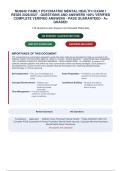
NU664C FAMILY PSYCHIATRIC MENTAL HEALTH I EXAM 1
REGIS 2026/2027 - QUESTIONS AND ANSWERS 100% VERIFIED
COMPLETE VERIFIED ANSWERS - PASS GUARANTEED - A+
GRADED
145 Questions with Answers and Detailed Rationales
100 PERCENT GUARANTEED PASS
INSTANT DOWNLOAD ANSWERS INCLUDED
IMPORTANCE OF THIS DOCUMENT
This comprehensive examination preparation guide has been meticulously developed to help you succeed in the
NU664C FAMILY PSYCHIATRIC MENTAL HEALTH I EXAM 1 REGIS 2026/2027 - QUESTIONS AND ANSWERS
100% VERIFIED COMPLETE VERIFIED ANSWERS - PASS GUARANTEED - A+ GRADED. It contains 145
carefully selected questions that reflect the most current exam content and testing strategies. Each question is
accompanied by a correct answer and a detailed rationale that explains the underlying pathophysiology,
pharmacology, or clinical reasoning.
Self-Assessment – Test your knowledge and Exam Preparation – Familiarize yourself with the
identify areas requiring further question format and content
study areas
Concept Reinforcement – Deepen your Confidence Building – Develop test-taking
understanding through strategies and reduce
evidence-based exam anxiety
rationales
Time Management – Practice answering
questions under simulated
exam conditions
Review Summary 145 Questions
Foundations - Application - Nu664c Family Psychiatric Mental Health I 1 Regis 2026/2027 AND 100
Complete PASS Guaranteed A Family Psychiatric Mental Health Nursing I Graduate Msn/dnp Psychiatric
Mental Health Nurse Practitioner
All answers with rationales
,Table of Contents
Content Area Questions Key Topics
Nu664c Family Psychiatric 1-25 Disorder, Lithium, Confusion, Treatment-resistant, Current
Mental Health I 1 Regis
2026/2027 AND 100 Complete
PASS Guaranteed A Family
Psychiatric Mental Health
Nursing I Graduate Msn/dnp
Psychiatric Mental Health
Nurse Practitioner
Pmhnp 26-50 Disorder, Reports, Lithium, Schizophrenia, Clozapine
Current 51-75 Pmhnp, Disorder, Depressive, Reflects, Anxiety
Lithium 76-100 Disorder, Appropriate, Current, Finding, Depressive
Finding 101-125 Disorder, Pmhnp, Serotonin, Reflects, Psychiatric
Syndrome 126-145 Pmhnp, Disorder, Finding, Strongly, Bipolar
TOTAL 145 All questions include answers and detailed rationales
,Section A - Nu664c Family Psychiatric Mental Health I 1
Regis 2026/2027 AND 100 Complete PASS Guaranteed A
Family Psychiatric Mental Health Nursing I Graduate
Msn/dnp Psychiatric Mental Health Nurse Practitioner
Q1.
A patient develops serotonin syndrome after adding a second serotonergic agent. Which
pathophysiologic mechanism best explains the hyperthermia and neuromuscular
excitability?
A. Excess serotonin at 5-HT1A and 5-HT2A B. Dopamine D2 receptor blockade in the
receptors in the brainstem and spinal cord. basal ganglia.
C. GABA-A receptor potentiation in the D. Norepinephrine reuptake inhibition in the
cortex. periphery.
Correct: A - Excess serotonin at 5-HT1A and 5-HT2A receptors in the brainstem and spinal
cord.
Rationale:Serotonin syndrome results from excessive 5-HT1A and 5-HT2A receptor
stimulation, causing hyperthermia, clonus, and autonomic instability. D2 blockade causes
neuroleptic malignant syndrome, GABA potentiation causes sedation, and peripheral
norepinephrine effects do not explain the central excitability.
Q2.
Which statement best reflects the DSM-5-TR approach to diagnosing schizoaffective
disorder compared with schizophrenia?
A. Schizoaffective disorder requires mood B. Schizoaffective disorder requires
episodes for the majority of the illness delusions or hallucinations for 2 weeks in
duration, while schizophrenia does not. the absence of mood episodes, plus mood
episodes for the majority of the total illness.
C. Schizoaffective disorder is diagnosed D. Schizophrenia requires mood episodes,
only if mood symptoms are whereas schizoaffective disorder excludes
substance-induced. them.
Correct: B - Schizoaffective disorder requires delusions or hallucinations for 2 weeks in
the absence of mood episodes, plus mood episodes for the majority of the total illness.
Rationale:DSM-5-TR requires that in schizoaffective disorder, delusions or hallucinations
persist for at least 2 weeks without prominent mood symptoms, and mood episodes are
present for the majority of the illness. Option A omits the 2-week criterion, C is incorrect
because substance-induced mood is excluded, and D reverses the criteria.
Page 3
, Section A - Nu664c Family Psychiatric Mental Health I 1 Regis 2026/2027 AND 100 Complete PASS Guaranteed A Family Psychiatric Mental
Health Nursing I Graduate Msn/dnp Psychiatric Mental Health Nurse Practitioner
Q3.
A patient on lithium reports new-onset coarse tremor, ataxia, and confusion. Which factor
most likely precipitated this presentation?
A. Increased sodium intake. B. Initiation of an NSAID and a thiazide
diuretic.
C. Addition of a beta-blocker. D. Regular aerobic exercise.
Correct: B - Initiation of an NSAID and a thiazide diuretic.
Rationale:NSAIDs and thiazides reduce renal lithium clearance, raising serum levels and
causing toxicity. Increased sodium intake lowers lithium levels, beta-blockers may mask
tremor but do not raise levels, and exercise alone does not typically precipitate toxicity.
Q4.
Which neuroimaging finding is most consistently associated with treatment-resistant
depression and predicts poor response to standard antidepressants?
A. Increased hippocampal volume. B. Hypermetabolism in the subgenual
anterior cingulate cortex.
C. Reduced amygdala activation to D. Global cortical thickening.
emotional stimuli.
Correct: B - Hypermetabolism in the subgenual anterior cingulate cortex.
Rationale:Hypermetabolism in the subgenual anterior cingulate cortex is linked to
treatment-resistant depression and predicts poor pharmacologic response. Hippocampal
atrophy, not increased volume, is typical; reduced amygdala activation is not the hallmark;
and global thickening is not characteristic.
Q5.
Which therapeutic approach is most consistent with the recovery model in family
psychiatric care?
A. Paternalistic decision-making by the B. Focus solely on symptom reduction.
provider.
C. Collaborative goal-setting that prioritizes D. Emphasizing medication compliance
the patient's self-defined life roles. above all else.
Correct: C - Collaborative goal-setting that prioritizes the patient's self-defined life roles.
Rationale:The recovery model emphasizes person-centered, collaborative care that supports
self-defined goals and community integration. Paternalism, symptom-only focus, and
compliance-centric approaches conflict with recovery principles.
Page 4


