
Topic 10: Space
1.0 Specification notice:
Mathematical skills that could be developed in this topic include using
approximations and sketching relationships which are modelled by y =
k/x2.
This topic may be studied using contexts such as the formation and
evolution of stars and the history and future of the universe.
10.Q Exam questions
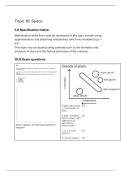
Draw a diagram of a hertzsprung-Russell
diagram?
, 𝐿
10.156 be able to use the equation, intensity 𝐼 = where L
4𝜋𝑑2
is luminosity and d is distance from the source
What is the equation for intensity using 𝐿
𝐼=
luminosity and the meaning for each 4𝜋𝑑2
variable? ● Where I = intensity
● L = luminosity
● d = distance from the source (e.g from earth to
object, depends on the scenario)
● Brightness of star proportional to intensity at Earth
This equation assumes: The power from the star radiates
uniformly through space. No radiation is absorbed
between the star and the Earth
What is the symbol and calculation for an ● 1 Arcminute = 1/60th of a degree (symbol = ‘ )
arcsecond, arcminute from a degree ● 1 Arcsecond = 1/3600th of a degree (symbol = “ )
1 Arcminute = 1/60th of an arcsecond
10.157 understand how astronomical distances can be
determined using trigonometric parallax
Describe how trigonometric parallax is used ● A star is viewed from 2 positions at 6 month
to measure distances of nearby stars? (3) intervals (1) [or the star is viewed from opposite
ends of its orbit diameter about the sun]
● The change in angle/position of the star against
backdrop of fixed stars is measured (1)
● Trigonometry is used to calculate the distance to
the star (1) [or the diameter/radius of Earth’s orbit
about the sun must be known]
\
Why is the trigonometric parallax not used ● The parallax angle becomes very small (or the
beyond a certain distances (2) diameter of the Earth’s orbit is very small) (1)
● Giving a large percentage uncertainty (1)
1.0 Specification notice:
Mathematical skills that could be developed in this topic include using
approximations and sketching relationships which are modelled by y =
k/x2.
This topic may be studied using contexts such as the formation and
evolution of stars and the history and future of the universe.
10.Q Exam questions
Draw a diagram of a hertzsprung-Russell
diagram?
, 𝐿
10.156 be able to use the equation, intensity 𝐼 = where L
4𝜋𝑑2
is luminosity and d is distance from the source
What is the equation for intensity using 𝐿
𝐼=
luminosity and the meaning for each 4𝜋𝑑2
variable? ● Where I = intensity
● L = luminosity
● d = distance from the source (e.g from earth to
object, depends on the scenario)
● Brightness of star proportional to intensity at Earth
This equation assumes: The power from the star radiates
uniformly through space. No radiation is absorbed
between the star and the Earth
What is the symbol and calculation for an ● 1 Arcminute = 1/60th of a degree (symbol = ‘ )
arcsecond, arcminute from a degree ● 1 Arcsecond = 1/3600th of a degree (symbol = “ )
1 Arcminute = 1/60th of an arcsecond
10.157 understand how astronomical distances can be
determined using trigonometric parallax
Describe how trigonometric parallax is used ● A star is viewed from 2 positions at 6 month
to measure distances of nearby stars? (3) intervals (1) [or the star is viewed from opposite
ends of its orbit diameter about the sun]
● The change in angle/position of the star against
backdrop of fixed stars is measured (1)
● Trigonometry is used to calculate the distance to
the star (1) [or the diameter/radius of Earth’s orbit
about the sun must be known]
\
Why is the trigonometric parallax not used ● The parallax angle becomes very small (or the
beyond a certain distances (2) diameter of the Earth’s orbit is very small) (1)
● Giving a large percentage uncertainty (1)


