
Page 1 of 57
NR 546 ADVANCED PHARMACOLOGY EXAM PREP | 100
PRACTICE QUESTIONS & RATIONALES
Nursing / medicine Health
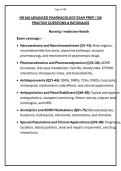
Exam coverage :-
• Neuroanatomy and Neurotransmission (Q1–15): Brain regions,
neurotransmitter functions, dopamine pathways, receptor
pharmacology, and mechanisms of psychotropic drugs.
• Pharmacokinetics and Pharmacodynamics (Q16–30): ADME
processes, first-pass metabolism, half-life, steady state, CYP450
interactions, therapeutic index, and bioavailability.
• Antidepressants (Q31–45): SSRIs, SNRIs, TCAs, MAOIs, bupropion,
mirtazapine, mechanisms, side effects, and clinical applications.
• Antipsychotics and Mood Stabilizers (Q46–60): Typical and atypical
antipsychotics, clozapine monitoring, lithium toxicity, valproic acid,
lamotrigine, and NMS.
• Anxiolytics and ADHD Medications (Q61–75): Benzodiazepines,
buspirone, hydroxyzine, stimulants, atomoxetine, and clonidine.
• Special Populations and Clinical Applications (Q76–90): Pregnancy,
lactation, elderly patients, renal and hepatic impairment, and drug
interactions.
, Page 2 of 57
• Adverse Effects, Monitoring, and Patient Education (Q91–100):
Serotonin syndrome, NMS, tardive dyskinesia, akathisia, and
medication monitoring.
Section 1: Neuroanatomy and Neurotransmission Foundations
(Questions 1–15)
Question 1: A patient recovering from a stroke has difficulty
understanding spoken and written language but can produce fluent,
nonsensical speech. Which area of the brain is most likely affected?
A. Broca's area
B. Wernicke's area
C. The limbic system
D. The occipital lobe
CORRECT ANSWER: B
RATIONALE: Wernicke's area, located in the temporal lobe, is
responsible for language comprehension. Damage to this area results in
receptive aphasia, characterized by fluent but nonsensical speech and
impaired comprehension. Broca's area (A) is responsible for speech
production; damage causes expressive aphasia. The limbic system (C)
is involved in emotion and memory. The occipital lobe (D) is responsible
for vision.
Question 2: A psychiatric-mental health nurse practitioner is reviewing
the role of neurotransmitters in mood regulation. Which
, Page 3 of 57
neurotransmitter is primarily associated with feelings of well-being,
happiness, and the regulation of sleep, appetite, and pain?
A. Dopamine
B. Norepinephrine
C. Serotonin
D. Glutamate
CORRECT ANSWER: C
RATIONALE: Serotonin (5-HT) is a monoamine neurotransmitter
involved in mood regulation, sleep, appetite, and pain perception.
Dopamine (A) is associated with reward, motivation, and motor control.
Norepinephrine (B) is involved in arousal, attention, and the stress
response. Glutamate (D) is the primary excitatory neurotransmitter in
the brain.
Question 3: Which dopamine pathway is primarily responsible for the
development of extrapyramidal symptoms (EPS) when D2 receptors are
blocked?
A. Mesolimbic pathway
B. Mesocortical pathway
C. Nigrostriatal pathway
D. Tuberoinfundibular pathway
CORRECT ANSWER: C
RATIONALE: The nigrostriatal pathway is involved in motor control.
Blockade of D2 receptors in this pathway by typical antipsychotics leads
, Page 4 of 57
to extrapyramidal symptoms such as dystonia, parkinsonism, and
akathisia. The mesolimbic pathway (A) is associated with positive
symptoms of schizophrenia. The mesocortical pathway (B) is associated
with negative symptoms. The tuberoinfundibular pathway (D) regulates
prolactin secretion.
Question 4: A patient taking an antipsychotic medication develops
galactorrhea and amenorrhea. Blockade of which dopamine pathway is
responsible for these adverse effects?
A. Mesolimbic pathway
B. Mesocortical pathway
C. Nigrostriatal pathway
D. Tuberoinfundibular pathway
CORRECT ANSWER: D
RATIONALE: The tuberoinfundibular pathway regulates prolactin
secretion from the anterior pituitary. Blockade of D2 receptors in this
pathway leads to increased prolactin levels, causing galactorrhea and
amenorrhea. The mesolimbic pathway (A) mediates positive symptoms.
The mesocortical pathway (B) mediates negative symptoms. The
nigrostriatal pathway (C) mediates motor control.
Question 5: A patient is prescribed a medication that acts as an inverse
agonist at a receptor. Which of the following best describes the effect of
an inverse agonist?


