
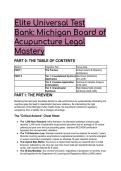
Elite Universal Test
Bank: Michigan Board of
Acupuncture Legal
Mastery
PART 0: THE TABLE OF CONTENTS
Section Cognitive Tier Focus Area
PART I The Preview Critical Axioms & Statutory
Architecture
PART II Tier 1: Foundational Syntax & Hard Deck Definitions
Application (Q1–Q18)
Tier 2: Complex Application Scenario & Variable Analysis
& Simulation (Q19–Q37)
Tier 3: Grandmaster High-Stakes Multi-Variable
Synthesis Synthesis (Q38–Q55)
PART I: THE PREVIEW
Mastering this test bank translates directly to elite performance by systematically eliminating the
cognitive gaps that lead to catastrophic licensure violations. By internalizing the rigid
architecture of the Michigan Public Health Code, the practitioner transforms regulatory
compliance from a liability into a strategic advantage.
The "Critical Axioms" Cheat Sheet
● The 1,245-Hour Standard: Initial licensure via alternative pathways unequivocally
requires 1,245 hours of systematic acupuncture education and an average of 50 unique
patients per year over the four preceding years. Standard NCCAOM certification
bypasses this via equivalent validation.
● The 7/15 Retention Law: Standard medical records must be retained for exactly 7 years.
Records involving sensitive examinations (vaginal/anal penetration), or records entangled
in sexual misconduct complaints, require an absolute 15-year retention protocol.
● The Implicit Bias Matrix: Two hours of implicit bias training are required prior to initial
licensure, followed by one hour per year (two hours total per standard biennial renewal
cycle), with records retained for 6 years.
● The 30-Day Mandate: Any criminal conviction, regardless of jurisdiction or severity, must
be self-reported to the Department of Licensing and Regulatory Affairs (LARA) within
, exactly 30 days of the conviction date.
● The Absolute Non-Delegation Rule: An acupuncturist cannot delegate acts that require
their specific licensed level of education, skill, and judgment to an unlicensed individual.
Statutory Architecture and Context
To achieve universal mastery, the candidate must synthesize the raw data of the Michigan
Public Health Code (MCL 333.1101 et seq.) into a cohesive operational framework. The
legislative intent behind Part 165 is the rigid delineation of East Asian medicine from allopathic,
osteopathic, and chiropractic scopes. By codifying precise definitions for modalities such as dry
needling, acupressure, and moxibustion, the statute creates an "Isolated Island" of practice.
The regulatory landscape demands precise continuing education (CE) tracking. The table below
outlines the non-negotiable CE quotas required for biennial renewal.
Requirement Category Hour Quota Acceptable Modality/Sponsor
Total CEU / PDA 30 hours NCCAOM approved (1 PDA = 1
CEU)
Pain & Symptom Mgmt. 5 hours (included in 30) NCCAOM approved
Implicit Bias 2 hours (included in 30) Pre/post-test required;
interactive elements mandatory
Human Trafficking One-time requirement State/Nationally recognized
health organization
Furthermore, the legal risk matrix for practitioners heavily weights administrative compliance.
Minor lapses in record retention or failure to report address changes compound rapidly into
formal administrative complaints. The Disciplinary Subcommittee (DSC) leverages these
statutes to enforce public safety, applying sanctions ranging from fines to permanent revocation.
Violation Statutory Trigger DSC Sanction Mandate
Unreported Conviction Failure to report within 30 days Discretionary (Fine, Probation,
Suspension)
Sexual Misconduct (Pretext) CSC committed under medical Mandatory Permanent
pretext Revocation
Unlicensed Practice Practicing on Felony Prosecution; Permanent
lapsed/suspended license Ban
Illegal Delegation Delegating core clinical Discretionary (Suspension,
judgment Limitation)
PART II: THE ELITE TEST BANK
Tier 1: Foundational Syntax & Application
Q1: An individual applies physical pressure to various points on the body of a patient suffering
from myofascial pain, without utilizing needles, herbs, or heat. Based on the principles of the
Michigan Public Health Code (MCL 333.16501), which classification is the MOST
APPROPRIATE? A) Dry needling B) Manual therapy C) Acupressure D) Dermal friction
● Answer: C (Acupressure)
● Distractor Analysis:
○ A is incorrect: Dry needling explicitly requires the use of filiform needles to
penetrate the skin.
, ○ B is incorrect: While related, manual therapy is defined generally as an accurately
determined and specifically directed manual force, whereas acupressure
specifically targets "various points on the body".
○ D is incorrect: Dermal friction requires a smooth-edged instrument and a lubricated
area, not merely physical pressure.
The Mentor's Analysis: Statutory definitions are absolute and operate via specific key phrases.
When facing classification ambiguities, the immediate priority is matching the exact mechanical
action to the statutory text. By utilizing the specific language regarding "pressure applied to
various points," the practitioner bypasses the common trap of generalized terminology.
Professional Intuition: Clinical jargon never supersedes statutory definitions; the law only
recognizes the exact text of MCL 333.16501.
Q2: A practitioner utilizes filiform needles to target a myofascial trigger point for the
management of neuromusculoskeletal pain, explicitly avoiding auricular or other traditional
acupuncture points. Based on the principles of MCL 333.16501, which classification is the
FIRST applicable term? A) Electroacupuncture B) Dry needling C) Intramuscular stimulation D)
Systematic acupuncture
● Answer: B (Dry needling)
● Distractor Analysis:
○ A is incorrect: Electroacupuncture requires electrical stimulation of the needles,
which is absent in this statutory definition.
○ C is incorrect: Intramuscular stimulation is grouped under acupuncture broadly, but
the specific avoidance of auricular points defines this narrowly.
○ D is incorrect: Systematic acupuncture is an educational standard, not a procedural
definition.
The Mentor's Analysis: Dry needling is statutorily isolated from traditional acupuncture by its
target limitations. When facing overlapping needle modalities, the immediate priority is
identifying anatomical exclusions. By utilizing the exclusion of auricular points, the practitioner
bypasses the common trap of conflating eastern and western needling frameworks.
Professional Intuition: Dry needling targets the myofascial trigger, strictly divorcing itself from
meridian theory.
Q3: An applicant for a Michigan acupuncture license via the alternative pathway submits
documentation showing 1,000 hours of systematic acupuncture education. Based on the
principles of LARA Administrative Rules, which conclusion is UNEQUIVOCALLY correct? A)
The applicant meets the baseline requirement for licensure. B) The applicant requires an
additional 245 hours of systematic education. C) The applicant qualifies for a limited license but
not a full license. D) The applicant must pass the NCCAOM examination to waive the hour
requirement.
● Answer: B (The applicant requires an additional 245 hours of systematic education.)
● Distractor Analysis:
○ A is incorrect: The statutory minimum for this pathway is precisely 1,245 hours.
○ C is incorrect: Limited licenses require supervision by an MD/DO and active
licensure in another health profession, not a deficit in foundational academic hours.
○ D is incorrect: NCCAOM certification is an independent standard pathway; it does
not "waive" the specific alternative legacy pathway requirements.
The Mentor's Analysis: Educational thresholds are non-negotiable hard decks. When facing
alternative applicant credentials, the immediate priority is verifying the 1,245-hour baseline. By
utilizing the exact numerical standard, the practitioner bypasses the common trap of assuming
partial completion warrants restricted licensure. Professional Intuition: 1,245 hours represents
Bank: Michigan Board of
Acupuncture Legal
Mastery
PART 0: THE TABLE OF CONTENTS
Section Cognitive Tier Focus Area
PART I The Preview Critical Axioms & Statutory
Architecture
PART II Tier 1: Foundational Syntax & Hard Deck Definitions
Application (Q1–Q18)
Tier 2: Complex Application Scenario & Variable Analysis
& Simulation (Q19–Q37)
Tier 3: Grandmaster High-Stakes Multi-Variable
Synthesis Synthesis (Q38–Q55)
PART I: THE PREVIEW
Mastering this test bank translates directly to elite performance by systematically eliminating the
cognitive gaps that lead to catastrophic licensure violations. By internalizing the rigid
architecture of the Michigan Public Health Code, the practitioner transforms regulatory
compliance from a liability into a strategic advantage.
The "Critical Axioms" Cheat Sheet
● The 1,245-Hour Standard: Initial licensure via alternative pathways unequivocally
requires 1,245 hours of systematic acupuncture education and an average of 50 unique
patients per year over the four preceding years. Standard NCCAOM certification
bypasses this via equivalent validation.
● The 7/15 Retention Law: Standard medical records must be retained for exactly 7 years.
Records involving sensitive examinations (vaginal/anal penetration), or records entangled
in sexual misconduct complaints, require an absolute 15-year retention protocol.
● The Implicit Bias Matrix: Two hours of implicit bias training are required prior to initial
licensure, followed by one hour per year (two hours total per standard biennial renewal
cycle), with records retained for 6 years.
● The 30-Day Mandate: Any criminal conviction, regardless of jurisdiction or severity, must
be self-reported to the Department of Licensing and Regulatory Affairs (LARA) within
, exactly 30 days of the conviction date.
● The Absolute Non-Delegation Rule: An acupuncturist cannot delegate acts that require
their specific licensed level of education, skill, and judgment to an unlicensed individual.
Statutory Architecture and Context
To achieve universal mastery, the candidate must synthesize the raw data of the Michigan
Public Health Code (MCL 333.1101 et seq.) into a cohesive operational framework. The
legislative intent behind Part 165 is the rigid delineation of East Asian medicine from allopathic,
osteopathic, and chiropractic scopes. By codifying precise definitions for modalities such as dry
needling, acupressure, and moxibustion, the statute creates an "Isolated Island" of practice.
The regulatory landscape demands precise continuing education (CE) tracking. The table below
outlines the non-negotiable CE quotas required for biennial renewal.
Requirement Category Hour Quota Acceptable Modality/Sponsor
Total CEU / PDA 30 hours NCCAOM approved (1 PDA = 1
CEU)
Pain & Symptom Mgmt. 5 hours (included in 30) NCCAOM approved
Implicit Bias 2 hours (included in 30) Pre/post-test required;
interactive elements mandatory
Human Trafficking One-time requirement State/Nationally recognized
health organization
Furthermore, the legal risk matrix for practitioners heavily weights administrative compliance.
Minor lapses in record retention or failure to report address changes compound rapidly into
formal administrative complaints. The Disciplinary Subcommittee (DSC) leverages these
statutes to enforce public safety, applying sanctions ranging from fines to permanent revocation.
Violation Statutory Trigger DSC Sanction Mandate
Unreported Conviction Failure to report within 30 days Discretionary (Fine, Probation,
Suspension)
Sexual Misconduct (Pretext) CSC committed under medical Mandatory Permanent
pretext Revocation
Unlicensed Practice Practicing on Felony Prosecution; Permanent
lapsed/suspended license Ban
Illegal Delegation Delegating core clinical Discretionary (Suspension,
judgment Limitation)
PART II: THE ELITE TEST BANK
Tier 1: Foundational Syntax & Application
Q1: An individual applies physical pressure to various points on the body of a patient suffering
from myofascial pain, without utilizing needles, herbs, or heat. Based on the principles of the
Michigan Public Health Code (MCL 333.16501), which classification is the MOST
APPROPRIATE? A) Dry needling B) Manual therapy C) Acupressure D) Dermal friction
● Answer: C (Acupressure)
● Distractor Analysis:
○ A is incorrect: Dry needling explicitly requires the use of filiform needles to
penetrate the skin.
, ○ B is incorrect: While related, manual therapy is defined generally as an accurately
determined and specifically directed manual force, whereas acupressure
specifically targets "various points on the body".
○ D is incorrect: Dermal friction requires a smooth-edged instrument and a lubricated
area, not merely physical pressure.
The Mentor's Analysis: Statutory definitions are absolute and operate via specific key phrases.
When facing classification ambiguities, the immediate priority is matching the exact mechanical
action to the statutory text. By utilizing the specific language regarding "pressure applied to
various points," the practitioner bypasses the common trap of generalized terminology.
Professional Intuition: Clinical jargon never supersedes statutory definitions; the law only
recognizes the exact text of MCL 333.16501.
Q2: A practitioner utilizes filiform needles to target a myofascial trigger point for the
management of neuromusculoskeletal pain, explicitly avoiding auricular or other traditional
acupuncture points. Based on the principles of MCL 333.16501, which classification is the
FIRST applicable term? A) Electroacupuncture B) Dry needling C) Intramuscular stimulation D)
Systematic acupuncture
● Answer: B (Dry needling)
● Distractor Analysis:
○ A is incorrect: Electroacupuncture requires electrical stimulation of the needles,
which is absent in this statutory definition.
○ C is incorrect: Intramuscular stimulation is grouped under acupuncture broadly, but
the specific avoidance of auricular points defines this narrowly.
○ D is incorrect: Systematic acupuncture is an educational standard, not a procedural
definition.
The Mentor's Analysis: Dry needling is statutorily isolated from traditional acupuncture by its
target limitations. When facing overlapping needle modalities, the immediate priority is
identifying anatomical exclusions. By utilizing the exclusion of auricular points, the practitioner
bypasses the common trap of conflating eastern and western needling frameworks.
Professional Intuition: Dry needling targets the myofascial trigger, strictly divorcing itself from
meridian theory.
Q3: An applicant for a Michigan acupuncture license via the alternative pathway submits
documentation showing 1,000 hours of systematic acupuncture education. Based on the
principles of LARA Administrative Rules, which conclusion is UNEQUIVOCALLY correct? A)
The applicant meets the baseline requirement for licensure. B) The applicant requires an
additional 245 hours of systematic education. C) The applicant qualifies for a limited license but
not a full license. D) The applicant must pass the NCCAOM examination to waive the hour
requirement.
● Answer: B (The applicant requires an additional 245 hours of systematic education.)
● Distractor Analysis:
○ A is incorrect: The statutory minimum for this pathway is precisely 1,245 hours.
○ C is incorrect: Limited licenses require supervision by an MD/DO and active
licensure in another health profession, not a deficit in foundational academic hours.
○ D is incorrect: NCCAOM certification is an independent standard pathway; it does
not "waive" the specific alternative legacy pathway requirements.
The Mentor's Analysis: Educational thresholds are non-negotiable hard decks. When facing
alternative applicant credentials, the immediate priority is verifying the 1,245-hour baseline. By
utilizing the exact numerical standard, the practitioner bypasses the common trap of assuming
partial completion warrants restricted licensure. Professional Intuition: 1,245 hours represents


