
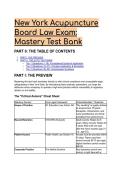
New York Acupuncture
Board Law Exam:
Mastery Test Bank
PART 0: THE TABLE OF CONTENTS
1. PART I: THE PREVIEW
2. PART II: THE ELITE TEST BANK
○ Tier 1 (Questions 1–18): Foundational Syntax & Application
○ Tier 2 (Questions 19–37): Complex Application & Simulation
○ Tier 3 (Questions 38–55): Grandmaster Synthesis
PART I: THE PREVIEW
Mastering this test bank translates directly to elite clinical compliance and unassailable legal
safeguarding in New York State. By internalizing these statutory parameters, you forge the
defensive armor necessary to operate a high-level practice without vulnerability to regulatory
attrition or civil liability.
The "Critical Axioms" Cheat Sheet
Statutory Domain Core Legal Framework Critical Mandate / Threshold
Scope of Practice NY Education Law Article 160 "Dry needling" is legally defined
as acupuncture. Physical
therapists, chiropractors, and
nurse practitioners are strictly
prohibited from performing it.
Record Retention 8 NYCRR 29.2(a)(3) Adult records: Retain for 6
years. Minor records: Retain for
6 years AND until one year
after the minor reaches age 21
(i.e., age 22).
Patient Access Public Health Law Section 18 Access must be provided within
10 days. Paper copy fees
cannot exceed $0.75 per page;
digital transfers cannot exceed
$60.00.
Corporate Practice The Mallela Doctrine Non-licensees cannot own,
control, or split fees with a
,Statutory Domain Core Legal Framework Critical Mandate / Threshold
professional medical
corporation. Violations result in
the lawful denial of No-Fault
insurance reimbursements.
Professional Misconduct Education Law 6509(5) & 6512 Any criminal conviction
(including a misdemeanor DWI)
automatically constitutes
professional misconduct.
Unauthorized practice of a
profession is a Class E felony.
Infection Control Public Health Law 239 Healthcare professionals must
complete 4 hours of
NYSED-approved infection
control training every 4 years.
PART II: THE ELITE TEST BANK
Tier 1 (Questions 1–18): Foundational Syntax & Application
Q1: A physical therapist in New York integrates filiform needle insertion into a patient's trigger
points for pain relief. Based on the principles of New York Education Law Article 160, which
conclusion is the MOST ACCURATE?
A) The therapist is operating within their scope if they hold a national dry needling certification.
B) The therapist may perform this action if supervised directly by a licensed acupuncturist. C)
The therapist is committing unauthorized practice of a profession. D) The therapist may perform
this if they bill the procedure as neuromuscular reeducation.
● Answer: C (The therapist is committing unauthorized practice of a profession.)
● Distractor Analysis:
○ A is incorrect: New York classifies this act strictly as acupuncture; there is no
separate physical therapy dry needling certification recognized by the state.
○ B is incorrect: Physical therapists are not eligible for limited permits or supervision
exemptions to practice acupuncture.
○ D is incorrect: Billing terminology does not supersede statutory definitions of an
invasive scope of practice.
The Mentor's Analysis: New York law defines acupuncture by the tool and intent, categorizing
dry needling inherently as acupuncture. When facing scope of practice ambiguities, the
immediate priority is enforcing statutory definitions over legacy physical therapy protocols. By
utilizing Article 160, you bypass the common trap of relying on out-of-state "dry needling"
precedents. Professional Intuition: In New York, dry needling is acupuncture; physical
therapists and chiropractors are strictly prohibited from penetrating the skin.
Q2: An adult patient requests a complete copy of their medical records. Based on the principles
of Public Health Law Section 18, what is the MAXIMUM per-page fee the acupuncturist may
legally charge for paper copies?
A) $0.25 B) $0.50 C) $0.75 D) $1.00
● Answer: C ($0.75)
● Distractor Analysis:
○ A is incorrect: Twenty-five cents applies to certain Department of Health agency
, record copies, but not private patient medical records.
○ B is incorrect: This is an arbitrary figure with no basis in New York Public Health
Law.
○ D is incorrect: Charging one dollar per page violates the statutory maximum and
constitutes unprofessional conduct.
The Mentor's Analysis: Patient access to records is heavily regulated to prevent financial
barriers to care continuity. When facing a patient record request, the immediate priority is
absolute compliance with the statutory fee cap. By utilizing the seventy-five cents maximum, you
bypass the common trap of overcharging based on administrative burden. Professional
Intuition: Never charge more than $0.75 per paper page for medical records in New York State.
Q3: A licensed acupuncturist is treating a 14-year-old patient. Based on the principles of 8
NYCRR 29.2, when is the EARLIEST the practitioner may legally destroy this patient's records?
A) When the patient turns 18. B) When the patient turns 20. C) When the patient turns 21. D)
When the patient turns 22.
● Answer: D (When the patient turns 22.)
● Distractor Analysis:
○ A is incorrect: Retaining records only until the age of majority violates specific
healthcare retention rules for minors.
○ B is incorrect: Six years from the time of treatment for a 14-year-old only reaches
age 20, which fails the secondary statutory age requirement.
○ C is incorrect: The law explicitly requires retention until one year after the minor
reaches age 21.
The Mentor's Analysis: Minors possess an extended statute of limitations for medical
malpractice claims. When facing pediatric record retention, the immediate priority is calculating
the "age 21 plus one year" threshold. By utilizing the minor retention rule, you bypass the
common trap of applying the standard six-year adult rule. Professional Intuition: For minors,
retain records until their 22nd birthday to ensure absolute compliance.
Q4: A recent graduate seeks to practice acupuncture prior to full licensure. Based on the
principles of 8 NYCRR 79-2.3, which statement regarding a limited permit is TRUE?
A) The permit is valid for two years and cannot be renewed. B) The permittee may practice
independently in a satellite clinic. C) The supervising acupuncturist must be on-site at all times.
D) A single supervisor may oversee up to three permittees simultaneously.
● Answer: C (The supervising acupuncturist must be on-site at all times.)
● Distractor Analysis:
○ A is incorrect: A limited permit is valid for one year and may be renewed for one
additional year.
○ B is incorrect: Independent practice is strictly forbidden; supervision requires the
supervisor to be physically on the premises.
○ D is incorrect: The regulations explicitly state that no practitioner shall supervise
more than one permittee at any time.
The Mentor's Analysis: Limited permits bridge the gap between education and licensure but
require strict oversight to protect public health. When facing permit utilization, the immediate
priority is establishing continuous on-site supervision. By utilizing a one-to-one supervision ratio,
you bypass the common trap of illegal delegation. Professional Intuition: A limited permittee
requires a 1:1 ratio with an on-site supervisor present at all times.
Q5: A medical doctor (MD) wishes to incorporate acupuncture into their New York practice.
Based on the principles of Education Law Article 160, which action is REQUIRED?
A) The MD may practice acupuncture automatically under their standard medical license. B) The
Board Law Exam:
Mastery Test Bank
PART 0: THE TABLE OF CONTENTS
1. PART I: THE PREVIEW
2. PART II: THE ELITE TEST BANK
○ Tier 1 (Questions 1–18): Foundational Syntax & Application
○ Tier 2 (Questions 19–37): Complex Application & Simulation
○ Tier 3 (Questions 38–55): Grandmaster Synthesis
PART I: THE PREVIEW
Mastering this test bank translates directly to elite clinical compliance and unassailable legal
safeguarding in New York State. By internalizing these statutory parameters, you forge the
defensive armor necessary to operate a high-level practice without vulnerability to regulatory
attrition or civil liability.
The "Critical Axioms" Cheat Sheet
Statutory Domain Core Legal Framework Critical Mandate / Threshold
Scope of Practice NY Education Law Article 160 "Dry needling" is legally defined
as acupuncture. Physical
therapists, chiropractors, and
nurse practitioners are strictly
prohibited from performing it.
Record Retention 8 NYCRR 29.2(a)(3) Adult records: Retain for 6
years. Minor records: Retain for
6 years AND until one year
after the minor reaches age 21
(i.e., age 22).
Patient Access Public Health Law Section 18 Access must be provided within
10 days. Paper copy fees
cannot exceed $0.75 per page;
digital transfers cannot exceed
$60.00.
Corporate Practice The Mallela Doctrine Non-licensees cannot own,
control, or split fees with a
,Statutory Domain Core Legal Framework Critical Mandate / Threshold
professional medical
corporation. Violations result in
the lawful denial of No-Fault
insurance reimbursements.
Professional Misconduct Education Law 6509(5) & 6512 Any criminal conviction
(including a misdemeanor DWI)
automatically constitutes
professional misconduct.
Unauthorized practice of a
profession is a Class E felony.
Infection Control Public Health Law 239 Healthcare professionals must
complete 4 hours of
NYSED-approved infection
control training every 4 years.
PART II: THE ELITE TEST BANK
Tier 1 (Questions 1–18): Foundational Syntax & Application
Q1: A physical therapist in New York integrates filiform needle insertion into a patient's trigger
points for pain relief. Based on the principles of New York Education Law Article 160, which
conclusion is the MOST ACCURATE?
A) The therapist is operating within their scope if they hold a national dry needling certification.
B) The therapist may perform this action if supervised directly by a licensed acupuncturist. C)
The therapist is committing unauthorized practice of a profession. D) The therapist may perform
this if they bill the procedure as neuromuscular reeducation.
● Answer: C (The therapist is committing unauthorized practice of a profession.)
● Distractor Analysis:
○ A is incorrect: New York classifies this act strictly as acupuncture; there is no
separate physical therapy dry needling certification recognized by the state.
○ B is incorrect: Physical therapists are not eligible for limited permits or supervision
exemptions to practice acupuncture.
○ D is incorrect: Billing terminology does not supersede statutory definitions of an
invasive scope of practice.
The Mentor's Analysis: New York law defines acupuncture by the tool and intent, categorizing
dry needling inherently as acupuncture. When facing scope of practice ambiguities, the
immediate priority is enforcing statutory definitions over legacy physical therapy protocols. By
utilizing Article 160, you bypass the common trap of relying on out-of-state "dry needling"
precedents. Professional Intuition: In New York, dry needling is acupuncture; physical
therapists and chiropractors are strictly prohibited from penetrating the skin.
Q2: An adult patient requests a complete copy of their medical records. Based on the principles
of Public Health Law Section 18, what is the MAXIMUM per-page fee the acupuncturist may
legally charge for paper copies?
A) $0.25 B) $0.50 C) $0.75 D) $1.00
● Answer: C ($0.75)
● Distractor Analysis:
○ A is incorrect: Twenty-five cents applies to certain Department of Health agency
, record copies, but not private patient medical records.
○ B is incorrect: This is an arbitrary figure with no basis in New York Public Health
Law.
○ D is incorrect: Charging one dollar per page violates the statutory maximum and
constitutes unprofessional conduct.
The Mentor's Analysis: Patient access to records is heavily regulated to prevent financial
barriers to care continuity. When facing a patient record request, the immediate priority is
absolute compliance with the statutory fee cap. By utilizing the seventy-five cents maximum, you
bypass the common trap of overcharging based on administrative burden. Professional
Intuition: Never charge more than $0.75 per paper page for medical records in New York State.
Q3: A licensed acupuncturist is treating a 14-year-old patient. Based on the principles of 8
NYCRR 29.2, when is the EARLIEST the practitioner may legally destroy this patient's records?
A) When the patient turns 18. B) When the patient turns 20. C) When the patient turns 21. D)
When the patient turns 22.
● Answer: D (When the patient turns 22.)
● Distractor Analysis:
○ A is incorrect: Retaining records only until the age of majority violates specific
healthcare retention rules for minors.
○ B is incorrect: Six years from the time of treatment for a 14-year-old only reaches
age 20, which fails the secondary statutory age requirement.
○ C is incorrect: The law explicitly requires retention until one year after the minor
reaches age 21.
The Mentor's Analysis: Minors possess an extended statute of limitations for medical
malpractice claims. When facing pediatric record retention, the immediate priority is calculating
the "age 21 plus one year" threshold. By utilizing the minor retention rule, you bypass the
common trap of applying the standard six-year adult rule. Professional Intuition: For minors,
retain records until their 22nd birthday to ensure absolute compliance.
Q4: A recent graduate seeks to practice acupuncture prior to full licensure. Based on the
principles of 8 NYCRR 79-2.3, which statement regarding a limited permit is TRUE?
A) The permit is valid for two years and cannot be renewed. B) The permittee may practice
independently in a satellite clinic. C) The supervising acupuncturist must be on-site at all times.
D) A single supervisor may oversee up to three permittees simultaneously.
● Answer: C (The supervising acupuncturist must be on-site at all times.)
● Distractor Analysis:
○ A is incorrect: A limited permit is valid for one year and may be renewed for one
additional year.
○ B is incorrect: Independent practice is strictly forbidden; supervision requires the
supervisor to be physically on the premises.
○ D is incorrect: The regulations explicitly state that no practitioner shall supervise
more than one permittee at any time.
The Mentor's Analysis: Limited permits bridge the gap between education and licensure but
require strict oversight to protect public health. When facing permit utilization, the immediate
priority is establishing continuous on-site supervision. By utilizing a one-to-one supervision ratio,
you bypass the common trap of illegal delegation. Professional Intuition: A limited permittee
requires a 1:1 ratio with an on-site supervisor present at all times.
Q5: A medical doctor (MD) wishes to incorporate acupuncture into their New York practice.
Based on the principles of Education Law Article 160, which action is REQUIRED?
A) The MD may practice acupuncture automatically under their standard medical license. B) The


