
AC-HPAT Biology - Unit 4
comprehensive Questions and Answers
with Verified Solutions
Question 1:
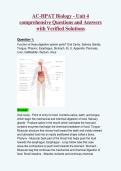
Function of these digestive system parts? Oral Cavity, Salivary Glands,
Tongue, Pharynx, Esophagus, Stomach, SI, LI, Appendix, Pancreas,
Liver, Gallbladder, Rectum, Anus
Answer:
Oral cavity - Point of entry for food. Contains saliva, teeth, and tongue
which begin the mechanical and chemical digestion of food. Salivary
glands - Produce saliva in the mouth which lubricates the food and
contains enzymes that begin the chemical breakdown of food. Tongue -
Muscular structure that moves food toward the teeth and molds chewed
and lubricated food into an easily swallowed shape called a bolus.
Pharynx - Muscular back part of the throat that helps push the food
towards the esophagus. Esophagus - Long hollow tube that uses
wave-like contractions to push food towards the stomach. Stomach -
Muscular bag that continues the mechanical and chemical digestion of
food. Small intestine - Absorbs nutrients and continues chemical
, digestion of food. It is made of three segments, the duodenum, the
jejunum, and the ileum. Large intestine - Allows water to be absorbed and
stores the indigestible portions of the food. Made up of three segments,
the ascending, transverse, and descending colon and a dead end called
the cecum. Appendix - A vestigial organ in humans (no longer serves a
clear function) that may have been involved in the digestion of bone at
the dead-end segment of the large intestine called the cecum. Pancreas -
Releases enzymes into the small intestine to aid with digestion. Liver -
Produces enzymes found in bile to help break down fats. Gallbladder -
Stores bile to be secreted into the small intestine. Rectum - Stores
indigestible waste before it is excreted. Anus - Indigestible waste is
excreted through the anus and out of the body.
Question 2:
What is the movement of food through the digestive system? (PT 1)
Answer:
1) The Mouth - Food enters the mouth and is broken down through
mechanical digestion by the teeth. 2) Salivary Glands - The three salivary
glands - parotid gland, submandibular gland, and sublingual gland -
release saliva, which is 98 percent water and two percent other
substances such as the enzymes amylase and lipase. These enzymes
begin the chemical digestion of the food. 3) Swallowing - The process of
swallowing occurs. The tongue shapes the food into a ball called a bolus
and pushes it back toward the pharynx. At the same time, a structure
called the epiglottis closes in order to block food from entering the
trachea, which leads to the lungs. The pharynx pushes the food into the
esophagus. 4) Esophagus - In the esophagus, the food is pushed
downward by a process called peristalsis. Peristalsis involves wavelike
muscle contractions to move the food through the esophagus to the
stomach. 5) Stomach - The food must pass through the stomach's first
sphincter (called the cardiac sphincter), which allows food into the
stomach. When functioning properly, the cardiac sphincter prevents any
acid from the stomach from leaking backward into the esophagus. The
acid in the stomach could burn the lining of the esophagus. The stomach
is one of the main sites of chemical digestion, which it accomplishes by
releasing gastric juices. They contain hydrochloric acid and the enzyme
comprehensive Questions and Answers
with Verified Solutions
Question 1:
Function of these digestive system parts? Oral Cavity, Salivary Glands,
Tongue, Pharynx, Esophagus, Stomach, SI, LI, Appendix, Pancreas,
Liver, Gallbladder, Rectum, Anus
Answer:
Oral cavity - Point of entry for food. Contains saliva, teeth, and tongue
which begin the mechanical and chemical digestion of food. Salivary
glands - Produce saliva in the mouth which lubricates the food and
contains enzymes that begin the chemical breakdown of food. Tongue -
Muscular structure that moves food toward the teeth and molds chewed
and lubricated food into an easily swallowed shape called a bolus.
Pharynx - Muscular back part of the throat that helps push the food
towards the esophagus. Esophagus - Long hollow tube that uses
wave-like contractions to push food towards the stomach. Stomach -
Muscular bag that continues the mechanical and chemical digestion of
food. Small intestine - Absorbs nutrients and continues chemical
, digestion of food. It is made of three segments, the duodenum, the
jejunum, and the ileum. Large intestine - Allows water to be absorbed and
stores the indigestible portions of the food. Made up of three segments,
the ascending, transverse, and descending colon and a dead end called
the cecum. Appendix - A vestigial organ in humans (no longer serves a
clear function) that may have been involved in the digestion of bone at
the dead-end segment of the large intestine called the cecum. Pancreas -
Releases enzymes into the small intestine to aid with digestion. Liver -
Produces enzymes found in bile to help break down fats. Gallbladder -
Stores bile to be secreted into the small intestine. Rectum - Stores
indigestible waste before it is excreted. Anus - Indigestible waste is
excreted through the anus and out of the body.
Question 2:
What is the movement of food through the digestive system? (PT 1)
Answer:
1) The Mouth - Food enters the mouth and is broken down through
mechanical digestion by the teeth. 2) Salivary Glands - The three salivary
glands - parotid gland, submandibular gland, and sublingual gland -
release saliva, which is 98 percent water and two percent other
substances such as the enzymes amylase and lipase. These enzymes
begin the chemical digestion of the food. 3) Swallowing - The process of
swallowing occurs. The tongue shapes the food into a ball called a bolus
and pushes it back toward the pharynx. At the same time, a structure
called the epiglottis closes in order to block food from entering the
trachea, which leads to the lungs. The pharynx pushes the food into the
esophagus. 4) Esophagus - In the esophagus, the food is pushed
downward by a process called peristalsis. Peristalsis involves wavelike
muscle contractions to move the food through the esophagus to the
stomach. 5) Stomach - The food must pass through the stomach's first
sphincter (called the cardiac sphincter), which allows food into the
stomach. When functioning properly, the cardiac sphincter prevents any
acid from the stomach from leaking backward into the esophagus. The
acid in the stomach could burn the lining of the esophagus. The stomach
is one of the main sites of chemical digestion, which it accomplishes by
releasing gastric juices. They contain hydrochloric acid and the enzyme


