

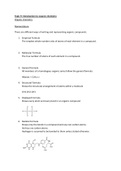
Topic 9: Introduction to organic chemistry
Organic chemistry
Nomenclature
There are different ways of writing and representing organic compounds:
1. Empirical Formula
The simplest whole number ratio of atoms of each element in a compound.
2. Molecular Formula
The true number of atoms of each element in a compound.
3. General Formula
All members of a homologous organic series follow the general formula.
Alkanes = CnH2n+2
4. Structural Formula
Shows the structural arrangement of atoms within a molecule
CH3-CH2-CH3
5. Displayed Formula
Shows every atom and every bond in an organic compound
6. Skeletal Formula
Shows only the bonds in a compound and any non-carbon atoms.
Vertices are carbon atoms.
Hydrogen is assumed to be bonded to them unless stated otherwise
, 7. Homologous series
Organic compounds are often part of a homologous series, in which all member
follow a general formula and react in a very similar way. Each consecutive member
differs by CH2 and there is an increase in boiling points as chain length increases.
Organic chemistry
Nomenclature
There are different ways of writing and representing organic compounds:
1. Empirical Formula
The simplest whole number ratio of atoms of each element in a compound.
2. Molecular Formula
The true number of atoms of each element in a compound.
3. General Formula
All members of a homologous organic series follow the general formula.
Alkanes = CnH2n+2
4. Structural Formula
Shows the structural arrangement of atoms within a molecule
CH3-CH2-CH3
5. Displayed Formula
Shows every atom and every bond in an organic compound
6. Skeletal Formula
Shows only the bonds in a compound and any non-carbon atoms.
Vertices are carbon atoms.
Hydrogen is assumed to be bonded to them unless stated otherwise
, 7. Homologous series
Organic compounds are often part of a homologous series, in which all member
follow a general formula and react in a very similar way. Each consecutive member
differs by CH2 and there is an increase in boiling points as chain length increases.



