
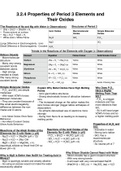
3.2.4 Properties of Period 3 Elements and
Their Oxides
The Reactions of Na and Mg with Water (+ Observations) Structures of Period 3
- 2Na + 2H₂O → 2NaOH + H₂
- Ionic Oxides Macromolecular Simple Molecular
Fizzes around on surface
Oxides Oxides
- Mg + H₂O → MgO + H₂
- White solid + White Flame Na₂O SiO₂ P₄O₁₀
MgO SO₂
Large Difference in Electronegativity - Ionic
Small Difference in Electronegativity - Covalent Al₂O₃
Trends in the Reactions of the Elements with Oxygen (+ Observations)
Silicon Dioxide Element Equation Flame Colour Solid Smoke Colour
- Macromolecular
structure Sodium 4Na + O₂ → 2Na₂O (s) Yellow White
- Many very strong Magnesium 2Mg + O₂ → 2MgO (s) White White
covalent bonds
between atoms Aluminium 4Al + 3O₂ → 2Al₂O₃ (s) White White
- High energy
Silicon Si + O₂ → SiO₂ (s) White White
needed to break
the many strong Phosphorus 4P + 5O₂ → P₄O₁₀ (s) White White
covalent bonds
Sulphur S + O₂ → SO₂ (g) Blue Acidic Choking Gas
Simple Molecular Oxides Explain Why Metal Oxides Have High Melting Why Does P₄O₁₀
- P₄O₁₀ and SO₂ are simple Points Have a Higher
molecular - Ionic giant lattice structures Melting Point Than
- With weak VDW's forces - Strong electrostatic forces of attraction between SO₂?
between molecules ions - P₄H₁₀ is a bigger
- They are covalent because of - The increased charge on the cation makes the molecule and has
the small electronegativity ionic forces stronger (bigger lattice enthalpies of more electrons than
difference between the non- dissociation) SO₂
metal and O atoms - So attracts delocalised sea of electrons more - So it will have larger
strongly VDW's forces and so
- Ionic Metal Oxides Show Basic - Going from Na to Al so leading to increasing a higher melting point
Behaviour melting points
- Non-Metal Covalent Oxides
Show Acidic Behaviour Properties of Al₂O₃ and
SiO₂
Reactions of the Alkali Oxides of the Reactions of the Acid Oxides of the - Insoluble in water
Elements Na–S with Water (+ pH) Elements Na–S with Water (+ pH) - Strong ionic lattice
- Na₂O + H₂O → 2NaOH (pH = 13) - P₄O₁₀ + 6H₂O → 4H₃PO₄ (pH = 0) - SiO₂ has a
- Na₂O + H₂O → 2Na⁺ OH⁻ - SO₂ + H₂O → H₂SO₃ (pH = 3) macromolecular
- SO₃ + H₂O → H₂SO₄ (pH = 0) structure
- MgO + 2H₂O → Mg(OH)₂ + H₂ - So neutral pH of 7
(sparingly soluble so fewer free OH⁻ so
lower pH = 9)
Why Silicon Dioxide Cannot React with Water
Why is MgO is Better than NaOH for Treating Acid in - Silicon dioxide has a giant covalent structure
Rivers? - With very strong bonds
- MgO is sparingly soluble and weakly alkaline - It will react with very concentrated NaOH
- So using an excess would not make the water - 2NaOH (l) + SiO₂ (s) → Na₂SiO₃ (aq) + H₂O
excessively alkaline


