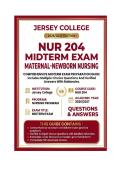
,NUR 204 Midterm Exam Maternal-Newborn Nursing Questions And
Answers 2026/2027 Jersey College
Q1. Which event marks the beginning of the embryonic period of
development?
A) Completion of implantation at term
B) Development following the preembryonic period, when major organ
formation becomes prominent
C) Onset of fetal breathing movements
D) Closure of the fetal circulatory shunts
Correct Answer: B) Development following the preembryonic period, when
major organ formation becomes prominent
Rationale: The embryonic period is characterized by rapid differentiation
and organogenesis, making it a particularly sensitive period for
developmental disruption.
Q2. Why can exposure to a teratogen during organogenesis cause
greater structural damage than the same exposure later in
pregnancy?
A) Placental circulation is absent during organogenesis
B) Fetal genes are inactive later in pregnancy
C) Maternal metabolism stops during early pregnancy
D) Major organ systems are differentiating and forming during this period
Correct Answer: D) Major organ systems are differentiating and forming
during this period
Rationale: The effect of a teratogen depends partly on timing. Exposure
during organ formation can interfere with the development of specific
structures and result in major congenital abnormalities.
Q3. Which fetal circulatory pathway directs blood from the
pulmonary artery toward the aorta because the fetal lungs are not
yet functioning for gas exchange?
A) Ductus arteriosus
B) Foramen ovale
C) Ductus venosus
D) Umbilical vein
Correct Answer: A) Ductus arteriosus
, Rationale: The ductus arteriosus connects the pulmonary artery with the
aorta, allowing much of the right ventricular output to bypass the high-
resistance fetal pulmonary circulation.
Q4. A genetic disorder is inherited only when a child receives an
abnormal allele from both parents. Which inheritance pattern does
this describe?
A) X-linked dominant
B) Autosomal dominant
C) Autosomal recessive
D) Mitochondrial inheritance
Correct Answer: C) Autosomal recessive
Rationale: Autosomal recessive disorders generally require two abnormal
alleles, one inherited from each parent, for the condition to be expressed.
Q5. Two parents are known carriers of the same autosomal
recessive condition. What is the probability that each pregnancy will
produce an affected child?
A) 50%
B) 75%
C) 25%
D) 100%
Correct Answer: C) 25%
Rationale: When both parents are heterozygous carriers, each pregnancy
has a 25% chance of producing an affected child, a 50% chance of producing
a carrier, and a 25% chance of producing a child with neither abnormal
allele.
Q6. What is the primary goal of genetic counseling for a couple with
an increased reproductive risk?
A) Make reproductive decisions for the couple
B) Provide understandable information about risk, testing, and available
options so the couple can make informed decisions
C) Guarantee the birth of an unaffected child
D) Recommend pregnancy termination whenever a genetic disorder is
possible
Answers 2026/2027 Jersey College
Q1. Which event marks the beginning of the embryonic period of
development?
A) Completion of implantation at term
B) Development following the preembryonic period, when major organ
formation becomes prominent
C) Onset of fetal breathing movements
D) Closure of the fetal circulatory shunts
Correct Answer: B) Development following the preembryonic period, when
major organ formation becomes prominent
Rationale: The embryonic period is characterized by rapid differentiation
and organogenesis, making it a particularly sensitive period for
developmental disruption.
Q2. Why can exposure to a teratogen during organogenesis cause
greater structural damage than the same exposure later in
pregnancy?
A) Placental circulation is absent during organogenesis
B) Fetal genes are inactive later in pregnancy
C) Maternal metabolism stops during early pregnancy
D) Major organ systems are differentiating and forming during this period
Correct Answer: D) Major organ systems are differentiating and forming
during this period
Rationale: The effect of a teratogen depends partly on timing. Exposure
during organ formation can interfere with the development of specific
structures and result in major congenital abnormalities.
Q3. Which fetal circulatory pathway directs blood from the
pulmonary artery toward the aorta because the fetal lungs are not
yet functioning for gas exchange?
A) Ductus arteriosus
B) Foramen ovale
C) Ductus venosus
D) Umbilical vein
Correct Answer: A) Ductus arteriosus
, Rationale: The ductus arteriosus connects the pulmonary artery with the
aorta, allowing much of the right ventricular output to bypass the high-
resistance fetal pulmonary circulation.
Q4. A genetic disorder is inherited only when a child receives an
abnormal allele from both parents. Which inheritance pattern does
this describe?
A) X-linked dominant
B) Autosomal dominant
C) Autosomal recessive
D) Mitochondrial inheritance
Correct Answer: C) Autosomal recessive
Rationale: Autosomal recessive disorders generally require two abnormal
alleles, one inherited from each parent, for the condition to be expressed.
Q5. Two parents are known carriers of the same autosomal
recessive condition. What is the probability that each pregnancy will
produce an affected child?
A) 50%
B) 75%
C) 25%
D) 100%
Correct Answer: C) 25%
Rationale: When both parents are heterozygous carriers, each pregnancy
has a 25% chance of producing an affected child, a 50% chance of producing
a carrier, and a 25% chance of producing a child with neither abnormal
allele.
Q6. What is the primary goal of genetic counseling for a couple with
an increased reproductive risk?
A) Make reproductive decisions for the couple
B) Provide understandable information about risk, testing, and available
options so the couple can make informed decisions
C) Guarantee the birth of an unaffected child
D) Recommend pregnancy termination whenever a genetic disorder is
possible