
STRAIGHTERLINE | BIOLOGY 201 | EXAM 1
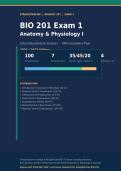
BIO 201 Exam 1
Anatomy & Physiology I
Actual Questions & Answers - 100% Guarantee Pass
Edition
100 7 35/45/20 4
Total Questions Exam Sections Recall / Apply / Analyze % Options per Q
COVERAGE MAP
1. Introduction to Anatomy & Physiology (Q1-12)
2. Chemical Level of Organization (Q13-24)
3. Cellular Level of Organization (Q25-42)
4. Tissue Level of Organization (Q43-58)
5. Integumentary System (Q59-72)
6. Skeletal System & Bone Tissue (Q73-90)
7. Muscular System Fundamentals (Q91-100)
Comprehensive coverage of StraighterLine BIO 201 Exam 1 learning objectives.
Each question includes verified answer and detailed anatomical / physiological rationale.
Aligned with 2026/2027 A&P I curriculum standards for StraighterLine BIO 201.
,BIO 201 Exam 1 | Anatomy & Physiology I StraighterLine - 2026/2027 Edition
Exam Overview & How to Use This Guide
This comprehensive exam preparation guide is aligned with the StraighterLine BIO 201
Anatomy & Physiology I Examination 1 (2026/2027 curriculum standards). It contains exactly
100 multiple-choice questions distributed across seven core content sections that mirror the
learning objectives of the course: Introduction to Anatomy & Physiology, Chemical Level of
Organization, Cellular Level of Organization, Tissue Level of Organization, Integumentary
System, Skeletal System and Bone Tissue, and Muscular System Fundamentals. Each question is
followed by four options (A-D), the verified correct answer flagged with [CORRECT], and a
detailed rationale grounded in established anatomical and physiological principles.
The exam is calibrated to the recommended cognitive-level distribution: approximately 35% of
items assess foundational recall, 45% require application of concepts to clinical or laboratory
scenarios, and 20% demand analysis of integrated physiological mechanisms. Approximately
70% of questions are scenario-based (patient presentations, microscopy identification,
directional-term applications, homeostatic disruption, and physiological sequence ordering),
while 30% are direct recall of anatomical structures, physiological definitions, and biochemical
facts. Distractors are designed to represent the most common A&P misconceptions documented
in undergraduate health-sciences education - including confusion of directional terms,
misunderstanding of negative versus positive feedback, mixing of epithelial and connective
tissue characteristics, and incorrect ordering of muscle contraction events.
How to use this guide: Read each question stem carefully, select the single best answer, then
review the rationale before moving on - the rationale explains both why the correct option is
right and why the distractors are wrong. Pay close attention to scenario questions involving cell
transport prediction, homeostatic feedback identification, tissue identification based on
structural characteristics, and ordering of muscle contraction events, as these are heavily
weighted on the actual StraighterLine exam. Verified high-confidence responses are flagged
with the [CORRECT] tag for rapid review.
Actual Questions & Answers - 100% Guarantee Pass Page 2
,BIO 201 Exam 1 | Anatomy & Physiology I StraighterLine - 2026/2027 Edition
Section 1: Introduction to Anatomy and Physiology
Definitions, Levels of Organization, Anatomical Terminology, Body
Planes, Body Cavities, & Homeostasis (Q1 - Q12)
Q1: A first-year nursing student is observing a shoulder arthroscopy. The surgeon asks the
student to define the discipline that studies the structures visible on the monitor. Which
response is most accurate?
A. Anatomy is the study of how body structures function.
B. Anatomy is the study of internal and external body structures and their physical
relationships among body parts. [CORRECT]
C. Physiology is the study of the structure of body parts.
D. Anatomy is the study of the chemical reactions that occur in cells.
Correct Answer: B
Rationale: Anatomy is the science of body structure and the physical relationships among body parts;
physiology is the study of function. Option A confuses anatomy with physiology; option C reverses the
two disciplines; option D describes biochemistry, not anatomy.
Q2: A pathologist examines a cardiac biopsy. Starting from the smallest functional unit,
which sequence correctly represents the levels of structural organization in the human body?
A. Cellular -> Chemical -> Tissue -> Organ -> Organ system -> Organism
B. Chemical -> Cellular -> Tissue -> Organ -> Organ system -> Organism [CORRECT]
C. Chemical -> Tissue -> Cellular -> Organ -> Organ system -> Organism
D. Tissue -> Chemical -> Cellular -> Organ system -> Organ -> Organism
Correct Answer: B
Rationale: The correct hierarchy proceeds from the simplest to the most complex: chemical
(atoms/molecules), cellular, tissue, organ, organ system, and organism. Options A, C, and D disrupt this
ordering by placing cellular before chemical or tissue before cellular, violating the principle of
increasing complexity.
Q3: A patient in the intensive-care unit has a blood pH of 7.30 (normal range 7.35-7.45). The
body responds by increasing respiratory rate. This response is best described as an example
of:
A. Positive feedback maintaining homeostasis
B. Negative feedback maintaining homeostasis [CORRECT]
C. Positive feedback disrupting homeostasis
D. Negative feedback disrupting homeostasis
Correct Answer: B
Rationale: Homeostasis is maintained through negative feedback loops that reverse a deviation from a
set point. The increased respiratory rate lowers CO2 and raises pH back toward normal - a corrective,
opposing response. Positive feedback amplifies the original stimulus (e.g., childbirth); options C and D
misidentify the loop direction.
Actual Questions & Answers - 100% Guarantee Pass Page 3
, BIO 201 Exam 1 | Anatomy & Physiology I StraighterLine - 2026/2027 Edition
Q4: After eating a glucose-rich meal, pancreatic beta cells release insulin, which lowers blood
glucose. As glucose falls, insulin secretion decreases. Which mechanism does this illustrate?
A. Positive feedback, because insulin amplifies glucose uptake
B. Negative feedback, because the response opposes the original stimulus [CORRECT]
C. Positive feedback, because the response removes the stimulus
D. Negative feedback, because the response reinforces the stimulus
Correct Answer: B
Rationale: This is a classic negative feedback loop: high blood glucose triggers insulin release, which
lowers glucose; the fall in glucose then removes the stimulus for further insulin secretion. The response
opposes the original change. Option A misclassifies the loop; options C and D confuse the directionality
of feedback.
Q5: During labor, oxytocin release causes uterine contractions that push the fetus against the
cervix. Cervical stretch triggers MORE oxytocin release. This scenario is best classified as:
A. Negative feedback, because the response removes the stimulus
B. Positive feedback, because the response amplifies the original stimulus [CORRECT]
C. Negative feedback, because oxytocin returns the system to its set point
D. Homeostatic regulation, because the loop is self-limiting
Correct Answer: B
Rationale: Childbirth is the textbook example of positive feedback: cervical stretch stimulates oxytocin
release, which intensifies contractions, causing further cervical stretch - the response amplifies the
stimulus until delivery ends the loop. Options A, C, and D misapply negative feedback terminology to an
inherently amplifying mechanism.
Q6: A clinical instructor asks a student to describe the relationship of the heart to the
stomach. The correct directional term pairing is:
A. The heart is inferior to the stomach; the stomach is superior to the heart
B. The heart is superior to the stomach; the stomach is inferior to the heart [CORRECT]
C. The heart is anterior to the stomach; the stomach is posterior to the heart
D. The heart is medial to the stomach; the stomach is lateral to the heart
Correct Answer: B
Rationale: Superior means "toward the head" and inferior means "away from the head." The heart lies
above the stomach in the anatomical position, so the heart is superior and the stomach is inferior.
Option A reverses the relationship; options C and D use correct terms but describe different anatomical
relationships (anterior/posterior and medial/lateral).
Actual Questions & Answers - 100% Guarantee Pass Page 4
BIO 201 Exam 1
Anatomy & Physiology I
Actual Questions & Answers - 100% Guarantee Pass
Edition
100 7 35/45/20 4
Total Questions Exam Sections Recall / Apply / Analyze % Options per Q
COVERAGE MAP
1. Introduction to Anatomy & Physiology (Q1-12)
2. Chemical Level of Organization (Q13-24)
3. Cellular Level of Organization (Q25-42)
4. Tissue Level of Organization (Q43-58)
5. Integumentary System (Q59-72)
6. Skeletal System & Bone Tissue (Q73-90)
7. Muscular System Fundamentals (Q91-100)
Comprehensive coverage of StraighterLine BIO 201 Exam 1 learning objectives.
Each question includes verified answer and detailed anatomical / physiological rationale.
Aligned with 2026/2027 A&P I curriculum standards for StraighterLine BIO 201.
,BIO 201 Exam 1 | Anatomy & Physiology I StraighterLine - 2026/2027 Edition
Exam Overview & How to Use This Guide
This comprehensive exam preparation guide is aligned with the StraighterLine BIO 201
Anatomy & Physiology I Examination 1 (2026/2027 curriculum standards). It contains exactly
100 multiple-choice questions distributed across seven core content sections that mirror the
learning objectives of the course: Introduction to Anatomy & Physiology, Chemical Level of
Organization, Cellular Level of Organization, Tissue Level of Organization, Integumentary
System, Skeletal System and Bone Tissue, and Muscular System Fundamentals. Each question is
followed by four options (A-D), the verified correct answer flagged with [CORRECT], and a
detailed rationale grounded in established anatomical and physiological principles.
The exam is calibrated to the recommended cognitive-level distribution: approximately 35% of
items assess foundational recall, 45% require application of concepts to clinical or laboratory
scenarios, and 20% demand analysis of integrated physiological mechanisms. Approximately
70% of questions are scenario-based (patient presentations, microscopy identification,
directional-term applications, homeostatic disruption, and physiological sequence ordering),
while 30% are direct recall of anatomical structures, physiological definitions, and biochemical
facts. Distractors are designed to represent the most common A&P misconceptions documented
in undergraduate health-sciences education - including confusion of directional terms,
misunderstanding of negative versus positive feedback, mixing of epithelial and connective
tissue characteristics, and incorrect ordering of muscle contraction events.
How to use this guide: Read each question stem carefully, select the single best answer, then
review the rationale before moving on - the rationale explains both why the correct option is
right and why the distractors are wrong. Pay close attention to scenario questions involving cell
transport prediction, homeostatic feedback identification, tissue identification based on
structural characteristics, and ordering of muscle contraction events, as these are heavily
weighted on the actual StraighterLine exam. Verified high-confidence responses are flagged
with the [CORRECT] tag for rapid review.
Actual Questions & Answers - 100% Guarantee Pass Page 2
,BIO 201 Exam 1 | Anatomy & Physiology I StraighterLine - 2026/2027 Edition
Section 1: Introduction to Anatomy and Physiology
Definitions, Levels of Organization, Anatomical Terminology, Body
Planes, Body Cavities, & Homeostasis (Q1 - Q12)
Q1: A first-year nursing student is observing a shoulder arthroscopy. The surgeon asks the
student to define the discipline that studies the structures visible on the monitor. Which
response is most accurate?
A. Anatomy is the study of how body structures function.
B. Anatomy is the study of internal and external body structures and their physical
relationships among body parts. [CORRECT]
C. Physiology is the study of the structure of body parts.
D. Anatomy is the study of the chemical reactions that occur in cells.
Correct Answer: B
Rationale: Anatomy is the science of body structure and the physical relationships among body parts;
physiology is the study of function. Option A confuses anatomy with physiology; option C reverses the
two disciplines; option D describes biochemistry, not anatomy.
Q2: A pathologist examines a cardiac biopsy. Starting from the smallest functional unit,
which sequence correctly represents the levels of structural organization in the human body?
A. Cellular -> Chemical -> Tissue -> Organ -> Organ system -> Organism
B. Chemical -> Cellular -> Tissue -> Organ -> Organ system -> Organism [CORRECT]
C. Chemical -> Tissue -> Cellular -> Organ -> Organ system -> Organism
D. Tissue -> Chemical -> Cellular -> Organ system -> Organ -> Organism
Correct Answer: B
Rationale: The correct hierarchy proceeds from the simplest to the most complex: chemical
(atoms/molecules), cellular, tissue, organ, organ system, and organism. Options A, C, and D disrupt this
ordering by placing cellular before chemical or tissue before cellular, violating the principle of
increasing complexity.
Q3: A patient in the intensive-care unit has a blood pH of 7.30 (normal range 7.35-7.45). The
body responds by increasing respiratory rate. This response is best described as an example
of:
A. Positive feedback maintaining homeostasis
B. Negative feedback maintaining homeostasis [CORRECT]
C. Positive feedback disrupting homeostasis
D. Negative feedback disrupting homeostasis
Correct Answer: B
Rationale: Homeostasis is maintained through negative feedback loops that reverse a deviation from a
set point. The increased respiratory rate lowers CO2 and raises pH back toward normal - a corrective,
opposing response. Positive feedback amplifies the original stimulus (e.g., childbirth); options C and D
misidentify the loop direction.
Actual Questions & Answers - 100% Guarantee Pass Page 3
, BIO 201 Exam 1 | Anatomy & Physiology I StraighterLine - 2026/2027 Edition
Q4: After eating a glucose-rich meal, pancreatic beta cells release insulin, which lowers blood
glucose. As glucose falls, insulin secretion decreases. Which mechanism does this illustrate?
A. Positive feedback, because insulin amplifies glucose uptake
B. Negative feedback, because the response opposes the original stimulus [CORRECT]
C. Positive feedback, because the response removes the stimulus
D. Negative feedback, because the response reinforces the stimulus
Correct Answer: B
Rationale: This is a classic negative feedback loop: high blood glucose triggers insulin release, which
lowers glucose; the fall in glucose then removes the stimulus for further insulin secretion. The response
opposes the original change. Option A misclassifies the loop; options C and D confuse the directionality
of feedback.
Q5: During labor, oxytocin release causes uterine contractions that push the fetus against the
cervix. Cervical stretch triggers MORE oxytocin release. This scenario is best classified as:
A. Negative feedback, because the response removes the stimulus
B. Positive feedback, because the response amplifies the original stimulus [CORRECT]
C. Negative feedback, because oxytocin returns the system to its set point
D. Homeostatic regulation, because the loop is self-limiting
Correct Answer: B
Rationale: Childbirth is the textbook example of positive feedback: cervical stretch stimulates oxytocin
release, which intensifies contractions, causing further cervical stretch - the response amplifies the
stimulus until delivery ends the loop. Options A, C, and D misapply negative feedback terminology to an
inherently amplifying mechanism.
Q6: A clinical instructor asks a student to describe the relationship of the heart to the
stomach. The correct directional term pairing is:
A. The heart is inferior to the stomach; the stomach is superior to the heart
B. The heart is superior to the stomach; the stomach is inferior to the heart [CORRECT]
C. The heart is anterior to the stomach; the stomach is posterior to the heart
D. The heart is medial to the stomach; the stomach is lateral to the heart
Correct Answer: B
Rationale: Superior means "toward the head" and inferior means "away from the head." The heart lies
above the stomach in the anatomical position, so the heart is superior and the stomach is inferior.
Option A reverses the relationship; options C and D use correct terms but describe different anatomical
relationships (anterior/posterior and medial/lateral).
Actual Questions & Answers - 100% Guarantee Pass Page 4


