
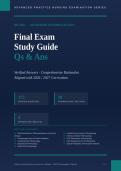
ADVANCED PRACTICE NURSING EXAMINATION SERIES
NR 566 · ADVANCED PHARMACOLOGY
Final Exam
Study Guide
Qs & Ans
Verified Answers · Comprehensive Rationales
Aligned with Curriculum
175 10
VERIFIED QUESTIONS PHARMACOLOGY SECTIONS
4
OPTIONS PER ITEM (A-D)
SECTIONS COVERED
01 Pharmacokinetics & Pharmacodynamics Across the 06 Central Nervous System Pharmacology
Lifespan 07 Infectious Disease Pharmacology
02 Pharmacogenomics & Precision Medicine 08 GI & Genitourinary Pharmacology
03 Cardiovascular Pharmacology 09 Pain Management & Anti-Inflammatory
04 Respiratory Pharmacology 10 Special Populations & Prescriptive Authority
05 Endocrine Pharmacology
Family-Centered Care Across the Lifespan · APRN Prescriptive Practice Z.AI
,NR 566 - Advanced Pharmacology for Care of the Family Final Exam Study Guide 2026/2027
NR 566 Final Exam Study Guide: Qs & Ans
Advanced Pharmacology for Care of the Family
Latest - Verified Answers
175 Questions with Detailed Rationales
Section 1: Pharmacokinetics and Pharmacodynamics Across the Lifespan
Q1. A 7-day-old neonate born at 34 weeks gestation is started on IV gentamicin for suspected sepsis.
Which pharmacokinetic parameter best explains why the dosing interval must be extended to every
36-48 hours rather than every 8 hours as in adults?
A. Increased glomerular filtration rate due to immature tubular reabsorption
B. Reduced glomerular filtration rate and immature tubular secretion slowing renal clearance [CORRECT]
C. Increased hepatic glucuronidation accelerating drug elimination
D. Higher total body water percentage increasing volume of distribution only
Correct Answer: B
Rationale:
Neonates, especially preterm infants, have a significantly reduced GFR (often <50% of adult values) and immature
active tubular secretion, leading to prolonged elimination half-lives of renally-cleared drugs such as aminoglycosides.
Extending the interval prevents accumulation and ototoxicity/nephrotoxicity. Increased Vd from higher total body water
also influences dosing, but the prolonged interval specifically reflects impaired clearance.
Q2. An 82-year-old female with CKD stage 3 (eGFR 38 mL/min) is prescribed diazepam 5 mg at
bedtime for insomnia. What pharmacokinetic change most increases her risk of prolonged sedation
and falls?
A. Increased hepatic CYP3A4 activity accelerating metabolism
B. Increased lean body mass shortening distribution half-life
C. Decreased hepatic blood flow, reduced phase I metabolism, and longer half-life of active metabolites
[CORRECT]
D. Enhanced renal excretion of parent drug only
Correct Answer: C
Rationale:
In older adults, hepatic blood flow and phase I oxidative metabolism (CYP-mediated) decline while phase II conjugation
is relatively preserved. Diazepam undergoes phase I metabolism to active metabolites (desmethyldiazepam, oxazepam)
with very long half-lives that accumulate in the elderly, increasing fall and delirium risk. Diazepam is therefore a BEERS
list drug to avoid in this population.
Verified Answers - APRN Examination Preparation Page 1
,NR 566 - Advanced Pharmacology for Care of the Family Final Exam Study Guide 2026/2027
Q3. A drug has a half-life of 12 hours and is administered once daily. Approximately how many days
are required to reach steady-state plasma concentration, and what proportion of steady-state is
reached after one half-life?
A. 1 day; 100% after one half-life
B. 2.5 days (about 5 half-lives); 50% after one half-life [CORRECT]
C. 12 hours; 90% after one half-life
D. 7 days; 75% after one half-life
Correct Answer: B
Rationale:
Steady state is reached in approximately 4-5 half-lives. With a 12-hour half-life, steady state occurs in about 60 hours
(~2.5 days). After one half-life, 50% of steady-state concentration is achieved; after two, 75%; after three, 87.5%; after
four, 93.75%; after five, ~96.9%.
Q4. Which pharmacokinetic process is most directly affected by the first-pass effect, and which route
of administration best bypasses it?
A. Distribution; intramuscular injection
B. Metabolism; sublingual administration [CORRECT]
C. Excretion; transdermal patch
D. Absorption; oral administration
Correct Answer: B
Rationale:
First-pass (presystemic) metabolism refers to drug metabolism by the liver and gut wall before reaching systemic
circulation, reducing bioavailability of oral medications. Sublingual administration (e.g., nitroglycerin) bypasses the portal
circulation, allowing direct entry into systemic blood via the venous plexus, achieving rapid onset and high bioavailability.
Q5. A 6-month-old infant has a higher percentage of total body water and lower serum albumin than
an adult. Which statement best describes the clinical implication for highly protein-bound acidic
drugs such as phenytoin?
A. Free (active) drug levels are lower, requiring higher doses
B. Free drug levels are higher, increasing risk of toxicity at standard doses [CORRECT]
C. Albumin binding is irrelevant in infants
D. Volume of distribution is unchanged in infants
Correct Answer: B
Rationale:
Infants have lower serum albumin and reduced binding capacity, plus higher total body water. Highly protein-bound
acidic drugs (phenytoin, valproate) will have a higher free fraction, increasing the risk of toxicity if dosed at adult
equivalent levels. Total phenytoin levels may appear therapeutic while free levels are toxic.
Verified Answers - APRN Examination Preparation Page 2
, NR 566 - Advanced Pharmacology for Care of the Family Final Exam Study Guide 2026/2027
Q6. A drug with a narrow therapeutic index has a low therapeutic index value. Which statement best
defines therapeutic index and its clinical relevance?
A. TI = ED50/LD50; a low TI means a wide safety margin
B. TI = TD50/ED50; a low TI requires close serum monitoring (e.g., digoxin, warfarin, lithium) [CORRECT]
C. TI = LD50/ED50 only relevant in pediatrics
D. TI = bioavailability x half-life
Correct Answer: B
Rationale:
Therapeutic index (TI) is the ratio of the toxic dose in 50% of the population (TD50) to the effective dose in 50% (ED50).
A low TI indicates a narrow margin between therapeutic and toxic effects, mandating serum drug monitoring (e.g.,
digoxin, lithium, warfarin, phenytoin, aminoglycosides, vancomycin).
Q7. A patient who is a CYP2D6 poor metabolizer is prescribed codeine for postoperative pain. Which
outcome is most likely and what is the appropriate alternative?
A. Excessive morphine formation causing respiratory depression
B. Reduced analgesia because codeine cannot be converted to morphine; switch to morphine or
hydromorphone [CORRECT]
C. No effect on analgesic efficacy
D. Increased risk of gastrointestinal bleeding
Correct Answer: B
Rationale:
Codeine is a prodrug requiring O-demethylation by CYP2D6 to morphine. Poor metabolizers produce little morphine,
leading to inadequate analgesia. Conversely, ultrarapid metabolizers (multiple gene copies) can develop opioid toxicity.
The safer alternative is to use a non-prodrug opioid such as morphine or hydromorphone whose efficacy is independent
of CYP2D6.
Q8. Which statement best describes the concept of volume of distribution (Vd) and its clinical
application?
A. Vd is the actual anatomical plasma volume
B. Vd is the apparent volume in which a drug would need to distribute to produce the observed plasma
concentration; high Vd indicates extensive tissue distribution [CORRECT]
C. Vd is unrelated to drug half-life
D. Vd is identical for all drugs in a class
Correct Answer: B
Rationale:
Volume of distribution (Vd) is a theoretical value relating dose to plasma concentration. A high Vd (e.g., amiodarone,
digoxin, fluoxetine) indicates extensive tissue sequestration and requires loading doses consideration; a low Vd (e.g.,
warfarin) indicates restriction to plasma. Vd influences half-life: t1/2 = 0.693 x Vd / Clearance.
Verified Answers - APRN Examination Preparation Page 3
NR 566 · ADVANCED PHARMACOLOGY
Final Exam
Study Guide
Qs & Ans
Verified Answers · Comprehensive Rationales
Aligned with Curriculum
175 10
VERIFIED QUESTIONS PHARMACOLOGY SECTIONS
4
OPTIONS PER ITEM (A-D)
SECTIONS COVERED
01 Pharmacokinetics & Pharmacodynamics Across the 06 Central Nervous System Pharmacology
Lifespan 07 Infectious Disease Pharmacology
02 Pharmacogenomics & Precision Medicine 08 GI & Genitourinary Pharmacology
03 Cardiovascular Pharmacology 09 Pain Management & Anti-Inflammatory
04 Respiratory Pharmacology 10 Special Populations & Prescriptive Authority
05 Endocrine Pharmacology
Family-Centered Care Across the Lifespan · APRN Prescriptive Practice Z.AI
,NR 566 - Advanced Pharmacology for Care of the Family Final Exam Study Guide 2026/2027
NR 566 Final Exam Study Guide: Qs & Ans
Advanced Pharmacology for Care of the Family
Latest - Verified Answers
175 Questions with Detailed Rationales
Section 1: Pharmacokinetics and Pharmacodynamics Across the Lifespan
Q1. A 7-day-old neonate born at 34 weeks gestation is started on IV gentamicin for suspected sepsis.
Which pharmacokinetic parameter best explains why the dosing interval must be extended to every
36-48 hours rather than every 8 hours as in adults?
A. Increased glomerular filtration rate due to immature tubular reabsorption
B. Reduced glomerular filtration rate and immature tubular secretion slowing renal clearance [CORRECT]
C. Increased hepatic glucuronidation accelerating drug elimination
D. Higher total body water percentage increasing volume of distribution only
Correct Answer: B
Rationale:
Neonates, especially preterm infants, have a significantly reduced GFR (often <50% of adult values) and immature
active tubular secretion, leading to prolonged elimination half-lives of renally-cleared drugs such as aminoglycosides.
Extending the interval prevents accumulation and ototoxicity/nephrotoxicity. Increased Vd from higher total body water
also influences dosing, but the prolonged interval specifically reflects impaired clearance.
Q2. An 82-year-old female with CKD stage 3 (eGFR 38 mL/min) is prescribed diazepam 5 mg at
bedtime for insomnia. What pharmacokinetic change most increases her risk of prolonged sedation
and falls?
A. Increased hepatic CYP3A4 activity accelerating metabolism
B. Increased lean body mass shortening distribution half-life
C. Decreased hepatic blood flow, reduced phase I metabolism, and longer half-life of active metabolites
[CORRECT]
D. Enhanced renal excretion of parent drug only
Correct Answer: C
Rationale:
In older adults, hepatic blood flow and phase I oxidative metabolism (CYP-mediated) decline while phase II conjugation
is relatively preserved. Diazepam undergoes phase I metabolism to active metabolites (desmethyldiazepam, oxazepam)
with very long half-lives that accumulate in the elderly, increasing fall and delirium risk. Diazepam is therefore a BEERS
list drug to avoid in this population.
Verified Answers - APRN Examination Preparation Page 1
,NR 566 - Advanced Pharmacology for Care of the Family Final Exam Study Guide 2026/2027
Q3. A drug has a half-life of 12 hours and is administered once daily. Approximately how many days
are required to reach steady-state plasma concentration, and what proportion of steady-state is
reached after one half-life?
A. 1 day; 100% after one half-life
B. 2.5 days (about 5 half-lives); 50% after one half-life [CORRECT]
C. 12 hours; 90% after one half-life
D. 7 days; 75% after one half-life
Correct Answer: B
Rationale:
Steady state is reached in approximately 4-5 half-lives. With a 12-hour half-life, steady state occurs in about 60 hours
(~2.5 days). After one half-life, 50% of steady-state concentration is achieved; after two, 75%; after three, 87.5%; after
four, 93.75%; after five, ~96.9%.
Q4. Which pharmacokinetic process is most directly affected by the first-pass effect, and which route
of administration best bypasses it?
A. Distribution; intramuscular injection
B. Metabolism; sublingual administration [CORRECT]
C. Excretion; transdermal patch
D. Absorption; oral administration
Correct Answer: B
Rationale:
First-pass (presystemic) metabolism refers to drug metabolism by the liver and gut wall before reaching systemic
circulation, reducing bioavailability of oral medications. Sublingual administration (e.g., nitroglycerin) bypasses the portal
circulation, allowing direct entry into systemic blood via the venous plexus, achieving rapid onset and high bioavailability.
Q5. A 6-month-old infant has a higher percentage of total body water and lower serum albumin than
an adult. Which statement best describes the clinical implication for highly protein-bound acidic
drugs such as phenytoin?
A. Free (active) drug levels are lower, requiring higher doses
B. Free drug levels are higher, increasing risk of toxicity at standard doses [CORRECT]
C. Albumin binding is irrelevant in infants
D. Volume of distribution is unchanged in infants
Correct Answer: B
Rationale:
Infants have lower serum albumin and reduced binding capacity, plus higher total body water. Highly protein-bound
acidic drugs (phenytoin, valproate) will have a higher free fraction, increasing the risk of toxicity if dosed at adult
equivalent levels. Total phenytoin levels may appear therapeutic while free levels are toxic.
Verified Answers - APRN Examination Preparation Page 2
, NR 566 - Advanced Pharmacology for Care of the Family Final Exam Study Guide 2026/2027
Q6. A drug with a narrow therapeutic index has a low therapeutic index value. Which statement best
defines therapeutic index and its clinical relevance?
A. TI = ED50/LD50; a low TI means a wide safety margin
B. TI = TD50/ED50; a low TI requires close serum monitoring (e.g., digoxin, warfarin, lithium) [CORRECT]
C. TI = LD50/ED50 only relevant in pediatrics
D. TI = bioavailability x half-life
Correct Answer: B
Rationale:
Therapeutic index (TI) is the ratio of the toxic dose in 50% of the population (TD50) to the effective dose in 50% (ED50).
A low TI indicates a narrow margin between therapeutic and toxic effects, mandating serum drug monitoring (e.g.,
digoxin, lithium, warfarin, phenytoin, aminoglycosides, vancomycin).
Q7. A patient who is a CYP2D6 poor metabolizer is prescribed codeine for postoperative pain. Which
outcome is most likely and what is the appropriate alternative?
A. Excessive morphine formation causing respiratory depression
B. Reduced analgesia because codeine cannot be converted to morphine; switch to morphine or
hydromorphone [CORRECT]
C. No effect on analgesic efficacy
D. Increased risk of gastrointestinal bleeding
Correct Answer: B
Rationale:
Codeine is a prodrug requiring O-demethylation by CYP2D6 to morphine. Poor metabolizers produce little morphine,
leading to inadequate analgesia. Conversely, ultrarapid metabolizers (multiple gene copies) can develop opioid toxicity.
The safer alternative is to use a non-prodrug opioid such as morphine or hydromorphone whose efficacy is independent
of CYP2D6.
Q8. Which statement best describes the concept of volume of distribution (Vd) and its clinical
application?
A. Vd is the actual anatomical plasma volume
B. Vd is the apparent volume in which a drug would need to distribute to produce the observed plasma
concentration; high Vd indicates extensive tissue distribution [CORRECT]
C. Vd is unrelated to drug half-life
D. Vd is identical for all drugs in a class
Correct Answer: B
Rationale:
Volume of distribution (Vd) is a theoretical value relating dose to plasma concentration. A high Vd (e.g., amiodarone,
digoxin, fluoxetine) indicates extensive tissue sequestration and requires loading doses consideration; a low Vd (e.g.,
warfarin) indicates restriction to plasma. Vd influences half-life: t1/2 = 0.693 x Vd / Clearance.
Verified Answers - APRN Examination Preparation Page 3


