
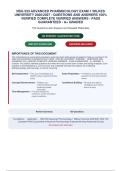
NSG 533 ADVANCED PHARMACOLOGY EXAM 1 WILKES
UNIVERSITY 2026/2027 - QUESTIONS AND ANSWERS 100%
VERIFIED COMPLETE VERIFIED ANSWERS - PASS
GUARANTEED - A+ GRADED
150 Questions with Answers and Detailed Rationales
100 PERCENT GUARANTEED PASS
INSTANT DOWNLOAD ANSWERS INCLUDED
IMPORTANCE OF THIS DOCUMENT
This comprehensive examination preparation guide has been meticulously developed to help you succeed in the
NSG 533 ADVANCED PHARMACOLOGY EXAM 1 WILKES UNIVERSITY 2026/2027 - QUESTIONS AND
ANSWERS 100% VERIFIED COMPLETE VERIFIED ANSWERS - PASS GUARANTEED - A+ GRADED. It
contains 150 carefully selected questions that reflect the most current exam content and testing strategies. Each
question is accompanied by a correct answer and a detailed rationale that explains the underlying
pathophysiology, pharmacology, or clinical reasoning.
Self-Assessment – Test your knowledge and Exam Preparation – Familiarize yourself with the
identify areas requiring further question format and content
study areas
Concept Reinforcement – Deepen your Confidence Building – Develop test-taking
understanding through strategies and reduce
evidence-based exam anxiety
rationales
Time Management – Practice answering
questions under simulated
exam conditions
Review Summary 150 Questions
Foundations - Application - NSG 533 Advanced Pharmacology 1 Wilkes University 2026/2027 AND 100
Complete PASS Guaranteed A Advanced Pharmacology Graduate Msn/dnp Advanced Nursing
All answers with rationales
,Table of Contents
Content Area Questions Key Topics
NSG 533 Advanced 1-25 Prescribed, Mechanism, Started, Explains, Effect
Pharmacology 1 Wilkes
University 2026/2027 AND
100 Complete PASS
Guaranteed A Advanced
Pharmacology Graduate
Msn/dnp Advanced Nursing
Explains 26-50 Develops, Monitoring, Mechanism, Therapeutic, Cyp3a4
Mechanism 51-75 Explains, Prescribed, Effect, Heart Failure, History
Heart 76-100 Prescribed, Pharmacodynamic, Therapeutic, Pharmacokinetic,
Therapy
Started 101-125 Prescribed, Explains, Chronic, Appropriate, Heart Failure
Pharmacokinetic 126-150 Mechanism, Explains, Prescribed, Disease, Aspirin
TOTAL 150 All questions include answers and detailed rationales
,Section A - NSG 533 Advanced Pharmacology 1 Wilkes
University 2026/2027 AND 100 Complete PASS Guaranteed
A Advanced Pharmacology Graduate Msn/dnp Advanced
Nursing
Q1.
A patient with heart failure and reduced ejection fraction is started on sacubitril/valsartan.
Which mechanism best explains the combined therapeutic advantage over an ACE
inhibitor alone?
A. Sacubitril inhibits neprilysin, increasing B. Sacubitril blocks angiotensin II formation,
natriuretic peptides, while valsartan blocks and valsartan enhances
AT1 receptors, reducing vasoconstriction bradykinin-mediated vasodilation.
and aldosterone release.
C. Sacubitril increases renin release, and D. Sacubitril acts as a direct renin inhibitor,
valsartan inhibits ACE, leading to synergistic and valsartan promotes potassium retention
blood pressure reduction. to improve cardiac output.
Correct: A - Sacubitril inhibits neprilysin, increasing natriuretic peptides, while valsartan
blocks AT1 receptors, reducing vasoconstriction and aldosterone release.
Rationale:Sacubitril inhibits neprilysin, which degrades natriuretic peptides, thereby
increasing their vasodilatory and natriuretic effects. Valsartan concurrently blocks AT1
receptors, reducing the adverse effects of angiotensin II. This dual mechanism provides
superior outcomes compared to ACE inhibition alone.
Q2.
A patient with a history of opioid use disorder is prescribed buprenorphine/naloxone.
Which pharmacological property of buprenorphine is most critical for its safety profile?
A. High intrinsic activity at mu receptors with B. Partial agonist activity at mu receptors
rapid dissociation. with high receptor affinity.
C. Competitive antagonism at kappa D. Full agonist activity at delta receptors
receptors with low bioavailability. with slow elimination.
Correct: B - Partial agonist activity at mu receptors with high receptor affinity.
Rationale:Buprenorphine is a partial mu-opioid agonist with high affinity, which limits
respiratory depression and produces a ceiling effect. Its high affinity allows it to displace full
agonists, reducing overdose risk. This property is central to its use in opioid use disorder.
Page 3
, Section A - NSG 533 Advanced Pharmacology 1 Wilkes University 2026/2027 AND 100 Complete PASS Guaranteed A Advanced Pharmacology
Graduate Msn/dnp Advanced Nursing
Q3.
A patient on warfarin is prescribed trimethoprim-sulfamethoxazole for a urinary tract
infection. Which interaction mechanism most likely increases bleeding risk?
A. Induction of CYP2C9, increasing warfarin B. Displacement of warfarin from albumin
metabolism. binding sites.
C. Inhibition of CYP2C9, reducing warfarin D. Increased renal excretion of warfarin due
clearance. to altered pH.
Correct: C - Inhibition of CYP2C9, reducing warfarin clearance.
Rationale:Trimethoprim-sulfamethoxazole inhibits CYP2C9, the primary enzyme metabolizing
S-warfarin, leading to increased warfarin levels and INR. This interaction significantly elevates
bleeding risk. Displacement from albumin is minor compared to metabolic inhibition.
Q4.
A patient with major depressive disorder is started on fluoxetine. Which
pharmacodynamic effect is primarily responsible for the delayed therapeutic response?
A. Immediate inhibition of serotonin B. Downregulation of presynaptic 5-HT1A
reuptake, leading to rapid synaptic serotonin autoreceptors over several weeks.
increase.
C. Direct activation of postsynaptic 5-HT2 D. Inhibition of monoamine oxidase,
receptors. increasing all monoamines.
Correct: B - Downregulation of presynaptic 5-HT1A autoreceptors over several weeks.
Rationale:SSRIs acutely increase synaptic serotonin, but therapeutic effects take weeks due
to adaptive changes, including desensitization of presynaptic 5-HT1A autoreceptors, which
enhances serotonergic neurotransmission. This delayed adaptation explains the lag in clinical
response.
Q5.
A patient with type 2 diabetes and chronic kidney disease (eGFR 35 mL/min/1.73 m²) is
prescribed empagliflozin. Which monitoring parameter is most critical to assess ongoing
safety?
A. Serum potassium and magnesium levels. B. Urine albumin-to-creatinine ratio and
eGFR.
C. Fasting lipid panel and liver enzymes. D. Serum calcium and phosphate levels.
Correct: B - Urine albumin-to-creatinine ratio and eGFR.
Page 4


