
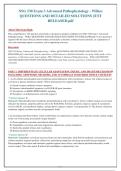
NSG 530 Exam 3 Advanced Pathophysiology - Wilkes
QUESTIONS AND DETAILED SOLUTIONS JUST
RELEASED.pdf
About This Exam Bank
This comprehensive 145-question exam bank is designed to prepare candidates for NSG 530 Exam 3 Advanced
Pathophysiology - Wilkes QUESTIONS AND DETAILED SOLUTIONS JUST RELEASED.pdf. Every question is
aligned with the latest official content outline and includes a detailed, evidence-based rationale, an explanation of
why each remaining option is incorrect, and a supporting reference.
Keywords
NSG 530 Exam 3 Advanced Pathophysiology - Wilkes QUESTIONS AND DETAILED SOLUTIONS JUST
RELEASED.pdf, exam bank, practice questions, verified answers, detailed rationales, test prep, study guide, review
questions, certification exam, latest update, NSG 530 Exam 3 Advanced Pathophysiology - Wilkes QUESTIONS
AND DETAILED SOLUTIONS JUST RELEASED.pdf, exam bank, practice questions, verified answers, detailed
rationales
PART 1: DIFFERENTIATE CELLULAR ADAPTATION, INJURY, AND DEATH MECHANISMS
INCLUDING APOPTOSIS, NECROSIS, AND AUTOPHAGY IN DIVERSE TISSUE CONTEXTS
1. A cell exhibits mitochondrial outer membrane permeabilization with cytochrome c release, but without caspase-8
activation or plasma membrane rupture. Which mechanism best explains this finding?
A) Death receptor-mediated extrinsic apoptosis
B) Intrinsic (mitochondrial) apoptosis via BAX/BAK pore formation
C) Necroptosis via RIPK1/RIPK3/MLKL signaling
D) Pyroptosis via inflammasome-activated caspase-1
' Correct Answer: B
Rationale: Mitochondrial outer membrane permeabilization with cytochrome c release without caspase-8 activation
indicates the intrinsic apoptotic pathway driven by BAX/BAK. Extrinsic apoptosis requires caspase-8, necroptosis
involves MLKL and membrane rupture, and pyroptosis requires caspase-1 and gasdermin D. The absence of plasma
membrane rupture excludes necrotic and pyroptotic death.
2. In decompensated heart failure, which combination of compensatory changes most directly sustains cardiac output
at the cost of increasing myocardial oxygen demand?
A) Parasympathetic activation and reduced afterload
B) Sympathetic activation and renin-angiotensin-aldosterone system stimulation
C) Natriuretic peptide release and vasodilation
D) Reduced preload and decreased contractility
' Correct Answer: B
Rationale: Sympathetic activation increases heart rate and contractility while RAAS-mediated vasoconstriction and
sodium retention augment preload, collectively maintaining output but elevating myocardial oxygen demand.
Parasympathetic activation and natriuretic peptides oppose these effects, and reduced preload/contractility would
worsen output. Thus only option B reflects the maladaptive compensatory axis.
Page 1
,3. A patient with syndrome of inappropriate antidiuretic hormone (SIADH) develops hyponatremia. Which renal
tubular change is the primary driver of this electrolyte disturbance?
A) Increased aquaporin-2 insertion in collecting duct principal cells
B) Inhibition of the Na+-K+-2Cl cotransporter in the thick ascending limb
C) Downregulation of the epithelial sodium channel in the distal tubule
D) Reduced urea recycling in the inner medullary collecting duct
' Correct Answer: A
Rationale: SIADH causes excessive ADH secretion, which binds V2 receptors and increases aquaporin-2 channels
in collecting duct principal cells, promoting free water reabsorption and dilutional hyponatremia. Loop diuretics
inhibit NKCC2, and ENaC downregulation or reduced urea recycling would not produce the water retention seen in
SIADH. Only option A directly describes the ADH-mediated mechanism.
4. Which molecular alteration is most characteristic of anaplastic thyroid carcinoma compared with
well-differentiated papillary thyroid carcinoma?
A) RET/PTC rearrangement
B) BRAF V600E mutation
C) TP53 mutation and loss of E-cadherin
D) PAX8/PPAR fusion
' Correct Answer: C
Rationale: Anaplastic thyroid carcinoma frequently harbors TP53 mutations and loss of E-cadherin, contributing to
dedifferentiation and aggressive behavior. RET/PTC and PAX8/PPAR fusions are associated with papillary and
follicular carcinomas, respectively, and BRAF V600E is common in papillary thyroid carcinoma. Thus TP53
mutation and E-cadherin loss best distinguish anaplastic from well-differentiated tumors.
5. In acute ischemic stroke, which mechanism best explains the concept of the ischemic penumbra?
A) Complete cessation of blood flow with irreversible necrosis
B) Region of hypoperfusion with impaired function but preserved structural integrity
C) Area of hyperemia surrounding the infarct core
D) Zone of reperfusion injury mediated by free radicals
' Correct Answer: B
Rationale: The ischemic penumbra is electrically silent but metabolically active tissue with reduced blood flow that
remains salvageable if perfusion is restored promptly. The infarct core represents irreversible necrosis, while
hyperemia and reperfusion injury are secondary phenomena. Therefore, option B accurately defines the penumbra.
6. A patient with chronic kidney disease has a hemoglobin of 9.0 g/dL, low erythropoietin, and normal iron studies.
Which pathophysiologic mechanism best explains the anemia?
A) Reduced renal erythropoietin production
B) Iron deficiency due to chronic blood loss
C) Hemolysis from uremic toxins
D) Bone marrow infiltration by fibrosis
' Correct Answer: A
Rationale: In chronic kidney disease, peritubular interstitial fibroblasts fail to produce adequate erythropoietin,
leading to normocytic normochromic anemia with low erythropoietin levels. Normal iron studies exclude iron
deficiency, and hemolysis or marrow infiltration would present with different laboratory findings. Thus reduced
erythropoietin is the primary mechanism.
7. Which statement best describes the role of regulatory T cells (Tregs) in preventing autoimmunity?
A) They secrete perforin and granzyme to kill autoreactive B cells.
Page 2
, B) They suppress effector T-cell activation via IL-10 and TGF-.
C) They promote complement-mediated lysis of self-antigens.
D) They enhance MHC class II expression on thymic epithelium.
' Correct Answer: B
Rationale: Tregs maintain peripheral tolerance by secreting immunosuppressive cytokines such as IL-10 and
TGF- and by contact-dependent inhibition of effector T cells. They do not primarily kill autoreactive B cells via
perforin/granzyme, activate complement, or enhance thymic MHC class II expression. Therefore, option B correctly
describes their suppressive function.
8. A patient with a femur fracture develops fat embolism syndrome. Which pathophysiologic sequence best explains
the clinical triad of hypoxemia, neurologic changes, and petechiae?
A) Fat globules obstruct pulmonary capillaries, releasing free fatty acids that damage endothelium and activate
inflammation.
B) Bone marrow emboli directly occlude cerebral arteries, causing ischemia and petechiae.
C) Systemic vasodilation from histamine release leads to capillary leak and petechiae.
D) Disseminated intravascular coagulation primarily causes platelet consumption and petechiae.
' Correct Answer: A
Rationale: Fat embolism syndrome involves mechanical obstruction of pulmonary capillaries by fat globules and
subsequent hydrolysis to free fatty acids, which injure endothelium and trigger inflammation, leading to hypoxemia,
neurologic symptoms, and petechiae. Bone marrow emboli do not typically cause the full triad, and
histamine-mediated vasodilation or DIC alone do not explain the fat globule-driven pathology. Option A is the most
comprehensive mechanism.
9. Which cellular adaptation is most likely in a tissue subjected to chronic intermittent mechanical stress, such as in
the bladder outlet obstruction?
A) Atrophy
B) Hyperplasia
C) Metaplasia
D) Dysplasia
' Correct Answer: B
Rationale: Chronic intermittent mechanical stress, such as bladder outlet obstruction, commonly leads to
hyperplasia (an increase in cell number) of the detrusor muscle and urothelium. Atrophy would decrease cell size,
metaplasia involves replacement of one cell type with another, and dysplasia denotes disordered growth. Thus
hyperplasia is the expected adaptation.
10. A patient with sepsis has a lactate of 4 mmol/L, hypotension, and warm extremities. Which type of shock best
matches this presentation?
A) Hypovolemic shock
B) Cardiogenic shock
C) Distributive shock
D) Obstructive shock
' Correct Answer: C
Rationale: Distributive shock, commonly from sepsis, presents with vasodilation, warm extremities, and elevated
lactate due to impaired cellular oxygen utilization. Hypovolemic and cardiogenic shock typically present with cold,
clammy extremities and low cardiac output, while obstructive shock involves mechanical obstruction to flow. The
warm extremities and sepsis context strongly indicate distributive shock.
Page 3
, 11. A patient with chronic kidney disease has an arterial pH of 7.30, PaCO2 of 32 mm Hg, and HCO3- of 16 mEq/L.
Which compensatory mechanism is primarily responsible for the respiratory finding, and what is the expected
direction of the anion gap if the underlying cause is uremic acidosis?
A) Hypoventilation; anion gap will be decreased
B) Hyperventilation; anion gap will be increased
C) Hyperventilation; anion gap will be normal
D) Hypoventilation; anion gap will be increased
' Correct Answer: B
Rationale: Metabolic acidosis triggers compensatory hyperventilation to lower PaCO2, and uremic acidosis is a
high-anion-gap acidosis due to retained sulfates, phosphates, and urate. The other options incorrectly pair the
respiratory response or the anion gap direction with the acidosis type.
12. Which statement best explains why a patient with a large pulmonary embolism may exhibit a normal PaO2
despite significant ventilation-perfusion (V/Q) mismatch?
A) Compensatory hyperventilation of unaffected alveoli raises PaO2 enough to mask the shunt effect
B) Embolized regions continue to participate in gas exchange via bronchial circulation
C) Hypoxic pulmonary vasoconstriction diverts blood to non-embolized lung regions, improving overall V/Q
matching
D) The Bohr effect increases oxygen unloading at the tissue level, maintaining arterial saturation
' Correct Answer: C
Rationale: Hypoxic pulmonary vasoconstriction shunts blood away from poorly ventilated embolized areas to
better-ventilated regions, which can preserve PaO2 despite a large clot burden. Hyperventilation may lower PaCO2
but does not correct the shunt, and bronchial circulation does not meaningfully support gas exchange.
13. In a patient with septic shock, which combination of hemodynamic and metabolic findings is most consistent
with the pathophysiology of distributive shock?
A) Increased systemic vascular resistance, decreased cardiac output, and lactic acidosis
B) Decreased systemic vascular resistance, increased cardiac output, and lactic acidosis
C) Increased systemic vascular resistance, increased cardiac output, and respiratory alkalosis
D) Decreased systemic vascular resistance, decreased cardiac output, and metabolic alkalosis
' Correct Answer: B
Rationale: Distributive shock from sepsis is characterized by vasodilation (low SVR), a compensatory high cardiac
output, and anaerobic metabolism leading to lactic acidosis. The other options incorrectly describe the vascular
resistance, cardiac output, or acid-base pattern.
14. Which molecular mechanism best accounts for the irreversible airway remodeling seen in chronic asthma?
A) IgE-mediated mast cell degranulation causing acute bronchospasm
B) Eosinophilic infiltration leading to epithelial desquamation
C) Th2-driven cytokine release promoting goblet cell hyperplasia and subepithelial fibrosis
D) Neutrophilic inflammation causing protease-antiprotease imbalance
' Correct Answer: C
Rationale: Chronic asthma remodeling involves Th2 cytokines (IL-4, IL-5, IL-13) that drive goblet cell metaplasia,
smooth muscle hypertrophy, and subepithelial fibrosis. Acute bronchospasm is reversible, and neutrophilic protease
imbalance is more characteristic of COPD.
15. A patient with heart failure has a BNP level of 1200 pg/mL and an echocardiogram showing an ejection fraction
of 35%. Which pathophysiologic mechanism best explains the elevated BNP?
A) Increased ventricular stretch due to volume overload stimulating natriuretic peptide release
Page 4
QUESTIONS AND DETAILED SOLUTIONS JUST
RELEASED.pdf
About This Exam Bank
This comprehensive 145-question exam bank is designed to prepare candidates for NSG 530 Exam 3 Advanced
Pathophysiology - Wilkes QUESTIONS AND DETAILED SOLUTIONS JUST RELEASED.pdf. Every question is
aligned with the latest official content outline and includes a detailed, evidence-based rationale, an explanation of
why each remaining option is incorrect, and a supporting reference.
Keywords
NSG 530 Exam 3 Advanced Pathophysiology - Wilkes QUESTIONS AND DETAILED SOLUTIONS JUST
RELEASED.pdf, exam bank, practice questions, verified answers, detailed rationales, test prep, study guide, review
questions, certification exam, latest update, NSG 530 Exam 3 Advanced Pathophysiology - Wilkes QUESTIONS
AND DETAILED SOLUTIONS JUST RELEASED.pdf, exam bank, practice questions, verified answers, detailed
rationales
PART 1: DIFFERENTIATE CELLULAR ADAPTATION, INJURY, AND DEATH MECHANISMS
INCLUDING APOPTOSIS, NECROSIS, AND AUTOPHAGY IN DIVERSE TISSUE CONTEXTS
1. A cell exhibits mitochondrial outer membrane permeabilization with cytochrome c release, but without caspase-8
activation or plasma membrane rupture. Which mechanism best explains this finding?
A) Death receptor-mediated extrinsic apoptosis
B) Intrinsic (mitochondrial) apoptosis via BAX/BAK pore formation
C) Necroptosis via RIPK1/RIPK3/MLKL signaling
D) Pyroptosis via inflammasome-activated caspase-1
' Correct Answer: B
Rationale: Mitochondrial outer membrane permeabilization with cytochrome c release without caspase-8 activation
indicates the intrinsic apoptotic pathway driven by BAX/BAK. Extrinsic apoptosis requires caspase-8, necroptosis
involves MLKL and membrane rupture, and pyroptosis requires caspase-1 and gasdermin D. The absence of plasma
membrane rupture excludes necrotic and pyroptotic death.
2. In decompensated heart failure, which combination of compensatory changes most directly sustains cardiac output
at the cost of increasing myocardial oxygen demand?
A) Parasympathetic activation and reduced afterload
B) Sympathetic activation and renin-angiotensin-aldosterone system stimulation
C) Natriuretic peptide release and vasodilation
D) Reduced preload and decreased contractility
' Correct Answer: B
Rationale: Sympathetic activation increases heart rate and contractility while RAAS-mediated vasoconstriction and
sodium retention augment preload, collectively maintaining output but elevating myocardial oxygen demand.
Parasympathetic activation and natriuretic peptides oppose these effects, and reduced preload/contractility would
worsen output. Thus only option B reflects the maladaptive compensatory axis.
Page 1
,3. A patient with syndrome of inappropriate antidiuretic hormone (SIADH) develops hyponatremia. Which renal
tubular change is the primary driver of this electrolyte disturbance?
A) Increased aquaporin-2 insertion in collecting duct principal cells
B) Inhibition of the Na+-K+-2Cl cotransporter in the thick ascending limb
C) Downregulation of the epithelial sodium channel in the distal tubule
D) Reduced urea recycling in the inner medullary collecting duct
' Correct Answer: A
Rationale: SIADH causes excessive ADH secretion, which binds V2 receptors and increases aquaporin-2 channels
in collecting duct principal cells, promoting free water reabsorption and dilutional hyponatremia. Loop diuretics
inhibit NKCC2, and ENaC downregulation or reduced urea recycling would not produce the water retention seen in
SIADH. Only option A directly describes the ADH-mediated mechanism.
4. Which molecular alteration is most characteristic of anaplastic thyroid carcinoma compared with
well-differentiated papillary thyroid carcinoma?
A) RET/PTC rearrangement
B) BRAF V600E mutation
C) TP53 mutation and loss of E-cadherin
D) PAX8/PPAR fusion
' Correct Answer: C
Rationale: Anaplastic thyroid carcinoma frequently harbors TP53 mutations and loss of E-cadherin, contributing to
dedifferentiation and aggressive behavior. RET/PTC and PAX8/PPAR fusions are associated with papillary and
follicular carcinomas, respectively, and BRAF V600E is common in papillary thyroid carcinoma. Thus TP53
mutation and E-cadherin loss best distinguish anaplastic from well-differentiated tumors.
5. In acute ischemic stroke, which mechanism best explains the concept of the ischemic penumbra?
A) Complete cessation of blood flow with irreversible necrosis
B) Region of hypoperfusion with impaired function but preserved structural integrity
C) Area of hyperemia surrounding the infarct core
D) Zone of reperfusion injury mediated by free radicals
' Correct Answer: B
Rationale: The ischemic penumbra is electrically silent but metabolically active tissue with reduced blood flow that
remains salvageable if perfusion is restored promptly. The infarct core represents irreversible necrosis, while
hyperemia and reperfusion injury are secondary phenomena. Therefore, option B accurately defines the penumbra.
6. A patient with chronic kidney disease has a hemoglobin of 9.0 g/dL, low erythropoietin, and normal iron studies.
Which pathophysiologic mechanism best explains the anemia?
A) Reduced renal erythropoietin production
B) Iron deficiency due to chronic blood loss
C) Hemolysis from uremic toxins
D) Bone marrow infiltration by fibrosis
' Correct Answer: A
Rationale: In chronic kidney disease, peritubular interstitial fibroblasts fail to produce adequate erythropoietin,
leading to normocytic normochromic anemia with low erythropoietin levels. Normal iron studies exclude iron
deficiency, and hemolysis or marrow infiltration would present with different laboratory findings. Thus reduced
erythropoietin is the primary mechanism.
7. Which statement best describes the role of regulatory T cells (Tregs) in preventing autoimmunity?
A) They secrete perforin and granzyme to kill autoreactive B cells.
Page 2
, B) They suppress effector T-cell activation via IL-10 and TGF-.
C) They promote complement-mediated lysis of self-antigens.
D) They enhance MHC class II expression on thymic epithelium.
' Correct Answer: B
Rationale: Tregs maintain peripheral tolerance by secreting immunosuppressive cytokines such as IL-10 and
TGF- and by contact-dependent inhibition of effector T cells. They do not primarily kill autoreactive B cells via
perforin/granzyme, activate complement, or enhance thymic MHC class II expression. Therefore, option B correctly
describes their suppressive function.
8. A patient with a femur fracture develops fat embolism syndrome. Which pathophysiologic sequence best explains
the clinical triad of hypoxemia, neurologic changes, and petechiae?
A) Fat globules obstruct pulmonary capillaries, releasing free fatty acids that damage endothelium and activate
inflammation.
B) Bone marrow emboli directly occlude cerebral arteries, causing ischemia and petechiae.
C) Systemic vasodilation from histamine release leads to capillary leak and petechiae.
D) Disseminated intravascular coagulation primarily causes platelet consumption and petechiae.
' Correct Answer: A
Rationale: Fat embolism syndrome involves mechanical obstruction of pulmonary capillaries by fat globules and
subsequent hydrolysis to free fatty acids, which injure endothelium and trigger inflammation, leading to hypoxemia,
neurologic symptoms, and petechiae. Bone marrow emboli do not typically cause the full triad, and
histamine-mediated vasodilation or DIC alone do not explain the fat globule-driven pathology. Option A is the most
comprehensive mechanism.
9. Which cellular adaptation is most likely in a tissue subjected to chronic intermittent mechanical stress, such as in
the bladder outlet obstruction?
A) Atrophy
B) Hyperplasia
C) Metaplasia
D) Dysplasia
' Correct Answer: B
Rationale: Chronic intermittent mechanical stress, such as bladder outlet obstruction, commonly leads to
hyperplasia (an increase in cell number) of the detrusor muscle and urothelium. Atrophy would decrease cell size,
metaplasia involves replacement of one cell type with another, and dysplasia denotes disordered growth. Thus
hyperplasia is the expected adaptation.
10. A patient with sepsis has a lactate of 4 mmol/L, hypotension, and warm extremities. Which type of shock best
matches this presentation?
A) Hypovolemic shock
B) Cardiogenic shock
C) Distributive shock
D) Obstructive shock
' Correct Answer: C
Rationale: Distributive shock, commonly from sepsis, presents with vasodilation, warm extremities, and elevated
lactate due to impaired cellular oxygen utilization. Hypovolemic and cardiogenic shock typically present with cold,
clammy extremities and low cardiac output, while obstructive shock involves mechanical obstruction to flow. The
warm extremities and sepsis context strongly indicate distributive shock.
Page 3
, 11. A patient with chronic kidney disease has an arterial pH of 7.30, PaCO2 of 32 mm Hg, and HCO3- of 16 mEq/L.
Which compensatory mechanism is primarily responsible for the respiratory finding, and what is the expected
direction of the anion gap if the underlying cause is uremic acidosis?
A) Hypoventilation; anion gap will be decreased
B) Hyperventilation; anion gap will be increased
C) Hyperventilation; anion gap will be normal
D) Hypoventilation; anion gap will be increased
' Correct Answer: B
Rationale: Metabolic acidosis triggers compensatory hyperventilation to lower PaCO2, and uremic acidosis is a
high-anion-gap acidosis due to retained sulfates, phosphates, and urate. The other options incorrectly pair the
respiratory response or the anion gap direction with the acidosis type.
12. Which statement best explains why a patient with a large pulmonary embolism may exhibit a normal PaO2
despite significant ventilation-perfusion (V/Q) mismatch?
A) Compensatory hyperventilation of unaffected alveoli raises PaO2 enough to mask the shunt effect
B) Embolized regions continue to participate in gas exchange via bronchial circulation
C) Hypoxic pulmonary vasoconstriction diverts blood to non-embolized lung regions, improving overall V/Q
matching
D) The Bohr effect increases oxygen unloading at the tissue level, maintaining arterial saturation
' Correct Answer: C
Rationale: Hypoxic pulmonary vasoconstriction shunts blood away from poorly ventilated embolized areas to
better-ventilated regions, which can preserve PaO2 despite a large clot burden. Hyperventilation may lower PaCO2
but does not correct the shunt, and bronchial circulation does not meaningfully support gas exchange.
13. In a patient with septic shock, which combination of hemodynamic and metabolic findings is most consistent
with the pathophysiology of distributive shock?
A) Increased systemic vascular resistance, decreased cardiac output, and lactic acidosis
B) Decreased systemic vascular resistance, increased cardiac output, and lactic acidosis
C) Increased systemic vascular resistance, increased cardiac output, and respiratory alkalosis
D) Decreased systemic vascular resistance, decreased cardiac output, and metabolic alkalosis
' Correct Answer: B
Rationale: Distributive shock from sepsis is characterized by vasodilation (low SVR), a compensatory high cardiac
output, and anaerobic metabolism leading to lactic acidosis. The other options incorrectly describe the vascular
resistance, cardiac output, or acid-base pattern.
14. Which molecular mechanism best accounts for the irreversible airway remodeling seen in chronic asthma?
A) IgE-mediated mast cell degranulation causing acute bronchospasm
B) Eosinophilic infiltration leading to epithelial desquamation
C) Th2-driven cytokine release promoting goblet cell hyperplasia and subepithelial fibrosis
D) Neutrophilic inflammation causing protease-antiprotease imbalance
' Correct Answer: C
Rationale: Chronic asthma remodeling involves Th2 cytokines (IL-4, IL-5, IL-13) that drive goblet cell metaplasia,
smooth muscle hypertrophy, and subepithelial fibrosis. Acute bronchospasm is reversible, and neutrophilic protease
imbalance is more characteristic of COPD.
15. A patient with heart failure has a BNP level of 1200 pg/mL and an echocardiogram showing an ejection fraction
of 35%. Which pathophysiologic mechanism best explains the elevated BNP?
A) Increased ventricular stretch due to volume overload stimulating natriuretic peptide release
Page 4


