
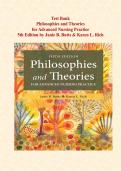
Test Bank
Philosophies and Theories
for Advanced Nursing Practice
5th Edition by Janie B. Butts & Karen L. Rich
,Test Bank for Philosophies and Theories for Advanced
Nursing Practice 5th Edition by Janie B. Butts &
Karen L. Rich (Latest Edition) |A Comprehensive
Sample of 725 Multichoice Questions Covering Full
Scope of the Text Book| Each Question Includes the
Correct Answer with a Detailed Clinical Rationale|
Guaranteed Pass
Table of Contents
Part I: Foundations of Nursing Science
• Chapter 1: Philosophy of Science: An Introduction (Questions 1–25)
• Chapter 2: The Evolution of Nursing Science (Questions 26–50)
• Chapter 3: The Essentials of the Doctor of Nursing Practice: A Philosophical
Perspective (Questions 51–75)
Part II: The Structure and Function of Theory
• Chapter 4: Theory as Practice (Questions 76–100)
• Chapter 5: Components and Levels of Abstraction in Nursing Knowledge
(Questions 101–125)
Part III: Interdisciplinary Philosophies and Theories
• Chapter 6: Complexity Science and Complex Adaptive Systems (Questions
126–150)
• Chapter 7: Critical Theory and Emancipatory Knowledge (Questions 151–
175)
• Chapter 8: Feminist Ethics: Some Applicable Thoughts for Advanced
Practice Nurses (Questions 176–200)
, • Chapter 9: Theories and Models in Ethics (Questions 201–225)
• Chapter 10: Educational and Learning Theories (Questions 226–250)
• Chapter 11: Health Behavior Theories (Questions 251–275)
• Chapter 12: Theories Focused on Interpersonal Relationships (Questions
276–300)
• Chapter 13: Environmental Philosophy and Theories (Questions 301–325)
• Chapter 14: Economic Theories (Questions 326–350)
• Chapter 15: Theories of Organizational Behavior and Leadership (Questions
351–375)
• Chapter 16: Theoretical Approaches to Quality Improvement (Questions
376–400)
• Chapter 17: Theories Focused on Health Inequity and Health Disparity
(Questions 401–425)
Part IV: Select Nursing Models and Theories
• Chapter 18: Models and Theories Focused on Nursing Goals and Functions
(Questions 426–465)
• Chapter 19: Models and Theories Focused on a Systems Approach
(Questions 466–505)
• Chapter 20: Models and Theories Focused on Human Existence and
Universal Energy (Questions 506–545)
• Chapter 21: Models and Theories Focused on Competencies and Skills
(Questions 546–585)
• Chapter 22: Theories Focused on Caring (Questions 586–625)
• Chapter 23: Models and Theories Focused on Culture (Questions 626–650)
• Chapter 24: The Praxis Theory of Suffering (Questions 651–675)
Part V: Tools for Integrating and Disseminating Knowledge in Advanced
Nursing Practice
, • Chapter 25: Theory Testing and Theory Evaluation (Questions 676–700)
• Chapter 26: Using Theory in Evidence-Based Advanced Nursing Practice
(Questions 701–725)
MULTI-CHOICE QUESTIONS
Part I: Foundations of Nursing Science
Chapter 1: Philosophy of Science: An Introduction
1. Why are natural sciences also referred to as "pure" sciences?
A. They are considered stand-alone bodies of unique knowledge.
B. They are the only sciences to which the scientific method can be applied.
C. They are the original sciences upon which all others are based.
D. They are not affected by subjectivity in the way other sciences are.
Correct Answer: A
Rationale: Natural sciences such as physics, chemistry, and biology are termed
"pure" sciences because they are viewed as independent and self-sufficient
branches of knowledge, distinct from applied sciences which utilize natural science
knowledge to solve practical problems.
DIF: Easy | KEY: Remembering | MSC: none | NOT: none
2. Which is NOT an example of an applied science as used in health care
today?
A. Social work
B. Psychotherapy
C. Examination of care disparities
D. Pathology
Correct Answer: D
Philosophies and Theories
for Advanced Nursing Practice
5th Edition by Janie B. Butts & Karen L. Rich
,Test Bank for Philosophies and Theories for Advanced
Nursing Practice 5th Edition by Janie B. Butts &
Karen L. Rich (Latest Edition) |A Comprehensive
Sample of 725 Multichoice Questions Covering Full
Scope of the Text Book| Each Question Includes the
Correct Answer with a Detailed Clinical Rationale|
Guaranteed Pass
Table of Contents
Part I: Foundations of Nursing Science
• Chapter 1: Philosophy of Science: An Introduction (Questions 1–25)
• Chapter 2: The Evolution of Nursing Science (Questions 26–50)
• Chapter 3: The Essentials of the Doctor of Nursing Practice: A Philosophical
Perspective (Questions 51–75)
Part II: The Structure and Function of Theory
• Chapter 4: Theory as Practice (Questions 76–100)
• Chapter 5: Components and Levels of Abstraction in Nursing Knowledge
(Questions 101–125)
Part III: Interdisciplinary Philosophies and Theories
• Chapter 6: Complexity Science and Complex Adaptive Systems (Questions
126–150)
• Chapter 7: Critical Theory and Emancipatory Knowledge (Questions 151–
175)
• Chapter 8: Feminist Ethics: Some Applicable Thoughts for Advanced
Practice Nurses (Questions 176–200)
, • Chapter 9: Theories and Models in Ethics (Questions 201–225)
• Chapter 10: Educational and Learning Theories (Questions 226–250)
• Chapter 11: Health Behavior Theories (Questions 251–275)
• Chapter 12: Theories Focused on Interpersonal Relationships (Questions
276–300)
• Chapter 13: Environmental Philosophy and Theories (Questions 301–325)
• Chapter 14: Economic Theories (Questions 326–350)
• Chapter 15: Theories of Organizational Behavior and Leadership (Questions
351–375)
• Chapter 16: Theoretical Approaches to Quality Improvement (Questions
376–400)
• Chapter 17: Theories Focused on Health Inequity and Health Disparity
(Questions 401–425)
Part IV: Select Nursing Models and Theories
• Chapter 18: Models and Theories Focused on Nursing Goals and Functions
(Questions 426–465)
• Chapter 19: Models and Theories Focused on a Systems Approach
(Questions 466–505)
• Chapter 20: Models and Theories Focused on Human Existence and
Universal Energy (Questions 506–545)
• Chapter 21: Models and Theories Focused on Competencies and Skills
(Questions 546–585)
• Chapter 22: Theories Focused on Caring (Questions 586–625)
• Chapter 23: Models and Theories Focused on Culture (Questions 626–650)
• Chapter 24: The Praxis Theory of Suffering (Questions 651–675)
Part V: Tools for Integrating and Disseminating Knowledge in Advanced
Nursing Practice
, • Chapter 25: Theory Testing and Theory Evaluation (Questions 676–700)
• Chapter 26: Using Theory in Evidence-Based Advanced Nursing Practice
(Questions 701–725)
MULTI-CHOICE QUESTIONS
Part I: Foundations of Nursing Science
Chapter 1: Philosophy of Science: An Introduction
1. Why are natural sciences also referred to as "pure" sciences?
A. They are considered stand-alone bodies of unique knowledge.
B. They are the only sciences to which the scientific method can be applied.
C. They are the original sciences upon which all others are based.
D. They are not affected by subjectivity in the way other sciences are.
Correct Answer: A
Rationale: Natural sciences such as physics, chemistry, and biology are termed
"pure" sciences because they are viewed as independent and self-sufficient
branches of knowledge, distinct from applied sciences which utilize natural science
knowledge to solve practical problems.
DIF: Easy | KEY: Remembering | MSC: none | NOT: none
2. Which is NOT an example of an applied science as used in health care
today?
A. Social work
B. Psychotherapy
C. Examination of care disparities
D. Pathology
Correct Answer: D


