
STUDY E DITIO N
G R A D U AT E P H A R M A C O L O G Y · S T U D Y Q U E S T I O N B A N K
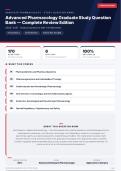
Advanced Pharmacology Graduate Study Question
Bank — Complete Review Edition
· Original Questions with Full Rationales
170 Questions Full Rationales Answer Key Included
170
Q U ES T I O N S
6
S EC T I O N S
100%
R AT I O N A L ES
Complete coverage Core pharmacology domains Every answer explained
W H AT T H I S C OVER S
01 Pharmacokinetics and Pharmacodynamics
02 Pharmacogenomics and Individualized Therapy
03 Cardiovascular and Hematologic Pharmacology
04 Anti-Infective, Immunologic and Anti-Inflammatory Agents
05 Endocrine, Neurological and Psychotropic Pharmacology
06 Special Populations, Polypharmacy and Safety
A BO U T THI S Q U E STI O N BA N K
Build mastery in advanced pharmacology — from pharmacokinetics, pharmacodynamics, and pharmacogenomics to
cardiovascular, hematologic, anti-infective, immunologic, anti-inflammatory, endocrine, neurological, and
psychotropic agents, plus special populations, polypharmacy, and safety. This original practice question bank
presents realistic clinical scenarios written at the application and analysis level, aligned with topics commonly
covered in graduate advanced pharmacology courses, and pairs every answer with a fully explained rationale. For
review use only; not an institutional proctored assessment.
PA SSI NG SC ORE LE V E L F ORM AT
80% Advanced (Graduate Pharmacology) Application / Analysis
ADVANCED PHARMACOLOGY STUDY BANK Page 1
, SECTION 1: PHARMACOKINETICS AND PHARMACODYNAMICS
Q1. A 74-year-old woman with atrial fibrillation takes digoxin 0.25 mg daily and furosemide 40 mg daily. She
presents with 3 days of vomiting and diarrhea, a serum potassium of 2.9 mEq/L, and reports seeing
yellow-green halos around lights. Which mechanism best explains why her hypokalemia has amplified digoxin
toxicity?
A. Hypokalemia displaces digoxin from albumin, increasing the unbound fraction delivered to cardiac tissue
B. Low potassium converts digoxin from zero-order to first-order elimination, causing rapid accumulation
C. Hypokalemia accelerates renal tubular secretion of digoxin, raising free drug concentrations at the
myocardium
D. Hypokalemia reduces potassium competition at the Na/K-ATPase binding site, allowing more digoxin to
bind and inhibit the pump
Correct Answer: D
Rationale: Digoxin and potassium compete for the same binding site on the extracellular surface of Na/K-ATPase, so low
serum potassium permits more digoxin binding and stronger pump inhibition. This is why hypokalemia from diuretics or
GI loss potentiates digoxin arrhythmias, and why potassium repletion is a first step in managing toxicity without
hemodynamic instability.
Q2. A 31-year-old man on phenytoin 300 mg nightly has a steady-state level of 11 mcg/mL. His neurologist
raises the dose to 350 mg nightly, and 3 weeks later the level returns at 27 mcg/mL with nystagmus and ataxia.
What kinetic property best explains this disproportionate rise?
A. Phenytoin has a very large volume of distribution, so any dose change triples the plasma concentration
B. Phenytoin follows saturable Michaelis-Menten kinetics, so once metabolizing enzymes are saturated, small
dose increases produce large level increases
C. Phenytoin induces its own metabolism over time, which paradoxically raises levels before lowering them
D. The patient must have doubled the dose, because phenytoin levels always rise proportionally with dose
Correct Answer: B
Rationale: Phenytoin is metabolized by saturable enzymes, so within the therapeutic range it transitions from first-order to
zero-order elimination. Dose changes near saturation cause nonlinear, disproportionate level increases, which is why
phenytoin is titrated in small 25 to 50 mg increments with level checks.
Q3. A man with chronic stable angina gets complete relief within 2 minutes from sublingual nitroglycerin, but
earlier in therapy the same milligram dose taken as an oral tablet gave him little benefit. What pharmacokinetic
principle accounts for the difference in effect?
A. Oral nitroglycerin is destroyed by gastric acid, which does not affect the sublingual route
B. Sublingual tablets achieve a slower, more sustained release that maintains steady nitrate levels
C. Sublingual absorption drains directly into the systemic circulation and avoids hepatic first-pass metabolism
that inactivates most oral nitroglycerin
D. The sublingual route increases protein binding of nitroglycerin, raising the free fraction reaching the
myocardium
Correct Answer: C
Rationale: Nitroglycerin is extensively metabolized on first pass through the liver, so oral bioavailability is very low.
Sublingual administration enters venous drainage directly and bypasses hepatic first-pass metabolism, delivering active drug
rapidly, which is the basis for its use in acute anginal attacks.
Advanced Pharmacology Study Bank · Page 2
,Q4. A 62-year-old hypertensive man who drinks 2 glasses of grapefruit juice daily reports dizziness and
lightheadedness on standing 3 days after starting felodipine. His blood pressure is 96/60 mm Hg. What
interaction mechanism is responsible?
A. Grapefruit juice displaces felodipine from plasma proteins, raising the unbound hypotensive fraction
B. Furanocoumarins in grapefruit juice irreversibly inhibit intestinal CYP3A4, reducing first-pass metabolism
and increasing felodipine bioavailability
C. Grapefruit juice inhibits renal organic cation transporters, decreasing felodipine excretion
D. Grapefruit juice induces hepatic CYP3A4, which accelerates felodipine clearance and reduces its effect
Correct Answer: B
Rationale: Grapefruit juice components irreversibly destroy intestinal CYP3A4, so pre-systemic metabolism of felodipine
falls and bioavailability rises, producing exaggerated vasodilation. The effect peaks within hours and can persist about 3
days after the last glass, so patients on highly CYP3A4-dependent drugs should avoid grapefruit entirely.
Q5. A patient begins amiodarone for ventricular arrhythmias with a loading regimen. His clinician explains that
even after stopping the drug, antiarrhythmic activity will persist for weeks to months. Which pharmacokinetic
feature most directly accounts for this prolonged persistence?
A. Complete bioavailability that prevents any elimination of the parent compound
B. An extremely long elimination half-life of roughly 40 to 60 days, so complete washout requires weeks to
months
C. Enterohepatic recycling that blocks biliary elimination indefinitely
D. Irreversible covalent binding of amiodarone to myocardial sodium channels
Correct Answer: B
Rationale: Amiodarone is highly lipophilic with a massive volume of distribution and an elimination half-life measured in
weeks to months. Steady state therefore takes months, and clinical effects persist long after discontinuation, which shapes
both its loading strategy and the duration of interaction monitoring after it is stopped.
Q6. A patient with recurrent ventricular tachycardia is started on oral amiodarone, and the team chooses a
divided loading schedule over several weeks instead of relying on maintenance dosing alone. What is the
primary rationale for administering a loading dose in this situation?
A. A large volume of distribution and long half-life delay steady state, so a loading dose rapidly achieves
therapeutic concentrations
B. A loading dose converts the drug to first-order kinetics, allowing predictable accumulation
C. Loading doses saturate renal clearance, which is the dominant route of amiodarone elimination
D. Loading doses reduce the risk of pulmonary fibrosis associated with chronic therapy
Correct Answer: A
Rationale: When a drug distributes extensively into tissues and has a long half-life, reaching steady state by maintenance
dosing alone would take an impractically long time. A loading dose fills the distribution volume to reach therapeutic levels
quickly, after which maintenance dosing replaces only the amount cleared.
Advanced Pharmacology Study Bank · Page 3
, Q7. A 68-year-old woman with diabetic neuropathy and stage 4 chronic kidney disease (eGFR 22 mL/min) is
started on gabapentin. Two days later she is somnolent, ataxic, and confused. Which kinetic change best
explains her presentation?
A. Gabapentin is eliminated almost entirely by the kidneys, so reduced clearance causes accumulation with a
prolonged half-life unless the dose is reduced
B. Gabapentin induces hepatic CYP enzymes that generate a toxic metabolite in renal failure
C. Uremia displaces gabapentin from plasma proteins, sharply raising its free concentration
D. Gabapentin undergoes enterohepatic recirculation that is enhanced in kidney disease
Correct Answer: A
Rationale: Because gabapentin is renally cleared without hepatic metabolism, a declining eGFR directly prolongs its
half-life and causes dose-dependent neurotoxicity such as somnolence and ataxia. Dosing intervals must be extended and
daily doses lowered in chronic kidney disease.
Q8. A patient with digoxin toxicity undergoes hemodialysis for unrelated acute kidney injury, and the
intensivist notes the digoxin level remains largely unchanged after the session. What property explains why
hemodialysis removes so little digoxin?
A. Irreversible binding of digoxin to circulating albumin that resists filtration
B. Active tubular reabsorption that occurs during hemodialysis filtration
C. A large volume of distribution reflecting extensive tissue binding, with only a small fraction of total body
drug present in plasma
D. Rapid redistribution from plasma into the dialyzer membrane
Correct Answer: C
Rationale: Digoxin distributes widely into skeletal and cardiac muscle, giving it a large volume of distribution; the plasma
pool is tiny compared with total body stores. Hemodialysis clears only intravascular drug, so it is ineffective for digoxin
removal, unlike digoxin-specific antibody fragments.
Q9. A postoperative patient receives IV morphine and develops respiratory depression that is reversed by a
single dose of IV naloxone. The team later discusses why a larger-than-usual morphine dose would be needed to
restore analgesia while naloxone remains on board. What concept applies?
A. Naloxone irreversibly alkylates mu receptors, so no agonist dose can restore effect
B. Naloxone is a competitive mu-receptor antagonist, so raising the agonist concentration can partially displace
it from the receptor
C. Naloxone accelerates morphine metabolism, so the agonist dose is irrelevant
D. Naloxone is a partial agonist that competes only for efficacy, not receptor binding
Correct Answer: B
Rationale: Competitive antagonists bind reversibly to the same receptor site as the agonist, and a higher agonist
concentration can partially overcome the block while the antagonist dose remains fixed. This competitive basis is also why
naloxone wears off before many opioids do, requiring repeat dosing in prolonged toxicity.
Advanced Pharmacology Study Bank · Page 4
G R A D U AT E P H A R M A C O L O G Y · S T U D Y Q U E S T I O N B A N K
Advanced Pharmacology Graduate Study Question
Bank — Complete Review Edition
· Original Questions with Full Rationales
170 Questions Full Rationales Answer Key Included
170
Q U ES T I O N S
6
S EC T I O N S
100%
R AT I O N A L ES
Complete coverage Core pharmacology domains Every answer explained
W H AT T H I S C OVER S
01 Pharmacokinetics and Pharmacodynamics
02 Pharmacogenomics and Individualized Therapy
03 Cardiovascular and Hematologic Pharmacology
04 Anti-Infective, Immunologic and Anti-Inflammatory Agents
05 Endocrine, Neurological and Psychotropic Pharmacology
06 Special Populations, Polypharmacy and Safety
A BO U T THI S Q U E STI O N BA N K
Build mastery in advanced pharmacology — from pharmacokinetics, pharmacodynamics, and pharmacogenomics to
cardiovascular, hematologic, anti-infective, immunologic, anti-inflammatory, endocrine, neurological, and
psychotropic agents, plus special populations, polypharmacy, and safety. This original practice question bank
presents realistic clinical scenarios written at the application and analysis level, aligned with topics commonly
covered in graduate advanced pharmacology courses, and pairs every answer with a fully explained rationale. For
review use only; not an institutional proctored assessment.
PA SSI NG SC ORE LE V E L F ORM AT
80% Advanced (Graduate Pharmacology) Application / Analysis
ADVANCED PHARMACOLOGY STUDY BANK Page 1
, SECTION 1: PHARMACOKINETICS AND PHARMACODYNAMICS
Q1. A 74-year-old woman with atrial fibrillation takes digoxin 0.25 mg daily and furosemide 40 mg daily. She
presents with 3 days of vomiting and diarrhea, a serum potassium of 2.9 mEq/L, and reports seeing
yellow-green halos around lights. Which mechanism best explains why her hypokalemia has amplified digoxin
toxicity?
A. Hypokalemia displaces digoxin from albumin, increasing the unbound fraction delivered to cardiac tissue
B. Low potassium converts digoxin from zero-order to first-order elimination, causing rapid accumulation
C. Hypokalemia accelerates renal tubular secretion of digoxin, raising free drug concentrations at the
myocardium
D. Hypokalemia reduces potassium competition at the Na/K-ATPase binding site, allowing more digoxin to
bind and inhibit the pump
Correct Answer: D
Rationale: Digoxin and potassium compete for the same binding site on the extracellular surface of Na/K-ATPase, so low
serum potassium permits more digoxin binding and stronger pump inhibition. This is why hypokalemia from diuretics or
GI loss potentiates digoxin arrhythmias, and why potassium repletion is a first step in managing toxicity without
hemodynamic instability.
Q2. A 31-year-old man on phenytoin 300 mg nightly has a steady-state level of 11 mcg/mL. His neurologist
raises the dose to 350 mg nightly, and 3 weeks later the level returns at 27 mcg/mL with nystagmus and ataxia.
What kinetic property best explains this disproportionate rise?
A. Phenytoin has a very large volume of distribution, so any dose change triples the plasma concentration
B. Phenytoin follows saturable Michaelis-Menten kinetics, so once metabolizing enzymes are saturated, small
dose increases produce large level increases
C. Phenytoin induces its own metabolism over time, which paradoxically raises levels before lowering them
D. The patient must have doubled the dose, because phenytoin levels always rise proportionally with dose
Correct Answer: B
Rationale: Phenytoin is metabolized by saturable enzymes, so within the therapeutic range it transitions from first-order to
zero-order elimination. Dose changes near saturation cause nonlinear, disproportionate level increases, which is why
phenytoin is titrated in small 25 to 50 mg increments with level checks.
Q3. A man with chronic stable angina gets complete relief within 2 minutes from sublingual nitroglycerin, but
earlier in therapy the same milligram dose taken as an oral tablet gave him little benefit. What pharmacokinetic
principle accounts for the difference in effect?
A. Oral nitroglycerin is destroyed by gastric acid, which does not affect the sublingual route
B. Sublingual tablets achieve a slower, more sustained release that maintains steady nitrate levels
C. Sublingual absorption drains directly into the systemic circulation and avoids hepatic first-pass metabolism
that inactivates most oral nitroglycerin
D. The sublingual route increases protein binding of nitroglycerin, raising the free fraction reaching the
myocardium
Correct Answer: C
Rationale: Nitroglycerin is extensively metabolized on first pass through the liver, so oral bioavailability is very low.
Sublingual administration enters venous drainage directly and bypasses hepatic first-pass metabolism, delivering active drug
rapidly, which is the basis for its use in acute anginal attacks.
Advanced Pharmacology Study Bank · Page 2
,Q4. A 62-year-old hypertensive man who drinks 2 glasses of grapefruit juice daily reports dizziness and
lightheadedness on standing 3 days after starting felodipine. His blood pressure is 96/60 mm Hg. What
interaction mechanism is responsible?
A. Grapefruit juice displaces felodipine from plasma proteins, raising the unbound hypotensive fraction
B. Furanocoumarins in grapefruit juice irreversibly inhibit intestinal CYP3A4, reducing first-pass metabolism
and increasing felodipine bioavailability
C. Grapefruit juice inhibits renal organic cation transporters, decreasing felodipine excretion
D. Grapefruit juice induces hepatic CYP3A4, which accelerates felodipine clearance and reduces its effect
Correct Answer: B
Rationale: Grapefruit juice components irreversibly destroy intestinal CYP3A4, so pre-systemic metabolism of felodipine
falls and bioavailability rises, producing exaggerated vasodilation. The effect peaks within hours and can persist about 3
days after the last glass, so patients on highly CYP3A4-dependent drugs should avoid grapefruit entirely.
Q5. A patient begins amiodarone for ventricular arrhythmias with a loading regimen. His clinician explains that
even after stopping the drug, antiarrhythmic activity will persist for weeks to months. Which pharmacokinetic
feature most directly accounts for this prolonged persistence?
A. Complete bioavailability that prevents any elimination of the parent compound
B. An extremely long elimination half-life of roughly 40 to 60 days, so complete washout requires weeks to
months
C. Enterohepatic recycling that blocks biliary elimination indefinitely
D. Irreversible covalent binding of amiodarone to myocardial sodium channels
Correct Answer: B
Rationale: Amiodarone is highly lipophilic with a massive volume of distribution and an elimination half-life measured in
weeks to months. Steady state therefore takes months, and clinical effects persist long after discontinuation, which shapes
both its loading strategy and the duration of interaction monitoring after it is stopped.
Q6. A patient with recurrent ventricular tachycardia is started on oral amiodarone, and the team chooses a
divided loading schedule over several weeks instead of relying on maintenance dosing alone. What is the
primary rationale for administering a loading dose in this situation?
A. A large volume of distribution and long half-life delay steady state, so a loading dose rapidly achieves
therapeutic concentrations
B. A loading dose converts the drug to first-order kinetics, allowing predictable accumulation
C. Loading doses saturate renal clearance, which is the dominant route of amiodarone elimination
D. Loading doses reduce the risk of pulmonary fibrosis associated with chronic therapy
Correct Answer: A
Rationale: When a drug distributes extensively into tissues and has a long half-life, reaching steady state by maintenance
dosing alone would take an impractically long time. A loading dose fills the distribution volume to reach therapeutic levels
quickly, after which maintenance dosing replaces only the amount cleared.
Advanced Pharmacology Study Bank · Page 3
, Q7. A 68-year-old woman with diabetic neuropathy and stage 4 chronic kidney disease (eGFR 22 mL/min) is
started on gabapentin. Two days later she is somnolent, ataxic, and confused. Which kinetic change best
explains her presentation?
A. Gabapentin is eliminated almost entirely by the kidneys, so reduced clearance causes accumulation with a
prolonged half-life unless the dose is reduced
B. Gabapentin induces hepatic CYP enzymes that generate a toxic metabolite in renal failure
C. Uremia displaces gabapentin from plasma proteins, sharply raising its free concentration
D. Gabapentin undergoes enterohepatic recirculation that is enhanced in kidney disease
Correct Answer: A
Rationale: Because gabapentin is renally cleared without hepatic metabolism, a declining eGFR directly prolongs its
half-life and causes dose-dependent neurotoxicity such as somnolence and ataxia. Dosing intervals must be extended and
daily doses lowered in chronic kidney disease.
Q8. A patient with digoxin toxicity undergoes hemodialysis for unrelated acute kidney injury, and the
intensivist notes the digoxin level remains largely unchanged after the session. What property explains why
hemodialysis removes so little digoxin?
A. Irreversible binding of digoxin to circulating albumin that resists filtration
B. Active tubular reabsorption that occurs during hemodialysis filtration
C. A large volume of distribution reflecting extensive tissue binding, with only a small fraction of total body
drug present in plasma
D. Rapid redistribution from plasma into the dialyzer membrane
Correct Answer: C
Rationale: Digoxin distributes widely into skeletal and cardiac muscle, giving it a large volume of distribution; the plasma
pool is tiny compared with total body stores. Hemodialysis clears only intravascular drug, so it is ineffective for digoxin
removal, unlike digoxin-specific antibody fragments.
Q9. A postoperative patient receives IV morphine and develops respiratory depression that is reversed by a
single dose of IV naloxone. The team later discusses why a larger-than-usual morphine dose would be needed to
restore analgesia while naloxone remains on board. What concept applies?
A. Naloxone irreversibly alkylates mu receptors, so no agonist dose can restore effect
B. Naloxone is a competitive mu-receptor antagonist, so raising the agonist concentration can partially displace
it from the receptor
C. Naloxone accelerates morphine metabolism, so the agonist dose is irrelevant
D. Naloxone is a partial agonist that competes only for efficacy, not receptor binding
Correct Answer: B
Rationale: Competitive antagonists bind reversibly to the same receptor site as the agonist, and a higher agonist
concentration can partially overcome the block while the antagonist dose remains fixed. This competitive basis is also why
naloxone wears off before many opioids do, requiring repeat dosing in prolonged toxicity.
Advanced Pharmacology Study Bank · Page 4


