
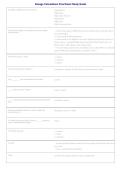
Dosage Calculations Final Exam Study Guide
Six Rights of Medication Administration: Right Patient
RIght Drug
Right Dose/Amount
Right Route
Right Time
Right Documentation
Check the Six Rights at 3 Different Points During Med 1. Check meds against MAR before/during administration and also check
Administration:
for med allergies
2. Check meds AFTER preparation
3. Check meds at the bedside: also check blood pressure and/or pulse or
blood sugars if needed BEFORE giving meds that affect the BP, pulse, or
blood sugars. AND always check allergy band.
***You will check patient name and DOB as well as check MR # on armband
against MAR before giving meds at bedside as well***
Oral meds come in 3 forms: 1. tablets
2. capsules
3. liquids
tabs and capsules are supplied in strengths or dosages in which they are commonly prescribed
only _________ tabs are intended to be divided scored
_____ tabs cannot be crushed enteric-coated
_____ capsules cannot be opened and mixed with food or sustained-release
fluid
Never use sustained-release or enteric-coated oral Nasogastric/NG or G-tube!
medications in a.....
it is safest & most accurate to give the ______ number of fewest
whole, undivided tabs possible
Three step approach: 1. convert
2. think
3. calculate
Convert: - all units of measurement must be in same system and all units must be in
same size
-if not, convert before proceeding
Think: estimate reasonable amount of drug to administer
, Dosage Calculations Final Exam Study Guide
Calculate: dosage on hand = dosage desired
amount on hand = X amount desired
If dosage is not in same size unit of measurement convert to same system or same size units
dosages for oral liquids: calculated in mL
question giving more than ___ tabs or capsules per dose 3
route of administration other than gi 1. intramuscular (IM)
2. subcutaneous (SC)
3. intradermal (ID)
4. IV
Subcutaneous Injections Injected into fatty tissue
Angle of injection= 45 degrees, depending on patient size
Areas appropriate for injection= abdomen, fatty back part of upper arm,
some fatty tissue in lumbar area, fatty tissue on thighs
Needle Length: 3/8th to 5/8th inches
Needle Gauge: 25-27 gauge typically
1 mL syringe!
Subcutaneous (SC) Injections
, Dosage Calculations Final Exam Study Guide
Intradermal Injections: Usually used for TB skin tests and allergy tests
Injected into the dermal layer, under epidermis
Use tuberculin or 1 mL syringe
Angle of injection= 10-15 degress
1mL syringe
Needle is typically 25-27 guage
1/4 to 5/8 inches in length
Intradermal (ID) Injections
Intramuscular (IM) -Absorbed more rapidly than subcutaneous or intradermal injections
-Typical volume to inject ranges from 0.5ml-3ml, depending on site and
age and size of person
-More than 3 ml is typically divided
-Angle of injection: 90 degrees, depends on individual
-ASPIRATE
Intramuscular (IM) Injections Needle gauge: 19-24 gauge
Needle length: 1-2 inches
Typical: 22 gauge, 1 ½ length needle
Sites for administration: deltoid muscle (up to 1ml), vastus lateralis muscle,
dorsogluteal and ventrogluteal muscle
most meds prepared in liquid form and packaged in: 1. dosage vials
2.ampules
3. prefilled syringes
injectable drugs measured in: syringes
Six Rights of Medication Administration: Right Patient
RIght Drug
Right Dose/Amount
Right Route
Right Time
Right Documentation
Check the Six Rights at 3 Different Points During Med 1. Check meds against MAR before/during administration and also check
Administration:
for med allergies
2. Check meds AFTER preparation
3. Check meds at the bedside: also check blood pressure and/or pulse or
blood sugars if needed BEFORE giving meds that affect the BP, pulse, or
blood sugars. AND always check allergy band.
***You will check patient name and DOB as well as check MR # on armband
against MAR before giving meds at bedside as well***
Oral meds come in 3 forms: 1. tablets
2. capsules
3. liquids
tabs and capsules are supplied in strengths or dosages in which they are commonly prescribed
only _________ tabs are intended to be divided scored
_____ tabs cannot be crushed enteric-coated
_____ capsules cannot be opened and mixed with food or sustained-release
fluid
Never use sustained-release or enteric-coated oral Nasogastric/NG or G-tube!
medications in a.....
it is safest & most accurate to give the ______ number of fewest
whole, undivided tabs possible
Three step approach: 1. convert
2. think
3. calculate
Convert: - all units of measurement must be in same system and all units must be in
same size
-if not, convert before proceeding
Think: estimate reasonable amount of drug to administer
, Dosage Calculations Final Exam Study Guide
Calculate: dosage on hand = dosage desired
amount on hand = X amount desired
If dosage is not in same size unit of measurement convert to same system or same size units
dosages for oral liquids: calculated in mL
question giving more than ___ tabs or capsules per dose 3
route of administration other than gi 1. intramuscular (IM)
2. subcutaneous (SC)
3. intradermal (ID)
4. IV
Subcutaneous Injections Injected into fatty tissue
Angle of injection= 45 degrees, depending on patient size
Areas appropriate for injection= abdomen, fatty back part of upper arm,
some fatty tissue in lumbar area, fatty tissue on thighs
Needle Length: 3/8th to 5/8th inches
Needle Gauge: 25-27 gauge typically
1 mL syringe!
Subcutaneous (SC) Injections
, Dosage Calculations Final Exam Study Guide
Intradermal Injections: Usually used for TB skin tests and allergy tests
Injected into the dermal layer, under epidermis
Use tuberculin or 1 mL syringe
Angle of injection= 10-15 degress
1mL syringe
Needle is typically 25-27 guage
1/4 to 5/8 inches in length
Intradermal (ID) Injections
Intramuscular (IM) -Absorbed more rapidly than subcutaneous or intradermal injections
-Typical volume to inject ranges from 0.5ml-3ml, depending on site and
age and size of person
-More than 3 ml is typically divided
-Angle of injection: 90 degrees, depends on individual
-ASPIRATE
Intramuscular (IM) Injections Needle gauge: 19-24 gauge
Needle length: 1-2 inches
Typical: 22 gauge, 1 ½ length needle
Sites for administration: deltoid muscle (up to 1ml), vastus lateralis muscle,
dorsogluteal and ventrogluteal muscle
most meds prepared in liquid form and packaged in: 1. dosage vials
2.ampules
3. prefilled syringes
injectable drugs measured in: syringes


