
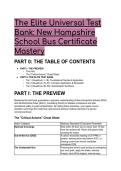
The Elite Universal Test
Bank: New Hampshire
School Bus Certificate
Mastery
PART 0: THE TABLE OF CONTENTS
● PART I: THE PREVIEW
○ The Intro
○ The "Critical Axioms" Cheat Sheet
● PART II: THE ELITE TEST BANK
○ Tier 1 (Questions 1–18): Foundational Syntax & Application
○ Tier 2 (Questions 19–37): Complex Application & Simulation
○ Tier 3 (Questions 38–55): Grandmaster Synthesis
PART I: THE PREVIEW
Mastering this test bank guarantees a granular understanding of New Hampshire statutes (RSA)
and Administrative Rules (Saf-C), translating directly to flawless compliance and elite
operational safety in pupil transportation. By drilling these scenarios, you bypass novice
hesitation and forge the instinctual, split-second decision-making required of a top-tier
commercial driver.
The "Critical Axioms" Cheat Sheet
Axiom Category Statutory Standard & Execution Parameter
Railroad Crossings Stop within 50 feet, but no closer than 15 feet
from the nearest rail. Never shift gears while
crossing the tracks.
Out-of-Service (OOS) A carbon monoxide reading of 20 PPM or
greater, steering axle tread below 4/32", or
missing cross-over mirrors mandates
immediate OOS.
The Unattended Bus If leaving the driver's seat during an emergency,
you must park, apply the brake, activate
4-ways, shut off the engine, remove keys,
,Axiom Category Statutory Standard & Execution Parameter
chock wheels, place reflectors, and remain
within 100 feet.
Medical & Training Drivers require a valid medical card (annual
renewal after age 70), 10 hours of pre-service
training, 8 hours of annual in-service training,
and listing on Form DSMV 126.
Aisle Clearance Aisles must be 12 inches wide at the floor and
slanted to 15 inches at the top of the seat back.
Zero obstructions are permitted.
PART II: THE ELITE TEST BANK
Tier 1: Foundational Syntax & Application
Q1: An applicant seeks to operate a school bus carrying pupils across state lines from New
Hampshire into Massachusetts. Based on the principles of Saf-C 1304.01, which age
requirement is the MINIMUM acceptable standard? A) 18 years of age with a valid medical card.
B) 21 years of age with 2 years of driving experience. C) 21 years of age with a valid driver
license for a minimum of 2 years. D) 25 years of age with a Class B CDL.
● Answer: C (21 years of age with a valid driver license for a minimum of 2 years.)
● Distractor Analysis:
○ A is incorrect: 18 years of age is the minimum solely for intrastate driving within
New Hampshire.
○ B is incorrect: While technically true regarding age, it omits the statutory phrasing
requiring the driver to have held a valid license specifically for the preceding 2
years.
○ D is incorrect: 25 years of age is an arbitrary legacy standard not supported by
Federal Motor Carrier Safety Administration (FMCSA) or NH RSA guidelines.
The Mentor's Analysis: Interstate commerce initiates stringent FMCSA age thresholds. While
NH allows 18-year-olds to operate intrastate, crossing state lines legally binds you to the
21-year age minimum alongside the 2-year license history requirement. Professional Intuition:
Always verify the intended route geography; state borders instantly alter your operational
jurisdiction and minimum age requirements.
Q2: During the hiring process for a new school bus driver, the transportation coordinator must
submit the driver's name to the division. Based on the principles of Saf-C 1304.01, which action
is REQUIRED to achieve compliance? A) Submission of the driver's name on a typed DSMV
126 School Bus Driver Roster. B) Submission of the driver's name via an electronic FMCSA
portal. C) Submission of the driver's name on a handwritten DSMV 126 School Bus Driver
Roster. D) Submission of the driver's medical certificate directly to the local police department.
● Answer: A (Submission of the driver's name on a typed DSMV 126 School Bus Driver
Roster.)
● Distractor Analysis:
○ B is incorrect: The state of NH relies on the specific Department of Safety form
DSMV 126 for the roster, not a federal FMCSA portal for this specific state-level
certification.
○ C is incorrect: Form DSMV 126 explicitly requires the roster to be typed;
, handwritten rosters are rejected by the division.
○ D is incorrect: Medical certificates are retained in the driver qualification file (RSA
263:29-a), not submitted to local police.
The Mentor's Analysis: Bureaucratic precision is as vital as operational safety. The DSMV 126
must be accurately typed and signed by the responsible school district official to legally validate
the driver's certificate status. Professional Intuition: A driver is not legally authorized to
transport pupils until their name is officially processed on a typed DSMV 126 roster.
Q3: A school bus driver has just celebrated their 71st birthday. Based on the principles of RSA
200:37, which conclusion regarding their physical examination is the MOST ACCURATE? A)
They must submit a medical certificate every 2 years. B) They are disqualified from operating a
school bus due to age restrictions. C) They must undergo an annual medical examination and
submit the certificate. D) They require a specialized waiver from the FMCSA to continue driving.
● Answer: C (They must undergo an annual medical examination and submit the
certificate.)
● Distractor Analysis:
○ A is incorrect: The standard 2-year interval applies only to drivers under the age of
70.
○ B is incorrect: New Hampshire does not impose a maximum age limit for school bus
drivers, provided they pass the required physicals.
○ D is incorrect: A federal waiver is for specific conditions (like vision or missing
limbs), not exclusively for reaching age 70.
The Mentor's Analysis: Advanced age introduces a higher frequency of medical monitoring.
RSA 200:37 mandates that once a driver reaches 70, the biennial medical exam accelerates to
an annual requirement to ensure continuous physical capability. Professional Intuition: Age 70
triggers the annual medical recertification protocol. Never let a driver over 70 operate on a
2-year medical card.
Q4: A candidate is undergoing the mandatory training program to become a certified school bus
driver. Based on the principles of Saf-C 1305.02, which action represents the MINIMUM
required duration for pre-service instruction? A) 8 hours, including road skills training. B) 10
hours, exclusive of road skills training. C) 12 hours, inclusive of road skills training. D) 10 hours,
including a mandatory CPR certification.
● Answer: B (10 hours, exclusive of road skills training.)
● Distractor Analysis:
○ A is incorrect: 8 hours is the requirement for annual in-service review, not initial
pre-service training.
○ C is incorrect: The baseline requirement is 10 hours, not 12, and road skills must be
calculated separately.
○ D is incorrect: While basic first aid instruction is required, a formal CPR certification
is not specifically mandated as part of the minimum 10-hour clock.
The Mentor's Analysis: Pre-service training establishes the foundation of driver safety. The
10-hour minimum applies strictly to classroom/instructional time; behind-the-wheel road skills
training must be tracked as an entirely separate metric. Professional Intuition: Pre-service is
10 hours (classroom only); In-service is 8 hours (annually). Keep these numbers isolated in your
mind.
Q5: When navigating a railroad grade crossing in a loaded school bus, the driver initiates the
stopping sequence. Based on the principles of RSA 265:50, which action is the MANDATORY
protocol? A) Stop within 50 feet but not less than 15 feet from the nearest rail, and do not shift
gears while crossing. B) Stop within 25 feet of the nearest rail, open the door, and shift to a
Bank: New Hampshire
School Bus Certificate
Mastery
PART 0: THE TABLE OF CONTENTS
● PART I: THE PREVIEW
○ The Intro
○ The "Critical Axioms" Cheat Sheet
● PART II: THE ELITE TEST BANK
○ Tier 1 (Questions 1–18): Foundational Syntax & Application
○ Tier 2 (Questions 19–37): Complex Application & Simulation
○ Tier 3 (Questions 38–55): Grandmaster Synthesis
PART I: THE PREVIEW
Mastering this test bank guarantees a granular understanding of New Hampshire statutes (RSA)
and Administrative Rules (Saf-C), translating directly to flawless compliance and elite
operational safety in pupil transportation. By drilling these scenarios, you bypass novice
hesitation and forge the instinctual, split-second decision-making required of a top-tier
commercial driver.
The "Critical Axioms" Cheat Sheet
Axiom Category Statutory Standard & Execution Parameter
Railroad Crossings Stop within 50 feet, but no closer than 15 feet
from the nearest rail. Never shift gears while
crossing the tracks.
Out-of-Service (OOS) A carbon monoxide reading of 20 PPM or
greater, steering axle tread below 4/32", or
missing cross-over mirrors mandates
immediate OOS.
The Unattended Bus If leaving the driver's seat during an emergency,
you must park, apply the brake, activate
4-ways, shut off the engine, remove keys,
,Axiom Category Statutory Standard & Execution Parameter
chock wheels, place reflectors, and remain
within 100 feet.
Medical & Training Drivers require a valid medical card (annual
renewal after age 70), 10 hours of pre-service
training, 8 hours of annual in-service training,
and listing on Form DSMV 126.
Aisle Clearance Aisles must be 12 inches wide at the floor and
slanted to 15 inches at the top of the seat back.
Zero obstructions are permitted.
PART II: THE ELITE TEST BANK
Tier 1: Foundational Syntax & Application
Q1: An applicant seeks to operate a school bus carrying pupils across state lines from New
Hampshire into Massachusetts. Based on the principles of Saf-C 1304.01, which age
requirement is the MINIMUM acceptable standard? A) 18 years of age with a valid medical card.
B) 21 years of age with 2 years of driving experience. C) 21 years of age with a valid driver
license for a minimum of 2 years. D) 25 years of age with a Class B CDL.
● Answer: C (21 years of age with a valid driver license for a minimum of 2 years.)
● Distractor Analysis:
○ A is incorrect: 18 years of age is the minimum solely for intrastate driving within
New Hampshire.
○ B is incorrect: While technically true regarding age, it omits the statutory phrasing
requiring the driver to have held a valid license specifically for the preceding 2
years.
○ D is incorrect: 25 years of age is an arbitrary legacy standard not supported by
Federal Motor Carrier Safety Administration (FMCSA) or NH RSA guidelines.
The Mentor's Analysis: Interstate commerce initiates stringent FMCSA age thresholds. While
NH allows 18-year-olds to operate intrastate, crossing state lines legally binds you to the
21-year age minimum alongside the 2-year license history requirement. Professional Intuition:
Always verify the intended route geography; state borders instantly alter your operational
jurisdiction and minimum age requirements.
Q2: During the hiring process for a new school bus driver, the transportation coordinator must
submit the driver's name to the division. Based on the principles of Saf-C 1304.01, which action
is REQUIRED to achieve compliance? A) Submission of the driver's name on a typed DSMV
126 School Bus Driver Roster. B) Submission of the driver's name via an electronic FMCSA
portal. C) Submission of the driver's name on a handwritten DSMV 126 School Bus Driver
Roster. D) Submission of the driver's medical certificate directly to the local police department.
● Answer: A (Submission of the driver's name on a typed DSMV 126 School Bus Driver
Roster.)
● Distractor Analysis:
○ B is incorrect: The state of NH relies on the specific Department of Safety form
DSMV 126 for the roster, not a federal FMCSA portal for this specific state-level
certification.
○ C is incorrect: Form DSMV 126 explicitly requires the roster to be typed;
, handwritten rosters are rejected by the division.
○ D is incorrect: Medical certificates are retained in the driver qualification file (RSA
263:29-a), not submitted to local police.
The Mentor's Analysis: Bureaucratic precision is as vital as operational safety. The DSMV 126
must be accurately typed and signed by the responsible school district official to legally validate
the driver's certificate status. Professional Intuition: A driver is not legally authorized to
transport pupils until their name is officially processed on a typed DSMV 126 roster.
Q3: A school bus driver has just celebrated their 71st birthday. Based on the principles of RSA
200:37, which conclusion regarding their physical examination is the MOST ACCURATE? A)
They must submit a medical certificate every 2 years. B) They are disqualified from operating a
school bus due to age restrictions. C) They must undergo an annual medical examination and
submit the certificate. D) They require a specialized waiver from the FMCSA to continue driving.
● Answer: C (They must undergo an annual medical examination and submit the
certificate.)
● Distractor Analysis:
○ A is incorrect: The standard 2-year interval applies only to drivers under the age of
70.
○ B is incorrect: New Hampshire does not impose a maximum age limit for school bus
drivers, provided they pass the required physicals.
○ D is incorrect: A federal waiver is for specific conditions (like vision or missing
limbs), not exclusively for reaching age 70.
The Mentor's Analysis: Advanced age introduces a higher frequency of medical monitoring.
RSA 200:37 mandates that once a driver reaches 70, the biennial medical exam accelerates to
an annual requirement to ensure continuous physical capability. Professional Intuition: Age 70
triggers the annual medical recertification protocol. Never let a driver over 70 operate on a
2-year medical card.
Q4: A candidate is undergoing the mandatory training program to become a certified school bus
driver. Based on the principles of Saf-C 1305.02, which action represents the MINIMUM
required duration for pre-service instruction? A) 8 hours, including road skills training. B) 10
hours, exclusive of road skills training. C) 12 hours, inclusive of road skills training. D) 10 hours,
including a mandatory CPR certification.
● Answer: B (10 hours, exclusive of road skills training.)
● Distractor Analysis:
○ A is incorrect: 8 hours is the requirement for annual in-service review, not initial
pre-service training.
○ C is incorrect: The baseline requirement is 10 hours, not 12, and road skills must be
calculated separately.
○ D is incorrect: While basic first aid instruction is required, a formal CPR certification
is not specifically mandated as part of the minimum 10-hour clock.
The Mentor's Analysis: Pre-service training establishes the foundation of driver safety. The
10-hour minimum applies strictly to classroom/instructional time; behind-the-wheel road skills
training must be tracked as an entirely separate metric. Professional Intuition: Pre-service is
10 hours (classroom only); In-service is 8 hours (annually). Keep these numbers isolated in your
mind.
Q5: When navigating a railroad grade crossing in a loaded school bus, the driver initiates the
stopping sequence. Based on the principles of RSA 265:50, which action is the MANDATORY
protocol? A) Stop within 50 feet but not less than 15 feet from the nearest rail, and do not shift
gears while crossing. B) Stop within 25 feet of the nearest rail, open the door, and shift to a


