
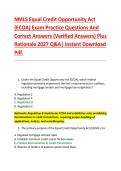
NMLS Equal Credit Opportunity Act
(ECOA) Exam Practice Questions And
Correct Answers (Verified Answers) Plus
Rationale 2027 Q&A| Instant Download
Pdf.
1. Under the Equal Credit Opportunity Act (ECOA), which federal
regulation primarily implements the law’s requirements for creditors,
including mortgage lenders and mortgage loan originators?
A. Regulation Z
B. Regulation X
C. Regulation B
D. Regulation C
Rationale: Regulation B implements ECOA and establishes rules prohibiting
discrimination in credit transactions, requiring proper handling of
applications, notices, and recordkeeping.
2. The primary purpose of the Equal Credit Opportunity Act (ECOA) is to:
A. Regulate mortgage interest rates
B. Establish minimum credit scores for borrowers
C. Prevent discrimination in credit transactions
D. Require all lenders to approve government loans
,Rationale: ECOA ensures that applicants are evaluated based on
creditworthiness rather than protected characteristics or prohibited
factors.
3. Which of the following is a protected basis under ECOA?
A. Employment history
B. Loan amount requested
C. Race
D. Property value
Rationale: ECOA prohibits discrimination based on race, color, religion,
national origin, sex, marital status, age, receipt of public assistance, and
exercise of consumer rights.
4. A mortgage lender denies an applicant because the applicant receives
disability income from a public assistance program. This action violates
ECOA because:
A. Income can never be considered
B. Disability automatically guarantees approval
C. Public assistance income cannot be discounted solely because of its
source
D. All applicants must receive identical loan terms
Rationale: ECOA prohibits creditors from discriminating against applicants
because they receive public assistance income.
5. Under ECOA, a creditor may consider an applicant’s age only when:
A. The applicant is over age 65
B. The creditor wants to reduce risk
C. Age has a valid relationship to creditworthiness or another permitted
purpose
D. The applicant is retired
, Rationale: ECOA generally prohibits age discrimination but allows limited
consideration of age when legally relevant, such as determining eligibility
for certain programs.
6. Which person is considered a creditor under ECOA?
A. Only the closing attorney
B. Only the real estate appraiser
C. A person or company that regularly participates in credit decisions
D. Only government housing agencies
Rationale: ECOA applies to creditors, including mortgage lenders and
others who regularly extend, arrange, or participate in credit decisions.
7. A loan officer tells a borrower that the lender does not make loans in a
certain neighborhood. This could violate ECOA because it may involve:
A. Property inspection rules
B. Loan servicing requirements
C. Discouraging applicants based on prohibited discrimination
D. Escrow violations
Rationale: Discouraging applicants from applying because of location-
related protected characteristics may constitute illegal discrimination.
8. Under ECOA, a creditor must provide a notice of adverse action within
generally:
A. 5 days
B. 15 days
C. 30 days
D. 90 days
Rationale: ECOA generally requires creditors to notify applicants of adverse
action within 30 days after receiving a completed application.
9. An adverse action notice must generally include:
(ECOA) Exam Practice Questions And
Correct Answers (Verified Answers) Plus
Rationale 2027 Q&A| Instant Download
Pdf.
1. Under the Equal Credit Opportunity Act (ECOA), which federal
regulation primarily implements the law’s requirements for creditors,
including mortgage lenders and mortgage loan originators?
A. Regulation Z
B. Regulation X
C. Regulation B
D. Regulation C
Rationale: Regulation B implements ECOA and establishes rules prohibiting
discrimination in credit transactions, requiring proper handling of
applications, notices, and recordkeeping.
2. The primary purpose of the Equal Credit Opportunity Act (ECOA) is to:
A. Regulate mortgage interest rates
B. Establish minimum credit scores for borrowers
C. Prevent discrimination in credit transactions
D. Require all lenders to approve government loans
,Rationale: ECOA ensures that applicants are evaluated based on
creditworthiness rather than protected characteristics or prohibited
factors.
3. Which of the following is a protected basis under ECOA?
A. Employment history
B. Loan amount requested
C. Race
D. Property value
Rationale: ECOA prohibits discrimination based on race, color, religion,
national origin, sex, marital status, age, receipt of public assistance, and
exercise of consumer rights.
4. A mortgage lender denies an applicant because the applicant receives
disability income from a public assistance program. This action violates
ECOA because:
A. Income can never be considered
B. Disability automatically guarantees approval
C. Public assistance income cannot be discounted solely because of its
source
D. All applicants must receive identical loan terms
Rationale: ECOA prohibits creditors from discriminating against applicants
because they receive public assistance income.
5. Under ECOA, a creditor may consider an applicant’s age only when:
A. The applicant is over age 65
B. The creditor wants to reduce risk
C. Age has a valid relationship to creditworthiness or another permitted
purpose
D. The applicant is retired
, Rationale: ECOA generally prohibits age discrimination but allows limited
consideration of age when legally relevant, such as determining eligibility
for certain programs.
6. Which person is considered a creditor under ECOA?
A. Only the closing attorney
B. Only the real estate appraiser
C. A person or company that regularly participates in credit decisions
D. Only government housing agencies
Rationale: ECOA applies to creditors, including mortgage lenders and
others who regularly extend, arrange, or participate in credit decisions.
7. A loan officer tells a borrower that the lender does not make loans in a
certain neighborhood. This could violate ECOA because it may involve:
A. Property inspection rules
B. Loan servicing requirements
C. Discouraging applicants based on prohibited discrimination
D. Escrow violations
Rationale: Discouraging applicants from applying because of location-
related protected characteristics may constitute illegal discrimination.
8. Under ECOA, a creditor must provide a notice of adverse action within
generally:
A. 5 days
B. 15 days
C. 30 days
D. 90 days
Rationale: ECOA generally requires creditors to notify applicants of adverse
action within 30 days after receiving a completed application.
9. An adverse action notice must generally include:


