

Renin Angiotensinogen Aldosterone System (RAAS) Questions with
Correct Answers (Grade A+)
Question 1: Fill in the Blank , an enzyme, catalyzes the conversion of angiotensinogen to an- giotensin
I.
Answer: Renin
Question 2: Compensatory mechanisms during acute hemorrhage include: A) decreased cerebral
and coronary blood flow B) decreased myocardial contractility C) renal and splanchnic vasodilation
D) increased respiratory rate E) decreased renal sodium resorption
Answer: D) increased respiratory rate Acute hemorrhage triggers the potent vasopres- sor activity of both
angiotensin and vasopressin to increase blood flow to the heart and brain via selective vasoconstriction of
the skin, kidneys, and splanchnic organs. Adrenergic discharge also re- sults in selective vasoconstriction of
skin, renal, and splanchnic vessels. Myocardial contractility and heart rate are in- creased, with the resultant
increased cardiac out- put. Hyperventilation is the typical response to the metabolic (lactic) acidosis
associated with hemor- rhagic shock and hypoperfusion. Aldosterone release, with subsequent increased re-
nal sodium resorption, is mediated by angiotensin 2 and ACTH, which prevents further intravascular
depletion. [Schwartz, 7/the, p 103]
Question 3: What am I? an enzyme with a molecular mass of about 40,000 Da that acts on its sub-
strate, angiotensinogen, an α2-globu- lin synthesized by the liver, to release angiotensin I, a
decapeptide, which in turn is converted to angiotensin II (AII), an octapeptide.
Answer: Renin
Page 1
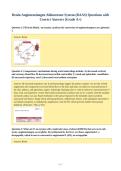
, Question 4: Renal microcirculation and the renin-angiotensin system. A. Diagram illustrating
relationships of the nephron with glomerular and per- itubular capillaries. B. Expanded view of the
glomerulus with its juxtaglomerular apparatus in- cluding the macula densa and adja- cent afferent
arteriole. C. Proteolytic processing steps in the generation of angiotensins.
Answer:
Question 5: Renal blood flow normally drains ~20% of the cardiac output, or 1000 mL/min.
Answer:
Question 6: How does the body regulate intravas- cular volume?
Answer: By retaining sodium via the renin-angiotensin-al- dosterone axis, but ADH can be a powerful
regula- tor of volume as well.
Page 2
Correct Answers (Grade A+)
Question 1: Fill in the Blank , an enzyme, catalyzes the conversion of angiotensinogen to an- giotensin
I.
Answer: Renin
Question 2: Compensatory mechanisms during acute hemorrhage include: A) decreased cerebral
and coronary blood flow B) decreased myocardial contractility C) renal and splanchnic vasodilation
D) increased respiratory rate E) decreased renal sodium resorption
Answer: D) increased respiratory rate Acute hemorrhage triggers the potent vasopres- sor activity of both
angiotensin and vasopressin to increase blood flow to the heart and brain via selective vasoconstriction of
the skin, kidneys, and splanchnic organs. Adrenergic discharge also re- sults in selective vasoconstriction of
skin, renal, and splanchnic vessels. Myocardial contractility and heart rate are in- creased, with the resultant
increased cardiac out- put. Hyperventilation is the typical response to the metabolic (lactic) acidosis
associated with hemor- rhagic shock and hypoperfusion. Aldosterone release, with subsequent increased re-
nal sodium resorption, is mediated by angiotensin 2 and ACTH, which prevents further intravascular
depletion. [Schwartz, 7/the, p 103]
Question 3: What am I? an enzyme with a molecular mass of about 40,000 Da that acts on its sub-
strate, angiotensinogen, an α2-globu- lin synthesized by the liver, to release angiotensin I, a
decapeptide, which in turn is converted to angiotensin II (AII), an octapeptide.
Answer: Renin
Page 1
, Question 4: Renal microcirculation and the renin-angiotensin system. A. Diagram illustrating
relationships of the nephron with glomerular and per- itubular capillaries. B. Expanded view of the
glomerulus with its juxtaglomerular apparatus in- cluding the macula densa and adja- cent afferent
arteriole. C. Proteolytic processing steps in the generation of angiotensins.
Answer:
Question 5: Renal blood flow normally drains ~20% of the cardiac output, or 1000 mL/min.
Answer:
Question 6: How does the body regulate intravas- cular volume?
Answer: By retaining sodium via the renin-angiotensin-al- dosterone axis, but ADH can be a powerful
regula- tor of volume as well.
Page 2


