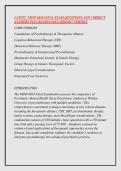
LATEST NRNP 6645 FINAL EXAM QUESTIONS AND CORRECT
ANSWERS PLUS RATIONALES 2026/2027 VERSION
CORE DOMAINS
Foundations of Psychotherapy & Therapeutic Alliance
Cognitive Behavioral Therapy (CBT)
Dialectical Behavior Therapy (DBT)
Psychodynamic & Interpersonal Psychotherapy
Humanistic-Existential, Gestalt, & Family Therapy
Group Therapy & Yalom's Therapeutic Factors
Ethical & Legal Considerations
Integrated Case Scenarios
INTRODUCTION
The NRNP 6645 Final Examination assesses the competency of
Psychiatric-Mental Health Nurse Practitioner students at Walden
University in psychotherapy with multiple modalities . This
comprehensive assessment evaluates knowledge across critical domains
including the therapeutic alliance, CBT, DBT, psychodynamic therapy,
family systems, group therapy, and ethical/legal considerations . The
examination consists of 100 multiple-choice questions with a 150-minute
time limit and a passing score of 75-80% . Emphasis is placed on
evidence-based applications of therapeutic approaches across the
lifespan. Successful completion validates the candidate's readiness to
integrate psychotherapy into advanced psychiatric practice.
,SECTION ONE: QUESTIONS 1–100
Question 1
A PMHNP candidate asks why the therapist does not voice personal
opinions about a patient's decision to divorce. Which component of the
therapeutic frame is this practice primarily preserving?
A. Anonymity, which requires the therapist to hide all credentials from
the patient
B. Neutrality, which keeps the therapist from imposing values and
allows the patient's own meaning to emerge
C. Non-intrusiveness, which forbids any direct question during sessions
D. Confidentiality, which prevents disclosure to third parties
B. Neutrality, which keeps the therapist from imposing values and
allows the patient's own meaning to emerge
RATIONALE: Neutrality means the therapist refrains from imposing
personal values or taking sides, allowing the patient's own meaning to
emerge; withholding opinions about the divorce preserves this
neutrality. Anonymity concerns limiting personal self-disclosure rather
than hiding credentials, non-intrusiveness does not forbid all direct
questions, and confidentiality governs outside disclosure rather than in-
session value imposition .
Question 2
A 34-year-old with major depressive disorder tells the PMHNP, "You
actually listen to me instead of just pushing pills." Which element of the
therapeutic alliance is the patient most directly describing?
,A. The agreed-upon goals of treatment
B. The affective bond of trust and feeling understood
C. The structured tasks and homework assigned each week
D. The pharmacologic management of symptoms
B. The affective bond of trust and feeling understood
RATIONALE: Bordin's therapeutic alliance consists of bond, goals,
and tasks; the patient's statement that the therapist actually listens
reflects the affective bond of trust and feeling understood. Goals and
tasks refer to what the pair agrees to accomplish and do, while
pharmacologic management is outside the alliance construct .
Question 3
During the final month of a 16-week course of psychotherapy, a patient
brings gifts, misses a session, and says, "I guess I never really needed
this anyway." The PMHNP recognizes these behaviors as most
characteristic of which phase?
A. The initial phase, when the frame is being established
B. The working phase, when core conflicts are interpreted
C. The termination phase, when loss and autonomy are negotiated
D. The pretreatment engagement phase
C. The termination phase, when loss and autonomy are negotiated
RATIONALE: Bringing gifts, missed sessions, and devaluing the
work are classic signs of the termination phase, in which the patient
negotiates loss, separation, and growing autonomy. These are not
initial-phase frame-setting or working-phase conflict interpretation, and
pretreatment engagement precedes the formal contract .
Question 4
, According to Benner's model of skill acquisition, a PMHNP who can no
longer articulate explicit rules but intuitively reads a suicidal patient's
subtle shifts in risk is functioning at which level?
A. Novice
B. Advanced beginner
C. Competent
D. Expert
D. Expert
RATIONALE: Benner's expert operates from a deep intuitive grasp
of the situation, having moved past reliance on explicit rules and
principles. The novice follows rigid rules, the advanced beginner uses
guidelines but lacks prioritization, and the competent clinician
consciously plans using rules but lacks the fluid intuition of the expert .
Question 5
A patient with panic disorder asks whether therapy can help "if the
problem is really just a chemical imbalance." A psychosocial framework
would respond that:
A. Meaning, relationships, and learned patterns of responding are central
to understanding and changing symptoms, alongside biology
B. Symptoms are purely biochemical and require medication alone
C. The therapist should defer entirely to the prescribing provider
D. Psychosocial factors are irrelevant once a biological diagnosis is
made
A. Meaning, relationships, and learned patterns of responding are
central to understanding and changing symptoms, alongside biology
RATIONALE: A psychosocial framework holds that meaning,
relationships, and learned patterns of responding are central to
ANSWERS PLUS RATIONALES 2026/2027 VERSION
CORE DOMAINS
Foundations of Psychotherapy & Therapeutic Alliance
Cognitive Behavioral Therapy (CBT)
Dialectical Behavior Therapy (DBT)
Psychodynamic & Interpersonal Psychotherapy
Humanistic-Existential, Gestalt, & Family Therapy
Group Therapy & Yalom's Therapeutic Factors
Ethical & Legal Considerations
Integrated Case Scenarios
INTRODUCTION
The NRNP 6645 Final Examination assesses the competency of
Psychiatric-Mental Health Nurse Practitioner students at Walden
University in psychotherapy with multiple modalities . This
comprehensive assessment evaluates knowledge across critical domains
including the therapeutic alliance, CBT, DBT, psychodynamic therapy,
family systems, group therapy, and ethical/legal considerations . The
examination consists of 100 multiple-choice questions with a 150-minute
time limit and a passing score of 75-80% . Emphasis is placed on
evidence-based applications of therapeutic approaches across the
lifespan. Successful completion validates the candidate's readiness to
integrate psychotherapy into advanced psychiatric practice.
,SECTION ONE: QUESTIONS 1–100
Question 1
A PMHNP candidate asks why the therapist does not voice personal
opinions about a patient's decision to divorce. Which component of the
therapeutic frame is this practice primarily preserving?
A. Anonymity, which requires the therapist to hide all credentials from
the patient
B. Neutrality, which keeps the therapist from imposing values and
allows the patient's own meaning to emerge
C. Non-intrusiveness, which forbids any direct question during sessions
D. Confidentiality, which prevents disclosure to third parties
B. Neutrality, which keeps the therapist from imposing values and
allows the patient's own meaning to emerge
RATIONALE: Neutrality means the therapist refrains from imposing
personal values or taking sides, allowing the patient's own meaning to
emerge; withholding opinions about the divorce preserves this
neutrality. Anonymity concerns limiting personal self-disclosure rather
than hiding credentials, non-intrusiveness does not forbid all direct
questions, and confidentiality governs outside disclosure rather than in-
session value imposition .
Question 2
A 34-year-old with major depressive disorder tells the PMHNP, "You
actually listen to me instead of just pushing pills." Which element of the
therapeutic alliance is the patient most directly describing?
,A. The agreed-upon goals of treatment
B. The affective bond of trust and feeling understood
C. The structured tasks and homework assigned each week
D. The pharmacologic management of symptoms
B. The affective bond of trust and feeling understood
RATIONALE: Bordin's therapeutic alliance consists of bond, goals,
and tasks; the patient's statement that the therapist actually listens
reflects the affective bond of trust and feeling understood. Goals and
tasks refer to what the pair agrees to accomplish and do, while
pharmacologic management is outside the alliance construct .
Question 3
During the final month of a 16-week course of psychotherapy, a patient
brings gifts, misses a session, and says, "I guess I never really needed
this anyway." The PMHNP recognizes these behaviors as most
characteristic of which phase?
A. The initial phase, when the frame is being established
B. The working phase, when core conflicts are interpreted
C. The termination phase, when loss and autonomy are negotiated
D. The pretreatment engagement phase
C. The termination phase, when loss and autonomy are negotiated
RATIONALE: Bringing gifts, missed sessions, and devaluing the
work are classic signs of the termination phase, in which the patient
negotiates loss, separation, and growing autonomy. These are not
initial-phase frame-setting or working-phase conflict interpretation, and
pretreatment engagement precedes the formal contract .
Question 4
, According to Benner's model of skill acquisition, a PMHNP who can no
longer articulate explicit rules but intuitively reads a suicidal patient's
subtle shifts in risk is functioning at which level?
A. Novice
B. Advanced beginner
C. Competent
D. Expert
D. Expert
RATIONALE: Benner's expert operates from a deep intuitive grasp
of the situation, having moved past reliance on explicit rules and
principles. The novice follows rigid rules, the advanced beginner uses
guidelines but lacks prioritization, and the competent clinician
consciously plans using rules but lacks the fluid intuition of the expert .
Question 5
A patient with panic disorder asks whether therapy can help "if the
problem is really just a chemical imbalance." A psychosocial framework
would respond that:
A. Meaning, relationships, and learned patterns of responding are central
to understanding and changing symptoms, alongside biology
B. Symptoms are purely biochemical and require medication alone
C. The therapist should defer entirely to the prescribing provider
D. Psychosocial factors are irrelevant once a biological diagnosis is
made
A. Meaning, relationships, and learned patterns of responding are
central to understanding and changing symptoms, alongside biology
RATIONALE: A psychosocial framework holds that meaning,
relationships, and learned patterns of responding are central to