
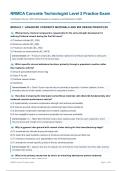
NRMCA Concrete Technologist Level 2 Practice Exam
Certification Review | 250 Verified Questions, Answers, and Rationales for 2026
MODULE 1: ADVANCED CONCRETE MATERIALS AND MIX DESIGN PRINCIPLES
Q1 What primary chemical compound is responsible for the early strength development in
ordinary Portland cement during the first 24 hours?
A) Tricalcium silicate ($C_3S$)
B) Dicalcium silicate ($C_2S$)
C) Tricalcium aluminate ($C_3A$)
D) Tetracalcium aluminoferrite ($C_4AF$)
Correct Answer: A — Tricalcium silicate ($C_3S$) hydrates rapidly and contributes significantly to setting and
early strength development within the first several days.
Q2 Which specific mineral admixture functions primarily through a pozzolanic reaction rather
than hydraulic activity?
A) Ground granulated blast-furnace slag
B) Class F fly ash
C) Portland cement clinker
D) Quicklime
Correct Answer: B — Class F fly ash requires calcium hydroxide (a byproduct of cement hydration) to form
secondary calcium silicate hydrate, characteristic of a pozzolanic reaction.
Q3 How does increasing the total water-cementitious materials ratio ($w/cm$) fundamentally alter
hardened concrete performance metrics?
A) It systematically increases compressive strength and reduces permeability
B) It reduces porosity while simultaneously enhancing freeze-thaw resistance
C) It decreases compressive strength and increases capillary porosity
D) It has negligible impact on mechanical properties but improves workability
Correct Answer: C — Higher $w/cm$ ratios create excess capillary water channels upon evaporation, which
reduces density and strength while increasing permeability.
Q4 Why is gypsum inter-ground with cement clinker during the final manufacturing stage?
A) To accelerate the ultimate drying shrinkage rate
B) To retard the rapid hydration reaction of tricalcium aluminate and prevent flash set
C) To introduce necessary color pigmentation into the finished powder
D) To elevate the overall specific gravity of the dry cement particles
Correct Answer: B — Gypsum acts as a set regulator by controlling the initial hydration rate of $C_3A$, avoiding
immediate flash setting.
Q5 What is the primary mechanism by which air-entraining admixtures protect hardened
concrete from freeze thaw damage?
NRMCA Level 2 Practice Exam Page 1 of 50
Certification Review | 250 Verified Questions, Answers, and Rationales for 2026
MODULE 1: ADVANCED CONCRETE MATERIALS AND MIX DESIGN PRINCIPLES
Q1 What primary chemical compound is responsible for the early strength development in
ordinary Portland cement during the first 24 hours?
A) Tricalcium silicate ($C_3S$)
B) Dicalcium silicate ($C_2S$)
C) Tricalcium aluminate ($C_3A$)
D) Tetracalcium aluminoferrite ($C_4AF$)
Correct Answer: A — Tricalcium silicate ($C_3S$) hydrates rapidly and contributes significantly to setting and
early strength development within the first several days.
Q2 Which specific mineral admixture functions primarily through a pozzolanic reaction rather
than hydraulic activity?
A) Ground granulated blast-furnace slag
B) Class F fly ash
C) Portland cement clinker
D) Quicklime
Correct Answer: B — Class F fly ash requires calcium hydroxide (a byproduct of cement hydration) to form
secondary calcium silicate hydrate, characteristic of a pozzolanic reaction.
Q3 How does increasing the total water-cementitious materials ratio ($w/cm$) fundamentally alter
hardened concrete performance metrics?
A) It systematically increases compressive strength and reduces permeability
B) It reduces porosity while simultaneously enhancing freeze-thaw resistance
C) It decreases compressive strength and increases capillary porosity
D) It has negligible impact on mechanical properties but improves workability
Correct Answer: C — Higher $w/cm$ ratios create excess capillary water channels upon evaporation, which
reduces density and strength while increasing permeability.
Q4 Why is gypsum inter-ground with cement clinker during the final manufacturing stage?
A) To accelerate the ultimate drying shrinkage rate
B) To retard the rapid hydration reaction of tricalcium aluminate and prevent flash set
C) To introduce necessary color pigmentation into the finished powder
D) To elevate the overall specific gravity of the dry cement particles
Correct Answer: B — Gypsum acts as a set regulator by controlling the initial hydration rate of $C_3A$, avoiding
immediate flash setting.
Q5 What is the primary mechanism by which air-entraining admixtures protect hardened
concrete from freeze thaw damage?
NRMCA Level 2 Practice Exam Page 1 of 50


