
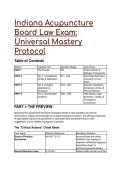
Indiana Acupuncture
Board Law Exam:
Universal Mastery
Protocol
Table of Contents
Section Cognitive Tier Question Range Core Focus
PART I The Preview N/A Critical Axioms &
Statutory Frameworks
PART II Tier 1: Foundational Q1 – Q18 Hard Deck Definitions,
Syntax & Application Licensing, & Core
Rules
PART II Tier 2: Complex Q19 – Q37 Scenario Adaptation,
Application & Disciplinary Action, &
Simulation Record Keeping
PART II Tier 3: Grandmaster Q38 – Q55 High-Stakes Legal
Synthesis Synthesis, Liability, &
Overlapping
Jurisdictions
PART I: THE PREVIEW
Mastering this assessment framework translates directly to elite academic and clinical
performance, forging raw knowledge into surgical regulatory precision. The absolute elimination
of legal liability requires the practitioner to internalize these parameters not as mere
suggestions, but as infallible boundaries of practice.
The "Critical Axioms" Cheat Sheet
Core Axiom Statutory Reference Mandatory Directive
Scope of Practice 844 IAC 13-1-2 Acupuncturists are strictly
Boundaries forbidden from making an
allopathic differential diagnosis,
prescribing drugs, or
performing physical therapy.
Record Retention Laws IC 16-39-1 Patient health records must be
,Core Axiom Statutory Reference Mandatory Directive
retained for exactly seven (7)
years from the last date of
service. Requests for records
must be fulfilled within thirty
(30) days.
Affiliated Professional 844 IAC 13-2-4 Chiropractors, dentists, and
Licensing podiatrists require two hundred
(200) hours of approved
acupuncture training to receive
an affiliated professional's
license.
Summary Suspensions IC 25-1-9-10 A board may suspend a
practitioner's license for up to
ninety (90) days before final
adjudication if the practitioner
represents a clear and
immediate danger to the public.
Acupuncture Detoxification 844 IAC 13-3-1 ADS practitioners treat strictly
(ADS) for substance abuse and
chemical dependency, requiring
NADA certification and
supervision by a licensed
acupuncturist.
PART II: THE ELITE TEST BANK
Q1: An applicant seeks an initial license to practice acupuncture in Indiana. Under IC
25-2.5-2-1, which credential is an ABSOLUTE prerequisite for board approval? A) An active
nursing license with advanced prescriptive authority B) Documentation of one thousand (1,000)
supervised clinical observation hours under a medical doctor C) Current active status as a
diplomate of the National Certification Commission for Acupuncture and Oriental Medicine
(NCCAOM) D) A passing score on the state-administered Indiana Acupuncture Jurisprudence
Examination
● Answer: C (Current active status as a diplomate of the National Certification Commission
for Acupuncture and Oriental Medicine (NCCAOM))
● Distractor Analysis:
○ A is incorrect: An RN or NP license does not confer acupuncture authority, nor does
it circumvent the requirement for a standalone acupuncture license issued under IC
25-2.5.
○ B is incorrect: The statutory requirement mandates graduation from an
ACAHM-accredited program and national certification, not a generalized allopathic
medical observation quota.
○ D is incorrect: Indiana relies strictly on the national NCCAOM examinations and
active diplomate status rather than demanding a separate state-administered
clinical exam.
The Mentor's Analysis: Baseline licensure in Indiana hinges entirely on national standardization.
By utilizing the NCCAOM diplomate status, the state ensures all practitioners meet a universal,
, rigorous metric of competency before entering the jurisdiction. This precludes the state from
needing to conduct independent clinical evaluations. Professional Intuition: National
certification is the non-negotiable gateway to state licensure.
Q2: A licensed physical therapist begins performing dry needling for neuromusculoskeletal pain.
Based on the Indiana Physical Therapy Practice Act and the definition of acupuncture, which
statement BEST describes the regulatory boundary? A) The physical therapist may practice
traditional acupuncture if they complete twelve (12) hours of continuing education. B) The
physical therapist is exempt from acupuncture licensing laws and may advertise as a licensed
acupuncturist. C) The physical therapist may use solid filiform needles for dry needling but is
strictly forbidden from engaging in the practice of acupuncture as defined in IC 25-2.5 unless
separately licensed. D) The physical therapist must operate under the direct, physical
supervision of a licensed acupuncturist to insert filiform needles.
● Answer: C (The physical therapist may use solid filiform needles for dry needling but is
strictly forbidden from engaging in the practice of acupuncture as defined in IC 25-2.5
unless separately licensed.)
● Distractor Analysis:
○ A is incorrect: Short continuing education courses authorize specific modalities like
dry needling under the PT board, but do not authorize the legal practice of systemic
acupuncture.
○ B is incorrect: Using the protected title "acupuncturist" without a license granted
under IC 25-2.5 is unlawful and constitutes consumer deception.
○ D is incorrect: Physical therapists perform dry needling independently under their
own board's continuing education rules, not as subordinates to a licensed
acupuncturist.
The Mentor's Analysis: Jurisdictional boundaries dictate that while physical therapists may
utilize needles for specific anatomical dysfunctions (dry needling), the holistic, systemic practice
of acupuncture remains exclusively protected under IC 25-2.5. Overlapping tools do not grant
overlapping scopes of practice. Professional Intuition: Tool overlap does not equal scope of
practice overlap.
Q3: A chiropractor licensed under IC 25-10 desires to incorporate acupuncture into their
practice. To obtain an affiliated professional's license under 844 IAC 13-2-4, what is the
MINIMUM number of acupuncture training hours the chiropractor must demonstrate? A) One
hundred (100) hours B) Two hundred (200) hours C) Five hundred (500) hours D) One
thousand, nine hundred (1,900) hours
● Answer: B (Two hundred (200) hours)
● Distractor Analysis:
○ A is incorrect: This volume of training falls below the statutory threshold established
for affiliated professionals in Indiana.
○ C is incorrect: This is a legacy standard used in other jurisdictions or advanced
certifications, but it exceeds Indiana's affiliated license baseline law.
○ D is incorrect: This volume mirrors full post-secondary acupuncture degree hours,
which affiliated professionals (chiropractors, dentists, podiatrists) bypass due to
their prior doctoral training.
The Mentor's Analysis: Affiliated professionals already possess an extensive anatomical and
clinical diagnostic foundation. Therefore, the state requires a truncated, highly specific minimum
of two hundred hours from an approved program to safely bridge their existing scope into basic
acupuncture modalities. Professional Intuition: Affiliated professionals require exactly 200
hours of specialized training to bridge their scope.
Board Law Exam:
Universal Mastery
Protocol
Table of Contents
Section Cognitive Tier Question Range Core Focus
PART I The Preview N/A Critical Axioms &
Statutory Frameworks
PART II Tier 1: Foundational Q1 – Q18 Hard Deck Definitions,
Syntax & Application Licensing, & Core
Rules
PART II Tier 2: Complex Q19 – Q37 Scenario Adaptation,
Application & Disciplinary Action, &
Simulation Record Keeping
PART II Tier 3: Grandmaster Q38 – Q55 High-Stakes Legal
Synthesis Synthesis, Liability, &
Overlapping
Jurisdictions
PART I: THE PREVIEW
Mastering this assessment framework translates directly to elite academic and clinical
performance, forging raw knowledge into surgical regulatory precision. The absolute elimination
of legal liability requires the practitioner to internalize these parameters not as mere
suggestions, but as infallible boundaries of practice.
The "Critical Axioms" Cheat Sheet
Core Axiom Statutory Reference Mandatory Directive
Scope of Practice 844 IAC 13-1-2 Acupuncturists are strictly
Boundaries forbidden from making an
allopathic differential diagnosis,
prescribing drugs, or
performing physical therapy.
Record Retention Laws IC 16-39-1 Patient health records must be
,Core Axiom Statutory Reference Mandatory Directive
retained for exactly seven (7)
years from the last date of
service. Requests for records
must be fulfilled within thirty
(30) days.
Affiliated Professional 844 IAC 13-2-4 Chiropractors, dentists, and
Licensing podiatrists require two hundred
(200) hours of approved
acupuncture training to receive
an affiliated professional's
license.
Summary Suspensions IC 25-1-9-10 A board may suspend a
practitioner's license for up to
ninety (90) days before final
adjudication if the practitioner
represents a clear and
immediate danger to the public.
Acupuncture Detoxification 844 IAC 13-3-1 ADS practitioners treat strictly
(ADS) for substance abuse and
chemical dependency, requiring
NADA certification and
supervision by a licensed
acupuncturist.
PART II: THE ELITE TEST BANK
Q1: An applicant seeks an initial license to practice acupuncture in Indiana. Under IC
25-2.5-2-1, which credential is an ABSOLUTE prerequisite for board approval? A) An active
nursing license with advanced prescriptive authority B) Documentation of one thousand (1,000)
supervised clinical observation hours under a medical doctor C) Current active status as a
diplomate of the National Certification Commission for Acupuncture and Oriental Medicine
(NCCAOM) D) A passing score on the state-administered Indiana Acupuncture Jurisprudence
Examination
● Answer: C (Current active status as a diplomate of the National Certification Commission
for Acupuncture and Oriental Medicine (NCCAOM))
● Distractor Analysis:
○ A is incorrect: An RN or NP license does not confer acupuncture authority, nor does
it circumvent the requirement for a standalone acupuncture license issued under IC
25-2.5.
○ B is incorrect: The statutory requirement mandates graduation from an
ACAHM-accredited program and national certification, not a generalized allopathic
medical observation quota.
○ D is incorrect: Indiana relies strictly on the national NCCAOM examinations and
active diplomate status rather than demanding a separate state-administered
clinical exam.
The Mentor's Analysis: Baseline licensure in Indiana hinges entirely on national standardization.
By utilizing the NCCAOM diplomate status, the state ensures all practitioners meet a universal,
, rigorous metric of competency before entering the jurisdiction. This precludes the state from
needing to conduct independent clinical evaluations. Professional Intuition: National
certification is the non-negotiable gateway to state licensure.
Q2: A licensed physical therapist begins performing dry needling for neuromusculoskeletal pain.
Based on the Indiana Physical Therapy Practice Act and the definition of acupuncture, which
statement BEST describes the regulatory boundary? A) The physical therapist may practice
traditional acupuncture if they complete twelve (12) hours of continuing education. B) The
physical therapist is exempt from acupuncture licensing laws and may advertise as a licensed
acupuncturist. C) The physical therapist may use solid filiform needles for dry needling but is
strictly forbidden from engaging in the practice of acupuncture as defined in IC 25-2.5 unless
separately licensed. D) The physical therapist must operate under the direct, physical
supervision of a licensed acupuncturist to insert filiform needles.
● Answer: C (The physical therapist may use solid filiform needles for dry needling but is
strictly forbidden from engaging in the practice of acupuncture as defined in IC 25-2.5
unless separately licensed.)
● Distractor Analysis:
○ A is incorrect: Short continuing education courses authorize specific modalities like
dry needling under the PT board, but do not authorize the legal practice of systemic
acupuncture.
○ B is incorrect: Using the protected title "acupuncturist" without a license granted
under IC 25-2.5 is unlawful and constitutes consumer deception.
○ D is incorrect: Physical therapists perform dry needling independently under their
own board's continuing education rules, not as subordinates to a licensed
acupuncturist.
The Mentor's Analysis: Jurisdictional boundaries dictate that while physical therapists may
utilize needles for specific anatomical dysfunctions (dry needling), the holistic, systemic practice
of acupuncture remains exclusively protected under IC 25-2.5. Overlapping tools do not grant
overlapping scopes of practice. Professional Intuition: Tool overlap does not equal scope of
practice overlap.
Q3: A chiropractor licensed under IC 25-10 desires to incorporate acupuncture into their
practice. To obtain an affiliated professional's license under 844 IAC 13-2-4, what is the
MINIMUM number of acupuncture training hours the chiropractor must demonstrate? A) One
hundred (100) hours B) Two hundred (200) hours C) Five hundred (500) hours D) One
thousand, nine hundred (1,900) hours
● Answer: B (Two hundred (200) hours)
● Distractor Analysis:
○ A is incorrect: This volume of training falls below the statutory threshold established
for affiliated professionals in Indiana.
○ C is incorrect: This is a legacy standard used in other jurisdictions or advanced
certifications, but it exceeds Indiana's affiliated license baseline law.
○ D is incorrect: This volume mirrors full post-secondary acupuncture degree hours,
which affiliated professionals (chiropractors, dentists, podiatrists) bypass due to
their prior doctoral training.
The Mentor's Analysis: Affiliated professionals already possess an extensive anatomical and
clinical diagnostic foundation. Therefore, the state requires a truncated, highly specific minimum
of two hundred hours from an approved program to safely bridge their existing scope into basic
acupuncture modalities. Professional Intuition: Affiliated professionals require exactly 200
hours of specialized training to bridge their scope.


