
NSG 526 Clinical Modalities in Advanced Psychiatric Practice | Exam 1 Wilkes University 2026/2027 - Study Guide + Review
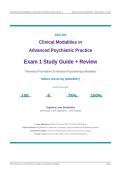
NSG 526
Clinical Modalities in
Advanced Psychiatric Practice
Exam 1 Study Guide + Review
Theoretical Foundations & Individual Psychotherapy Modalities
Wilkes University (2026/2027)
100
Total Questions 9
Sections 75%
Scenario-Based 100%
Verified Answers
Cognitive Level Distribution
30% Recall | 50% Application | 20% Analysis
Course Alignment: Wilkes University NSG 526 Clinical Modalities
Content Domain: Psychoanalytic, humanistic, existential, cognitive-behavioral, individual modalities
Rationale Standard: Verified with study guide notes and exam review strategy
Format: Multiple choice (A-D), ONE correct, with detailed rationales
NSG 526 Exam 1 | Theoretical Foundations & Individual Modalities Page 1
,NSG 526 Clinical Modalities in Advanced Psychiatric Practice | Exam 1 Wilkes University 2026/2027 - Study Guide + Review
About This Study Guide
This comprehensive study guide is designed for Wilkes University NSG 526 Clinical Modalities in Advanced
Psychiatric Practice Exam 1, aligned with the 2026/2027 academic cycle. It contains 100 multiple-choice
questions distributed across nine integrated sections covering theoretical foundations and individual
psychotherapy modalities. Topics span historical foundations of psychotherapy; psychodynamic and
psychoanalytic modalities (Freud, Jung, Adler, neo-Freudians); humanistic and existential modalities (Rogers,
Maslow, Frankl, Perls); cognitive and behavioral foundations (Pavlov, Skinner, Bandura, Beck, Ellis); individual
psychotherapy modalities (supportive, IPT, brief psychodynamic); therapeutic relationship and communication;
assessment and formulation; ethics and professional boundaries; and cultural competence and integrated care.
Each question includes four options (A-D) with exactly one correct answer. The correct option is marked with the
[CORRECT] tag, followed by a "Correct Answer" line and a 2-4 sentence rationale. Rationales explain why the
correct option is right AND why distractors are wrong, including theoretical foundations, clinical application,
evidence-based support, high-yield review points, and exam strategy notes. All answers are verified for accuracy
against standard psychiatric nursing and psychotherapy references. Use this guide for self-assessment, targeted
review, and to achieve success on Exam 1.
How to Use This Guide
Work through each question independently, then review the rationale to identify knowledge gaps and reinforce
understanding. The 75% scenario-based format reflects the application emphasis of graduate psychiatric nursing
exams. High-yield topics include: theorist-to-concept matching (Sections 1-4), modality selection for specific
clinical presentations (Section 5), therapeutic communication technique identification (Section 6), case
formulation using the 5 Ps (Section 7), Tarasoff and ethical decision-making (Section 8), and Cultural
Formulation Interview (Section 9). Embedded rationales include study guide notes and exam review strategy to
optimize preparation efficiency.
Exam Structure
# Topic Questions Items
1 Historical Foundations and Theoretical Frameworks of Psychotherapy Q1-Q12 12
2 Psychodynamic and Psychoanalytic Modalities Q13-Q25 13
3 Humanistic and Existential Modalities Q26-Q38 13
4 Cognitive and Behavioral Theoretical Foundations Q39-Q50 12
5 Individual Psychotherapy Modalities Q51-Q63 13
6 Therapeutic Relationship, Process, and Communication Q64-Q75 12
7 Assessment, Formulation, and Treatment Planning Q76-Q86 11
8 Ethics, Legal Issues, and Professional Boundaries Q87-Q95 9
NSG 526 Exam 1 | Theoretical Foundations & Individual Modalities Page 2
,NSG 526 Clinical Modalities in Advanced Psychiatric Practice | Exam 1 Wilkes University 2026/2027 - Study Guide + Review
9 Cultural Competence, Diversity, and Integration Q96-Q100 5
To
All Sections Q1-Q100 100
tal
NSG 526 Exam 1 | Theoretical Foundations & Individual Modalities Page 3
, NSG 526 Clinical Modalities in Advanced Psychiatric Practice | Exam 1 Wilkes University 2026/2027 - Study Guide + Review
Section 1: Historical Foundations and Theoretical Frameworks of
Psychotherapy
Psychoanalytic Origins, Ego Psychology, & Object Relations (Q1-Q12) | 12 Questions
Competency: Trace the historical development of psychotherapy from Mesmer through Freud; apply structural theory
(id/ego/superego), psychosexual stages, defense mechanisms, ego psychology, and object relations theory to clinical
understanding.
Q1: The use of 'animal magnetism' to treat patients with hysteria in the 18th century is credited to which
historical figure, whose work is considered a precursor to modern psychotherapy?
A. Sigmund Freud
B. Franz Anton Mesmer [CORRECT]
C. Jean-Martin Charcot
D. Josef Breuer
Correct Answer: B
Rationale:
Franz Anton Mesmer (1734-1815) developed 'animal magnetism' (mesmerism), a precursor to hypnosis and
psychotherapy. He believed a magnetic fluid connected all living things and could be manipulated to cure illness.
Although discredited scientifically, his demonstration of trance states influenced later investigators. Choice C (Charcot)
used hypnosis with hysteria patients at Salpêtrière, influencing Freud. Choice D (Breuer) used the cathartic method with
Anna O. Freud synthesized these influences into psychoanalysis.
Q2: Jean-Martin Charcot's work at the Salpêtrière hospital in Paris in the 1880s was MOST significant to
the development of psychotherapy because:
A. He developed psychoanalysis
B. He demonstrated that hysteria symptoms could be produced and removed under hypnosis, suggesting a
psychological (not neurological) etiology [CORRECT]
C. He discovered the unconscious
D. He treated Anna O
Correct Answer: B
Rationale:
Jean-Martin Charcot (1825-1893), a French neurologist, demonstrated that hysteria symptoms (paralysis, sensory loss,
seizures) could be produced and relieved under hypnosis, suggesting a psychological rather than neurological origin. His
lectures in Paris attracted Freud, who studied with him in 1885-86. This work influenced Freud's later development of
psychoanalysis. Choice A is wrong (Freud developed psychoanalysis). Choice C is wrong (Freud popularized the
unconscious). Choice D is wrong (Breuer treated Anna O, not Charcot).
NSG 526 Exam 1 | Theoretical Foundations & Individual Modalities Page 4
NSG 526
Clinical Modalities in
Advanced Psychiatric Practice
Exam 1 Study Guide + Review
Theoretical Foundations & Individual Psychotherapy Modalities
Wilkes University (2026/2027)
100
Total Questions 9
Sections 75%
Scenario-Based 100%
Verified Answers
Cognitive Level Distribution
30% Recall | 50% Application | 20% Analysis
Course Alignment: Wilkes University NSG 526 Clinical Modalities
Content Domain: Psychoanalytic, humanistic, existential, cognitive-behavioral, individual modalities
Rationale Standard: Verified with study guide notes and exam review strategy
Format: Multiple choice (A-D), ONE correct, with detailed rationales
NSG 526 Exam 1 | Theoretical Foundations & Individual Modalities Page 1
,NSG 526 Clinical Modalities in Advanced Psychiatric Practice | Exam 1 Wilkes University 2026/2027 - Study Guide + Review
About This Study Guide
This comprehensive study guide is designed for Wilkes University NSG 526 Clinical Modalities in Advanced
Psychiatric Practice Exam 1, aligned with the 2026/2027 academic cycle. It contains 100 multiple-choice
questions distributed across nine integrated sections covering theoretical foundations and individual
psychotherapy modalities. Topics span historical foundations of psychotherapy; psychodynamic and
psychoanalytic modalities (Freud, Jung, Adler, neo-Freudians); humanistic and existential modalities (Rogers,
Maslow, Frankl, Perls); cognitive and behavioral foundations (Pavlov, Skinner, Bandura, Beck, Ellis); individual
psychotherapy modalities (supportive, IPT, brief psychodynamic); therapeutic relationship and communication;
assessment and formulation; ethics and professional boundaries; and cultural competence and integrated care.
Each question includes four options (A-D) with exactly one correct answer. The correct option is marked with the
[CORRECT] tag, followed by a "Correct Answer" line and a 2-4 sentence rationale. Rationales explain why the
correct option is right AND why distractors are wrong, including theoretical foundations, clinical application,
evidence-based support, high-yield review points, and exam strategy notes. All answers are verified for accuracy
against standard psychiatric nursing and psychotherapy references. Use this guide for self-assessment, targeted
review, and to achieve success on Exam 1.
How to Use This Guide
Work through each question independently, then review the rationale to identify knowledge gaps and reinforce
understanding. The 75% scenario-based format reflects the application emphasis of graduate psychiatric nursing
exams. High-yield topics include: theorist-to-concept matching (Sections 1-4), modality selection for specific
clinical presentations (Section 5), therapeutic communication technique identification (Section 6), case
formulation using the 5 Ps (Section 7), Tarasoff and ethical decision-making (Section 8), and Cultural
Formulation Interview (Section 9). Embedded rationales include study guide notes and exam review strategy to
optimize preparation efficiency.
Exam Structure
# Topic Questions Items
1 Historical Foundations and Theoretical Frameworks of Psychotherapy Q1-Q12 12
2 Psychodynamic and Psychoanalytic Modalities Q13-Q25 13
3 Humanistic and Existential Modalities Q26-Q38 13
4 Cognitive and Behavioral Theoretical Foundations Q39-Q50 12
5 Individual Psychotherapy Modalities Q51-Q63 13
6 Therapeutic Relationship, Process, and Communication Q64-Q75 12
7 Assessment, Formulation, and Treatment Planning Q76-Q86 11
8 Ethics, Legal Issues, and Professional Boundaries Q87-Q95 9
NSG 526 Exam 1 | Theoretical Foundations & Individual Modalities Page 2
,NSG 526 Clinical Modalities in Advanced Psychiatric Practice | Exam 1 Wilkes University 2026/2027 - Study Guide + Review
9 Cultural Competence, Diversity, and Integration Q96-Q100 5
To
All Sections Q1-Q100 100
tal
NSG 526 Exam 1 | Theoretical Foundations & Individual Modalities Page 3
, NSG 526 Clinical Modalities in Advanced Psychiatric Practice | Exam 1 Wilkes University 2026/2027 - Study Guide + Review
Section 1: Historical Foundations and Theoretical Frameworks of
Psychotherapy
Psychoanalytic Origins, Ego Psychology, & Object Relations (Q1-Q12) | 12 Questions
Competency: Trace the historical development of psychotherapy from Mesmer through Freud; apply structural theory
(id/ego/superego), psychosexual stages, defense mechanisms, ego psychology, and object relations theory to clinical
understanding.
Q1: The use of 'animal magnetism' to treat patients with hysteria in the 18th century is credited to which
historical figure, whose work is considered a precursor to modern psychotherapy?
A. Sigmund Freud
B. Franz Anton Mesmer [CORRECT]
C. Jean-Martin Charcot
D. Josef Breuer
Correct Answer: B
Rationale:
Franz Anton Mesmer (1734-1815) developed 'animal magnetism' (mesmerism), a precursor to hypnosis and
psychotherapy. He believed a magnetic fluid connected all living things and could be manipulated to cure illness.
Although discredited scientifically, his demonstration of trance states influenced later investigators. Choice C (Charcot)
used hypnosis with hysteria patients at Salpêtrière, influencing Freud. Choice D (Breuer) used the cathartic method with
Anna O. Freud synthesized these influences into psychoanalysis.
Q2: Jean-Martin Charcot's work at the Salpêtrière hospital in Paris in the 1880s was MOST significant to
the development of psychotherapy because:
A. He developed psychoanalysis
B. He demonstrated that hysteria symptoms could be produced and removed under hypnosis, suggesting a
psychological (not neurological) etiology [CORRECT]
C. He discovered the unconscious
D. He treated Anna O
Correct Answer: B
Rationale:
Jean-Martin Charcot (1825-1893), a French neurologist, demonstrated that hysteria symptoms (paralysis, sensory loss,
seizures) could be produced and relieved under hypnosis, suggesting a psychological rather than neurological origin. His
lectures in Paris attracted Freud, who studied with him in 1885-86. This work influenced Freud's later development of
psychoanalysis. Choice A is wrong (Freud developed psychoanalysis). Choice C is wrong (Freud popularized the
unconscious). Choice D is wrong (Breuer treated Anna O, not Charcot).
NSG 526 Exam 1 | Theoretical Foundations & Individual Modalities Page 4


