
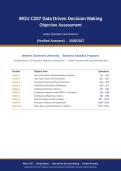
WGU C207 Data Driven Decision Making
Objective Assessment
Latest Questions and Answers
(Verified Answers) - 2026/2027
Western Governors University - Business Analytics Programs
Comprehensive 125-Question Objective Assessment - Verified Answers with Detailed Rationales
Section Subject Area Questions
Section 1 Intro to Data-Driven Decision Making & Analytics Q1 - Q10
Section 2 Data Types, Sources, and Data Quality Q11 - Q22
Section 3 Descriptive Statistics and Data Visualization Q23 - Q38
Section 4 Probability and Probability Distributions Q39 - Q52
Section 5 Sampling and Statistical Inference Q53 - Q68
Section 6 Comparative Statistics (t-tests, ANOVA, Chi-Square) Q69 - Q80
Section 7 Correlation and Regression Analysis Q81 - Q96
Section 8 Predictive Analytics and Forecasting Q97 - Q108
Section 9 Prescriptive Analytics and Optimization Q109 - Q118
Section 10 Ethics, Bias, and Communication of Analytics Q119 - Q125
WGU C207 - 125 Questions - Data Driven Decision Making - Verified Answers
Aligned with WGU C207 Objective Assessment Blueprint and 2026/2027 Business Analytics Standards
,WGU C207 Data Driven Decision Making | Objective Assessment | Latest Qs & Ans (Verified Answers) 2026/2027 Edition 2026/2027
WGU C207 Data Driven Decision Making
Objective Assessment - Latest Questions and Answers
(Verified Answers) - 2026/2027
This objective assessment presents 125 practice questions aligned with the WGU C207 Data Driven Decision Making
objective assessment blueprint. The exam covers ten content domains spanning business analytics and statistical inference: (1)
Introduction to Data-Driven Decision Making and Analytics; (2) Data Types, Sources, and Data Quality; (3) Descriptive
Statistics and Data Visualization; (4) Probability and Probability Distributions; (5) Sampling and Statistical Inference; (6)
Comparative Statistics; (7) Correlation and Regression Analysis; (8) Predictive Analytics and Forecasting; (9) Prescriptive
Analytics and Optimization; and (10) Ethics, Bias, and Communication of Analytics. Each question is multiple choice with
one verified correct answer; rationales include formula application, calculation steps, statistical principles, and business
decision-making implications consistent with the verified-answers format of the official WGU C207 objective assessment.
Approximately 70% of questions are application/calculation-based (statistical tests, calculations, data interpretation, model
selection); 30% test conceptual/scenario understanding. The 2026/2027 update reflects the current WGU C207 objective
assessment structure and analytics best practices.
Section 1
Section 1: Introduction to Data-Driven Decision Making and Analytics
(Analytics Types, Data-Driven Culture, & Business Applications)
Questions: Q1 - Q10 | Focus: Descriptive/Diagnostic/Predictive/Prescriptive analytics, analytics continuum, big data (3 Vs),
data-driven culture, organizational readiness
Q1: A retail manager uses last quarter's sales report to identify the best-selling product categories. This is
an example of:
A. Prescriptive analytics
B. Predictive analytics
C. Descriptive analytics (summarizes historical data to answer 'what happened') [CORRECT]
D. Diagnostic analytics
Correct Answer: C
Rationale: Descriptive analytics summarizes historical data to answer 'what happened?' - here, last quarter's sales report.
Diagnostic analytics (D) answers 'why did it happen?'. Predictive (B) forecasts future events. Prescriptive (A) recommends
actions.
Q2: An analyst at an airline builds a model to forecast demand for routes over the next 6 months. This
represents:
A. Descriptive analytics
B. Diagnostic analytics
C. Predictive analytics (forecasts future outcomes using historical data and statistical models) [CORRECT]
D. Prescriptive analytics
Correct Answer: C
Western Governors University - Business Analytics Programs Page 2
, Rationale: Predictive analytics uses historical data and statistical/ML models to forecast future outcomes (demand, churn,
risk). Descriptive (A) summarizes past data. Diagnostic (B) explains causes. Prescriptive (D) recommends optimal actions.
Q3: A logistics company uses optimization software to recommend the most cost-effective delivery routes.
This is:
A. Prescriptive analytics (recommends actions to optimize an objective under constraints) [CORRECT]
B. Predictive analytics
C. Descriptive analytics
D. Diagnostic analytics
Correct Answer: A
Rationale: Prescriptive analytics recommends the best course of action to optimize an objective (e.g., minimize cost) subject
to constraints - here, optimal delivery routes. Predictive (B) forecasts. Descriptive (C) summarizes. Diagnostic (D) explains
causes.
Q4: Which of the following best describes 'diagnostic analytics'?
A. Forecasting next quarter's revenue
B. Investigating why customer churn increased 15% last quarter using drill-down analysis and root
cause analysis [CORRECT]
C. Summarizing last year's profits by region
D. Recommending the optimal pricing strategy
Correct Answer: B
Rationale: Diagnostic analytics answers 'why did it happen?' through drill-down, data discovery, correlations, and root-cause
analysis. Choice A is predictive. Choice C is descriptive. Choice D is prescriptive.
Q5: The four types of analytics, ordered from lowest to highest complexity (and value), are:
A. Prescriptive -> Predictive -> Diagnostic -> Descriptive
B. Descriptive -> Diagnostic -> Predictive -> Prescriptive [CORRECT]
C. Predictive -> Descriptive -> Prescriptive -> Diagnostic
D. Diagnostic -> Prescriptive -> Descriptive -> Predictive
Correct Answer: B
Rationale: The analytics continuum: Descriptive (what happened) -> Diagnostic (why) -> Predictive (what will happen) ->
Prescriptive (what should we do). Complexity and value increase as you move right.
Q6: Building a data-driven decision-making culture in an organization requires all of the following
EXCEPT:
A. Executive sponsorship and clear analytics vision
B. Data literacy across decision makers
C. Relying solely on intuition and seniority for major decisions [CORRECT]
D. Quality data, integrated systems, and analytical tools
Correct Answer: C
Rationale: A data-driven culture requires leadership, data literacy, quality data, integrated systems, and the willingness to act
on evidence rather than intuition. Relying on intuition alone (Choice C) is the opposite of a data-driven culture.
Q7: Which business scenario best fits predictive analytics?
A. Reporting Q3 revenue by product line
, B. Identifying factors associated with last year's customer defections
C. Estimating the probability that an existing customer will churn in the next 90 days [CORRECT]
D. Recommending the optimal marketing mix across channels
Correct Answer: C
Rationale: Predicting churn probability (Choice C) is a classic predictive analytics task - using historical data and a model to
forecast a future outcome. Choice A is descriptive. Choice B is diagnostic. Choice D is prescriptive.
Q8: Big Data is often characterized by the '3 Vs'. Which set correctly identifies them?
A. Volume, Velocity, Variety [CORRECT]
B. Volume, Value, Verification
C. Velocity, Visibility, Verifiability
D. Volume, Variety, Validity
Correct Answer: A
Rationale: The original 3 Vs of Big Data are Volume (size), Velocity (speed of data generation), and Variety (heterogeneous
formats). Some extensions add Veracity and Value for a 5V model.
Q9: Which best reflects a business application of prescriptive analytics?
A. A dashboard showing yesterday's website traffic by source
B. An algorithm setting dynamic prices to maximize revenue given demand, inventory, and competitor
prices [CORRECT]
C. A report explaining why weekend sales declined last month
D. A forecast of next week's call-center volume
Correct Answer: B
Rationale: Dynamic pricing optimization (Choice B) is a classic prescriptive application - using a model to recommend
optimal decisions (prices) that maximize an objective (revenue) given constraints. Choice A is descriptive. Choice C is
diagnostic. Choice D is predictive.
Q10: Organizational readiness for analytics typically depends most on:
A. Having only the most advanced software tools
B. A combination of executive sponsorship, data quality, analytical talent, decision-making processes,
and change-management capacity [CORRECT]
C. Hiring the largest team of data scientists
D. Waiting for competitors to adopt analytics first
Correct Answer: B
Rationale: Analytics readiness is multi-dimensional: leadership and vision, data infrastructure and quality, analytical skills,
decision-making processes that incorporate analytics, and organizational change capacity. Tools (A) and team size (C) alone
are insufficient without the other dimensions. Choice D is the opposite of readiness.
Section 2
Section 2: Data Types, Sources, and Data Quality
(Structured/Unstructured Data, Data Collection, & Data Governance)
Objective Assessment
Latest Questions and Answers
(Verified Answers) - 2026/2027
Western Governors University - Business Analytics Programs
Comprehensive 125-Question Objective Assessment - Verified Answers with Detailed Rationales
Section Subject Area Questions
Section 1 Intro to Data-Driven Decision Making & Analytics Q1 - Q10
Section 2 Data Types, Sources, and Data Quality Q11 - Q22
Section 3 Descriptive Statistics and Data Visualization Q23 - Q38
Section 4 Probability and Probability Distributions Q39 - Q52
Section 5 Sampling and Statistical Inference Q53 - Q68
Section 6 Comparative Statistics (t-tests, ANOVA, Chi-Square) Q69 - Q80
Section 7 Correlation and Regression Analysis Q81 - Q96
Section 8 Predictive Analytics and Forecasting Q97 - Q108
Section 9 Prescriptive Analytics and Optimization Q109 - Q118
Section 10 Ethics, Bias, and Communication of Analytics Q119 - Q125
WGU C207 - 125 Questions - Data Driven Decision Making - Verified Answers
Aligned with WGU C207 Objective Assessment Blueprint and 2026/2027 Business Analytics Standards
,WGU C207 Data Driven Decision Making | Objective Assessment | Latest Qs & Ans (Verified Answers) 2026/2027 Edition 2026/2027
WGU C207 Data Driven Decision Making
Objective Assessment - Latest Questions and Answers
(Verified Answers) - 2026/2027
This objective assessment presents 125 practice questions aligned with the WGU C207 Data Driven Decision Making
objective assessment blueprint. The exam covers ten content domains spanning business analytics and statistical inference: (1)
Introduction to Data-Driven Decision Making and Analytics; (2) Data Types, Sources, and Data Quality; (3) Descriptive
Statistics and Data Visualization; (4) Probability and Probability Distributions; (5) Sampling and Statistical Inference; (6)
Comparative Statistics; (7) Correlation and Regression Analysis; (8) Predictive Analytics and Forecasting; (9) Prescriptive
Analytics and Optimization; and (10) Ethics, Bias, and Communication of Analytics. Each question is multiple choice with
one verified correct answer; rationales include formula application, calculation steps, statistical principles, and business
decision-making implications consistent with the verified-answers format of the official WGU C207 objective assessment.
Approximately 70% of questions are application/calculation-based (statistical tests, calculations, data interpretation, model
selection); 30% test conceptual/scenario understanding. The 2026/2027 update reflects the current WGU C207 objective
assessment structure and analytics best practices.
Section 1
Section 1: Introduction to Data-Driven Decision Making and Analytics
(Analytics Types, Data-Driven Culture, & Business Applications)
Questions: Q1 - Q10 | Focus: Descriptive/Diagnostic/Predictive/Prescriptive analytics, analytics continuum, big data (3 Vs),
data-driven culture, organizational readiness
Q1: A retail manager uses last quarter's sales report to identify the best-selling product categories. This is
an example of:
A. Prescriptive analytics
B. Predictive analytics
C. Descriptive analytics (summarizes historical data to answer 'what happened') [CORRECT]
D. Diagnostic analytics
Correct Answer: C
Rationale: Descriptive analytics summarizes historical data to answer 'what happened?' - here, last quarter's sales report.
Diagnostic analytics (D) answers 'why did it happen?'. Predictive (B) forecasts future events. Prescriptive (A) recommends
actions.
Q2: An analyst at an airline builds a model to forecast demand for routes over the next 6 months. This
represents:
A. Descriptive analytics
B. Diagnostic analytics
C. Predictive analytics (forecasts future outcomes using historical data and statistical models) [CORRECT]
D. Prescriptive analytics
Correct Answer: C
Western Governors University - Business Analytics Programs Page 2
, Rationale: Predictive analytics uses historical data and statistical/ML models to forecast future outcomes (demand, churn,
risk). Descriptive (A) summarizes past data. Diagnostic (B) explains causes. Prescriptive (D) recommends optimal actions.
Q3: A logistics company uses optimization software to recommend the most cost-effective delivery routes.
This is:
A. Prescriptive analytics (recommends actions to optimize an objective under constraints) [CORRECT]
B. Predictive analytics
C. Descriptive analytics
D. Diagnostic analytics
Correct Answer: A
Rationale: Prescriptive analytics recommends the best course of action to optimize an objective (e.g., minimize cost) subject
to constraints - here, optimal delivery routes. Predictive (B) forecasts. Descriptive (C) summarizes. Diagnostic (D) explains
causes.
Q4: Which of the following best describes 'diagnostic analytics'?
A. Forecasting next quarter's revenue
B. Investigating why customer churn increased 15% last quarter using drill-down analysis and root
cause analysis [CORRECT]
C. Summarizing last year's profits by region
D. Recommending the optimal pricing strategy
Correct Answer: B
Rationale: Diagnostic analytics answers 'why did it happen?' through drill-down, data discovery, correlations, and root-cause
analysis. Choice A is predictive. Choice C is descriptive. Choice D is prescriptive.
Q5: The four types of analytics, ordered from lowest to highest complexity (and value), are:
A. Prescriptive -> Predictive -> Diagnostic -> Descriptive
B. Descriptive -> Diagnostic -> Predictive -> Prescriptive [CORRECT]
C. Predictive -> Descriptive -> Prescriptive -> Diagnostic
D. Diagnostic -> Prescriptive -> Descriptive -> Predictive
Correct Answer: B
Rationale: The analytics continuum: Descriptive (what happened) -> Diagnostic (why) -> Predictive (what will happen) ->
Prescriptive (what should we do). Complexity and value increase as you move right.
Q6: Building a data-driven decision-making culture in an organization requires all of the following
EXCEPT:
A. Executive sponsorship and clear analytics vision
B. Data literacy across decision makers
C. Relying solely on intuition and seniority for major decisions [CORRECT]
D. Quality data, integrated systems, and analytical tools
Correct Answer: C
Rationale: A data-driven culture requires leadership, data literacy, quality data, integrated systems, and the willingness to act
on evidence rather than intuition. Relying on intuition alone (Choice C) is the opposite of a data-driven culture.
Q7: Which business scenario best fits predictive analytics?
A. Reporting Q3 revenue by product line
, B. Identifying factors associated with last year's customer defections
C. Estimating the probability that an existing customer will churn in the next 90 days [CORRECT]
D. Recommending the optimal marketing mix across channels
Correct Answer: C
Rationale: Predicting churn probability (Choice C) is a classic predictive analytics task - using historical data and a model to
forecast a future outcome. Choice A is descriptive. Choice B is diagnostic. Choice D is prescriptive.
Q8: Big Data is often characterized by the '3 Vs'. Which set correctly identifies them?
A. Volume, Velocity, Variety [CORRECT]
B. Volume, Value, Verification
C. Velocity, Visibility, Verifiability
D. Volume, Variety, Validity
Correct Answer: A
Rationale: The original 3 Vs of Big Data are Volume (size), Velocity (speed of data generation), and Variety (heterogeneous
formats). Some extensions add Veracity and Value for a 5V model.
Q9: Which best reflects a business application of prescriptive analytics?
A. A dashboard showing yesterday's website traffic by source
B. An algorithm setting dynamic prices to maximize revenue given demand, inventory, and competitor
prices [CORRECT]
C. A report explaining why weekend sales declined last month
D. A forecast of next week's call-center volume
Correct Answer: B
Rationale: Dynamic pricing optimization (Choice B) is a classic prescriptive application - using a model to recommend
optimal decisions (prices) that maximize an objective (revenue) given constraints. Choice A is descriptive. Choice C is
diagnostic. Choice D is predictive.
Q10: Organizational readiness for analytics typically depends most on:
A. Having only the most advanced software tools
B. A combination of executive sponsorship, data quality, analytical talent, decision-making processes,
and change-management capacity [CORRECT]
C. Hiring the largest team of data scientists
D. Waiting for competitors to adopt analytics first
Correct Answer: B
Rationale: Analytics readiness is multi-dimensional: leadership and vision, data infrastructure and quality, analytical skills,
decision-making processes that incorporate analytics, and organizational change capacity. Tools (A) and team size (C) alone
are insufficient without the other dimensions. Choice D is the opposite of readiness.
Section 2
Section 2: Data Types, Sources, and Data Quality
(Structured/Unstructured Data, Data Collection, & Data Governance)


