
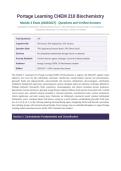
Portage Learning CHEM 210 Biochemistry
Module 3 Exam (2026/2027) - Questions and Verified Answers
Carbohydrate Fundamentals | Monosaccharide Structure | Glycosidic Bonds | Polysaccharides | Glycoconjugates |
Carbohydrate Metabolism | Lab Techniques | Clinical Correlations
Total Questions 100
Cognitive Mix 30% Recall | 50% Application | 20% Analysis
Question Style 70% Application/Scenario-Based | 30% Direct Recall
Sections 8 (Carbohydrate fundamentals through clinical correlations)
Scoring Standard Verified Answers against Lehninger, Garrett & Grisham standards
Audience Portage Learning CHEM 210 Biochemistry students
Edition 2026/2027 - 100% Guarantee Pass format
This Module 3 examination for Portage Learning CHEM 210 Biochemistry is aligned with 2026/2027 updated course
objectives and covers the full carbohydrate curriculum: classification, monosaccharide structure and stereochemistry,
glycosidic bonds and oligosaccharides, polysaccharides and structural carbohydrates, glycoconjugates, carbohydrate
metabolism fundamentals (glycolysis, gluconeogenesis, pentose phosphate pathway), laboratory techniques (Benedict's,
Fehling's, Barfoed's, Seliwanoff's, Bial's, polarimetry, chromatography), and clinical correlations (lactose intolerance,
galactosemia, fructose intolerance, glycogen storage diseases, diabetes mellitus). Each question is presented with a verified
correct answer and a detailed rationale grounded in structural principles, stereochemical rules, reaction mechanisms,
clinical significance, and study strategy notes. Distractors are deliberately constructed around common carbohydrate
biochemistry errors: confusing aldoses and ketoses, mixing up α and β anomers, misidentifying glycosidic bond types
(α-1,4, α-1,6, β-1,4, α-1,2-β), confusing reducing and nonreducing sugars, misapplying Fischer and Haworth conventions,
and confusing storage with structural polysaccharides. Exam strategy notes are embedded throughout to support Portage
Learning module assessment success and the 100% Guarantee Pass standard.
Section 1: Carbohydrate Fundamentals and Classification
,Q1: Which statement most accurately defines a carbohydrate?
A. An organic molecule composed solely of amino acids.
B. A polyhydroxy aldehyde or polyhydroxy ketone (or compound that yields these on hydrolysis), with the
general formula (CH2O)n. [CORRECT]
C. A lipid molecule with a long hydrocarbon chain.
D. A nitrogenous base attached to a sugar and phosphate.
Correct Answer: B. A polyhydroxy aldehyde or polyhydroxy ketone (or compound that yields these
on hydrolys...
Rationale: Carbohydrates are polyhydroxy aldehydes or ketones yielding these on hydrolysis, with empirical formula
(CH2O)n. Option A describes proteins. Options C and D describe lipids and nucleotides. A+ verification: classic
biochemistry definition (Lehninger, Chapter 7). Study tip: 'hydrate of carbon' = general formula (CH2O)n.
Q2: A monosaccharide with three carbon atoms is classified as a:
A. Tetrose.
B. Triose. [CORRECT]
C. Pentose.
D. Hexose.
Correct Answer: B. Triose.
Rationale: Triose has 3 carbons, tetrose 4, pentose 5, hexose 6, heptose 7. Option A is 4 carbons. Options C and D are
5 and 6 carbons. A+ verification: glyceraldehyde (an aldotriose) and dihydroxyacetone (a ketotriose) are the simplest
sugars. Study tip: Greek prefixes indicate carbon count.
Q3: The presence of an aldehyde functional group on a sugar classifies it as:
A. A ketose.
B. An aldose. [CORRECT]
C. A glycoside.
D. An amino sugar.
Correct Answer: B. An aldose.
Rationale: Aldoses contain an aldehyde group (-CHO) at C1 (in linear form); ketoses contain a ketone group (-C=O),
typically at C2. Glycoside (C) is a sugar with anomeric carbon bonded to another group. Amino sugar (D) has an
amino group replacing a hydroxyl. A+ verification: glucose is an aldohexose; fructose is a ketohexose.
Q4: Which sugar is a ketohexose?
A. Glucose.
B. Galactose.
C. Fructose. [CORRECT]
D. Mannose.
Correct Answer: C. Fructose.
Rationale: Fructose is a ketohexose (ketone at C2). Glucose, galactose, and mannose are all aldohexoses. A+
verification: fructose is the sweetest naturally occurring sugar and is found in honey and fruit. Study tip: 'fructose =
fruit sugar = ketohexose.'
, Q5: Glucose, galactose, and mannose all share which classification?
A. Aldopentoses.
B. Aldohexoses. [CORRECT]
C. Ketopentoses.
D. Ketohexoses.
Correct Answer: B. Aldohexoses.
Rationale: Glucose, galactose, and mannose are all aldohexoses (6-carbon sugars with aldehyde group). They differ
only in the configuration at one chiral center (C2 for glucose vs mannose; C4 for glucose vs galactose), making them
epimers. A+ verification: only 4 aldohexoses (D-glucose, D-galactose, D-mannose, D-allose - one of 16 aldohexoses)
are common in nature.
Q6: Which sugar is an aldopentose commonly found in RNA?
A. Deoxyribose.
B. Ribose. [CORRECT]
C. Glucose.
D. Fructose.
Correct Answer: B. Ribose.
Rationale: Ribose is an aldopentose found in RNA nucleotides. Deoxyribose (A) lacks a 2'-OH and is in DNA.
Glucose (C) is an aldohexose. Fructose (D) is a ketohexose. A+ verification: ribose is the most common sugar
component of nucleotide coenzymes (ATP, NADH, FADH2, coenzyme A).
Q7: Which compound is the smallest ketose?
A. Glyceraldehyde.
B. Dihydroxyacetone (DHA). [CORRECT]
C. Erythrulose.
D. Ribulose.
Correct Answer: B. Dihydroxyacetone (DHA).
Rationale: Dihydroxyacetone (DHA) is the smallest ketose (3 carbons, ketone at C2). Glyceraldehyde (A) is the
smallest aldose. Erythrulose (C) is a 4-carbon ketose. A+ verification: DHA is achiral (no stereocenter) despite being a
sugar; it is used in sunless tanning products.
Q8: An L-sugar has the configuration at the highest-numbered chiral carbon (penultimate carbon):
A. -OH on the right in Fischer projection.
B. -OH on the left in Fischer projection. [CORRECT]
C. -OH at the top.
D. No -OH present.
Correct Answer: B. -OH on the left in Fischer projection.
Rationale: In Fischer projection, the penultimate (second from last) chiral carbon determines D/L: -OH on right = D;
-OH on left = L. A+ verification: most naturally occurring sugars are D-form (e.g., D-glucose, D-ribose). L-amino
acids and D-sugars are the biological norm.
Module 3 Exam (2026/2027) - Questions and Verified Answers
Carbohydrate Fundamentals | Monosaccharide Structure | Glycosidic Bonds | Polysaccharides | Glycoconjugates |
Carbohydrate Metabolism | Lab Techniques | Clinical Correlations
Total Questions 100
Cognitive Mix 30% Recall | 50% Application | 20% Analysis
Question Style 70% Application/Scenario-Based | 30% Direct Recall
Sections 8 (Carbohydrate fundamentals through clinical correlations)
Scoring Standard Verified Answers against Lehninger, Garrett & Grisham standards
Audience Portage Learning CHEM 210 Biochemistry students
Edition 2026/2027 - 100% Guarantee Pass format
This Module 3 examination for Portage Learning CHEM 210 Biochemistry is aligned with 2026/2027 updated course
objectives and covers the full carbohydrate curriculum: classification, monosaccharide structure and stereochemistry,
glycosidic bonds and oligosaccharides, polysaccharides and structural carbohydrates, glycoconjugates, carbohydrate
metabolism fundamentals (glycolysis, gluconeogenesis, pentose phosphate pathway), laboratory techniques (Benedict's,
Fehling's, Barfoed's, Seliwanoff's, Bial's, polarimetry, chromatography), and clinical correlations (lactose intolerance,
galactosemia, fructose intolerance, glycogen storage diseases, diabetes mellitus). Each question is presented with a verified
correct answer and a detailed rationale grounded in structural principles, stereochemical rules, reaction mechanisms,
clinical significance, and study strategy notes. Distractors are deliberately constructed around common carbohydrate
biochemistry errors: confusing aldoses and ketoses, mixing up α and β anomers, misidentifying glycosidic bond types
(α-1,4, α-1,6, β-1,4, α-1,2-β), confusing reducing and nonreducing sugars, misapplying Fischer and Haworth conventions,
and confusing storage with structural polysaccharides. Exam strategy notes are embedded throughout to support Portage
Learning module assessment success and the 100% Guarantee Pass standard.
Section 1: Carbohydrate Fundamentals and Classification
,Q1: Which statement most accurately defines a carbohydrate?
A. An organic molecule composed solely of amino acids.
B. A polyhydroxy aldehyde or polyhydroxy ketone (or compound that yields these on hydrolysis), with the
general formula (CH2O)n. [CORRECT]
C. A lipid molecule with a long hydrocarbon chain.
D. A nitrogenous base attached to a sugar and phosphate.
Correct Answer: B. A polyhydroxy aldehyde or polyhydroxy ketone (or compound that yields these
on hydrolys...
Rationale: Carbohydrates are polyhydroxy aldehydes or ketones yielding these on hydrolysis, with empirical formula
(CH2O)n. Option A describes proteins. Options C and D describe lipids and nucleotides. A+ verification: classic
biochemistry definition (Lehninger, Chapter 7). Study tip: 'hydrate of carbon' = general formula (CH2O)n.
Q2: A monosaccharide with three carbon atoms is classified as a:
A. Tetrose.
B. Triose. [CORRECT]
C. Pentose.
D. Hexose.
Correct Answer: B. Triose.
Rationale: Triose has 3 carbons, tetrose 4, pentose 5, hexose 6, heptose 7. Option A is 4 carbons. Options C and D are
5 and 6 carbons. A+ verification: glyceraldehyde (an aldotriose) and dihydroxyacetone (a ketotriose) are the simplest
sugars. Study tip: Greek prefixes indicate carbon count.
Q3: The presence of an aldehyde functional group on a sugar classifies it as:
A. A ketose.
B. An aldose. [CORRECT]
C. A glycoside.
D. An amino sugar.
Correct Answer: B. An aldose.
Rationale: Aldoses contain an aldehyde group (-CHO) at C1 (in linear form); ketoses contain a ketone group (-C=O),
typically at C2. Glycoside (C) is a sugar with anomeric carbon bonded to another group. Amino sugar (D) has an
amino group replacing a hydroxyl. A+ verification: glucose is an aldohexose; fructose is a ketohexose.
Q4: Which sugar is a ketohexose?
A. Glucose.
B. Galactose.
C. Fructose. [CORRECT]
D. Mannose.
Correct Answer: C. Fructose.
Rationale: Fructose is a ketohexose (ketone at C2). Glucose, galactose, and mannose are all aldohexoses. A+
verification: fructose is the sweetest naturally occurring sugar and is found in honey and fruit. Study tip: 'fructose =
fruit sugar = ketohexose.'
, Q5: Glucose, galactose, and mannose all share which classification?
A. Aldopentoses.
B. Aldohexoses. [CORRECT]
C. Ketopentoses.
D. Ketohexoses.
Correct Answer: B. Aldohexoses.
Rationale: Glucose, galactose, and mannose are all aldohexoses (6-carbon sugars with aldehyde group). They differ
only in the configuration at one chiral center (C2 for glucose vs mannose; C4 for glucose vs galactose), making them
epimers. A+ verification: only 4 aldohexoses (D-glucose, D-galactose, D-mannose, D-allose - one of 16 aldohexoses)
are common in nature.
Q6: Which sugar is an aldopentose commonly found in RNA?
A. Deoxyribose.
B. Ribose. [CORRECT]
C. Glucose.
D. Fructose.
Correct Answer: B. Ribose.
Rationale: Ribose is an aldopentose found in RNA nucleotides. Deoxyribose (A) lacks a 2'-OH and is in DNA.
Glucose (C) is an aldohexose. Fructose (D) is a ketohexose. A+ verification: ribose is the most common sugar
component of nucleotide coenzymes (ATP, NADH, FADH2, coenzyme A).
Q7: Which compound is the smallest ketose?
A. Glyceraldehyde.
B. Dihydroxyacetone (DHA). [CORRECT]
C. Erythrulose.
D. Ribulose.
Correct Answer: B. Dihydroxyacetone (DHA).
Rationale: Dihydroxyacetone (DHA) is the smallest ketose (3 carbons, ketone at C2). Glyceraldehyde (A) is the
smallest aldose. Erythrulose (C) is a 4-carbon ketose. A+ verification: DHA is achiral (no stereocenter) despite being a
sugar; it is used in sunless tanning products.
Q8: An L-sugar has the configuration at the highest-numbered chiral carbon (penultimate carbon):
A. -OH on the right in Fischer projection.
B. -OH on the left in Fischer projection. [CORRECT]
C. -OH at the top.
D. No -OH present.
Correct Answer: B. -OH on the left in Fischer projection.
Rationale: In Fischer projection, the penultimate (second from last) chiral carbon determines D/L: -OH on right = D;
-OH on left = L. A+ verification: most naturally occurring sugars are D-form (e.g., D-glucose, D-ribose). L-amino
acids and D-sugars are the biological norm.


