
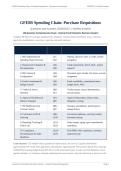
GFEBS Spending Chain: Purchase Requisitions - Questions and Answers 2026/2027 | Verified Answers
GFEBS Spending Chain: Purchase Requisitions
Questions and Answers (2026/2027) | Verified Answers
135-Question Comprehensive Exam - General Fund Enterprise Business System
Complete PR lifecycle coverage: fundamentals, validation, creation, funds commitment, source selection,
approvals, modifications, conversion, reporting, and audit readiness
Section Q Topic Focus
Range
1. PR Fundamentals & Q1 - Purpose, lifecycle, roles, T-codes, system
Spending Chain Overview Q15 navigation
2. Requirement Validation & Q16 - Valid requirements, IGCE, J&A;, market
Documentation Q28 research
3. PR Creation & Q29 - Document types, header, line items, account
Configuration Q44 assignment
4. Funds Commitment & Q45 - Funds availability, commitment items,
Budget Control Q59 budget check, ADA
5. Vendor & Source Q60 - Vendor master, source determination,
Selection Q71 socioeconomic
6. Approval Workflows & Q72 - Approval hierarchies, release codes,
Release Strategies Q85 delegation, routing
7. PR Modifications & Q86 - Changes, amendments, quantity/price,
Version Control Q97 change history
8. Conversion to PO & Q98 - Conversion pathways, sourcing cockpit,
Sourcing Q110 document tracing
9. Reporting, Tracking & Q111 - Status reports, aging, open commitments,
Follow-Up Q123 expediting
10. Compliance, Q124 - DoD FMR, FAR compliance, retention,
Documentation & Audit Q135 inspection prep
Readiness
Exam structure: 135 multiple-choice questions (4 options each, one correct). Cognitive distribution
approximately 35% recall, 45% application, 20% analysis. Approximately 70% scenario-based items requiring
GFEBS PR processing judgment and 30% direct recall of document types, T-codes, and role definitions. Each
question includes a 2-4 sentence rationale explaining the correct answer, why each distractor is incorrect, with
General Fund Enterprise Business System - Federal Financial Management Page 1
,GFEBS Spending Chain: Purchase Requisitions - Questions and Answers 2026/2027 | Verified Answers
specific T-codes, document types, DoD FMR citations, FAR references, and GFEBS business process
requirements. Aligned with current GFEBS release updates and 2026/2027 federal financial management policy.
Section 1: Purchase Requisition Fundamentals and Spending Chain Overview
(PR Purpose, Lifecycle Position, Roles, & System Navigation)
Q1: Within the GFEBS spending chain, what is the primary purpose of a Purchase Requisition (PR)?
A. To serve as the internal requesting document that authorizes the purchasing organization to
procure goods or services and triggers funds commitment before conversion to a Purchase Order
[CORRECT]
B. To serve as the final payment authorization to the vendor
C. To record the receipt of goods into the warehouse
D. To serve as the invoice verification document
Correct Answer: A
Rationale: A Purchase Requisition is the internal requesting document that authorizes procurement and triggers funds
commitment before conversion to a Purchase Order. Payment authorization (B) is the vendor invoice/payment role.
Goods receipt (C) is the MIGO/GR role. Invoice verification (D) is the MIRO role. The PR sits at the front of the
spending chain per GFEBS business process.
Q2: Which GFEBS transaction code is most commonly used to create a Purchase Requisition?
A. ME51N (Create Purchase Requisition) [CORRECT]
B. ME52N (Change Purchase Requisition)
C. ME53N (Display Purchase Requisition)
D. ME21N (Create Purchase Order)
Correct Answer: A
Rationale: ME51N creates a PR. ME52N (B) changes an existing PR. ME53N (C) displays an existing PR. ME21N
(D) creates a Purchase Order, not a PR. GFEBS uses SAP-standard T-codes for PR lifecycle management per the
spending chain business process.
General Fund Enterprise Business System - Federal Financial Management Page 2
,GFEBS Spending Chain: Purchase Requisitions - Questions and Answers 2026/2027 | Verified Answers
Q3: Which role within the GFEBS spending chain is responsible for initiating a Purchase Requisition
based on an identified need?
A. Requisitioner - the individual who identifies the requirement and initiates the PR
[CORRECT]
B. Approving Official - who authorizes the PR
C. Budget Analyst - who verifies funds availability
D. Resource Manager - who controls the fund center
Correct Answer: A
Rationale: The Requisitioner initiates the PR based on an identified need. The Approving Official (B) authorizes via
release strategy. The Budget Analyst (C) verifies funds. The Resource Manager (D) controls the fund center. Each role
has distinct spending chain responsibilities per DoD FMR.
Q4: Where does the Purchase Requisition sit within the GFEBS spending chain lifecycle?
A. At the beginning of the spending chain, before commitment, sourcing, PO creation, goods
receipt, and invoice payment [CORRECT]
B. At the end, after invoice payment
C. In the middle, after PO creation but before goods receipt
D. Outside the spending chain entirely
Correct Answer: A
Rationale: The PR is at the beginning of the spending chain: PR -> Commitment -> Sourcing -> PO -> Goods Receipt
-> Invoice -> Payment. End (B), middle (C), and outside (D) misplace the PR. The PR initiates the documented need
and triggers downstream spending events.
Q5: Which statement best describes the relationship between a PR and funds commitment in GFEBS?
A. A PR triggers a funds commitment that encumbers budget against the appropriate fund
center and commitment item, reducing available budget [CORRECT]
B. A PR has no impact on funds commitment
C. A PR triggers a funds payment directly to the vendor
D. A PR triggers an invoice verification
Correct Answer: A
Rationale: A PR triggers a funds commitment (encumbrance) reducing available budget. No impact (B), direct
payment (C), and invoice verification (D) are wrong. The commitment reserves funds before the PO is created,
supporting Antideficiency Act compliance per DoD FMR.
General Fund Enterprise Business System - Federal Financial Management Page 3
, GFEBS Spending Chain: Purchase Requisitions - Questions and Answers 2026/2027 | Verified Answers
Q6: Which GFEBS T-code is used to display an existing Purchase Requisition?
A. ME53N (Display Purchase Requisition) [CORRECT]
B. ME51N (Create Purchase Requisition)
C. ME22N (Change Purchase Order)
D. MIGO (Goods Receipt)
Correct Answer: A
Rationale: ME53N displays an existing PR. ME51N (B) creates a PR. ME22N (C) changes a PO, not a PR. MIGO (D)
posts goods receipt. Display T-codes end in '3N' while create ends in '1N' and change ends in '2N' per GFEBS T-code
conventions.
Q7: Who is responsible for verifying funds availability before a Purchase Requisition is approved?
A. Budget Analyst or Resource Manager responsible for the fund center against which the PR is
charged [CORRECT]
B. The vendor
C. The Requisitioner alone
D. The Defense Finance and Accounting Service (DFAS) without local input
Correct Answer: A
Rationale: The Budget Analyst or Resource Manager verifies funds availability for the fund center. The vendor (B)
has no role. The Requisitioner (C) initiates but doesn't verify funds. DFAS (D) processes payments but doesn't verify
local fund availability. Funds verification is a local responsibility per DoD FMR.
Q8: Which GFEBS T-code is used to change an existing Purchase Requisition?
A. ME52N (Change Purchase Requisition) [CORRECT]
B. ME51N (Create Purchase Requisition)
C. ME53N (Display Purchase Requisition)
D. ME21N (Create Purchase Order)
Correct Answer: A
Rationale: ME52N changes an existing PR. ME51N (B) creates. ME53N (C) displays. ME21N (D) creates a PO.
GFEBS T-code conventions: '1N' create, '2N' change, '3N' display, supporting the PR lifecycle.
General Fund Enterprise Business System - Federal Financial Management Page 4
GFEBS Spending Chain: Purchase Requisitions
Questions and Answers (2026/2027) | Verified Answers
135-Question Comprehensive Exam - General Fund Enterprise Business System
Complete PR lifecycle coverage: fundamentals, validation, creation, funds commitment, source selection,
approvals, modifications, conversion, reporting, and audit readiness
Section Q Topic Focus
Range
1. PR Fundamentals & Q1 - Purpose, lifecycle, roles, T-codes, system
Spending Chain Overview Q15 navigation
2. Requirement Validation & Q16 - Valid requirements, IGCE, J&A;, market
Documentation Q28 research
3. PR Creation & Q29 - Document types, header, line items, account
Configuration Q44 assignment
4. Funds Commitment & Q45 - Funds availability, commitment items,
Budget Control Q59 budget check, ADA
5. Vendor & Source Q60 - Vendor master, source determination,
Selection Q71 socioeconomic
6. Approval Workflows & Q72 - Approval hierarchies, release codes,
Release Strategies Q85 delegation, routing
7. PR Modifications & Q86 - Changes, amendments, quantity/price,
Version Control Q97 change history
8. Conversion to PO & Q98 - Conversion pathways, sourcing cockpit,
Sourcing Q110 document tracing
9. Reporting, Tracking & Q111 - Status reports, aging, open commitments,
Follow-Up Q123 expediting
10. Compliance, Q124 - DoD FMR, FAR compliance, retention,
Documentation & Audit Q135 inspection prep
Readiness
Exam structure: 135 multiple-choice questions (4 options each, one correct). Cognitive distribution
approximately 35% recall, 45% application, 20% analysis. Approximately 70% scenario-based items requiring
GFEBS PR processing judgment and 30% direct recall of document types, T-codes, and role definitions. Each
question includes a 2-4 sentence rationale explaining the correct answer, why each distractor is incorrect, with
General Fund Enterprise Business System - Federal Financial Management Page 1
,GFEBS Spending Chain: Purchase Requisitions - Questions and Answers 2026/2027 | Verified Answers
specific T-codes, document types, DoD FMR citations, FAR references, and GFEBS business process
requirements. Aligned with current GFEBS release updates and 2026/2027 federal financial management policy.
Section 1: Purchase Requisition Fundamentals and Spending Chain Overview
(PR Purpose, Lifecycle Position, Roles, & System Navigation)
Q1: Within the GFEBS spending chain, what is the primary purpose of a Purchase Requisition (PR)?
A. To serve as the internal requesting document that authorizes the purchasing organization to
procure goods or services and triggers funds commitment before conversion to a Purchase Order
[CORRECT]
B. To serve as the final payment authorization to the vendor
C. To record the receipt of goods into the warehouse
D. To serve as the invoice verification document
Correct Answer: A
Rationale: A Purchase Requisition is the internal requesting document that authorizes procurement and triggers funds
commitment before conversion to a Purchase Order. Payment authorization (B) is the vendor invoice/payment role.
Goods receipt (C) is the MIGO/GR role. Invoice verification (D) is the MIRO role. The PR sits at the front of the
spending chain per GFEBS business process.
Q2: Which GFEBS transaction code is most commonly used to create a Purchase Requisition?
A. ME51N (Create Purchase Requisition) [CORRECT]
B. ME52N (Change Purchase Requisition)
C. ME53N (Display Purchase Requisition)
D. ME21N (Create Purchase Order)
Correct Answer: A
Rationale: ME51N creates a PR. ME52N (B) changes an existing PR. ME53N (C) displays an existing PR. ME21N
(D) creates a Purchase Order, not a PR. GFEBS uses SAP-standard T-codes for PR lifecycle management per the
spending chain business process.
General Fund Enterprise Business System - Federal Financial Management Page 2
,GFEBS Spending Chain: Purchase Requisitions - Questions and Answers 2026/2027 | Verified Answers
Q3: Which role within the GFEBS spending chain is responsible for initiating a Purchase Requisition
based on an identified need?
A. Requisitioner - the individual who identifies the requirement and initiates the PR
[CORRECT]
B. Approving Official - who authorizes the PR
C. Budget Analyst - who verifies funds availability
D. Resource Manager - who controls the fund center
Correct Answer: A
Rationale: The Requisitioner initiates the PR based on an identified need. The Approving Official (B) authorizes via
release strategy. The Budget Analyst (C) verifies funds. The Resource Manager (D) controls the fund center. Each role
has distinct spending chain responsibilities per DoD FMR.
Q4: Where does the Purchase Requisition sit within the GFEBS spending chain lifecycle?
A. At the beginning of the spending chain, before commitment, sourcing, PO creation, goods
receipt, and invoice payment [CORRECT]
B. At the end, after invoice payment
C. In the middle, after PO creation but before goods receipt
D. Outside the spending chain entirely
Correct Answer: A
Rationale: The PR is at the beginning of the spending chain: PR -> Commitment -> Sourcing -> PO -> Goods Receipt
-> Invoice -> Payment. End (B), middle (C), and outside (D) misplace the PR. The PR initiates the documented need
and triggers downstream spending events.
Q5: Which statement best describes the relationship between a PR and funds commitment in GFEBS?
A. A PR triggers a funds commitment that encumbers budget against the appropriate fund
center and commitment item, reducing available budget [CORRECT]
B. A PR has no impact on funds commitment
C. A PR triggers a funds payment directly to the vendor
D. A PR triggers an invoice verification
Correct Answer: A
Rationale: A PR triggers a funds commitment (encumbrance) reducing available budget. No impact (B), direct
payment (C), and invoice verification (D) are wrong. The commitment reserves funds before the PO is created,
supporting Antideficiency Act compliance per DoD FMR.
General Fund Enterprise Business System - Federal Financial Management Page 3
, GFEBS Spending Chain: Purchase Requisitions - Questions and Answers 2026/2027 | Verified Answers
Q6: Which GFEBS T-code is used to display an existing Purchase Requisition?
A. ME53N (Display Purchase Requisition) [CORRECT]
B. ME51N (Create Purchase Requisition)
C. ME22N (Change Purchase Order)
D. MIGO (Goods Receipt)
Correct Answer: A
Rationale: ME53N displays an existing PR. ME51N (B) creates a PR. ME22N (C) changes a PO, not a PR. MIGO (D)
posts goods receipt. Display T-codes end in '3N' while create ends in '1N' and change ends in '2N' per GFEBS T-code
conventions.
Q7: Who is responsible for verifying funds availability before a Purchase Requisition is approved?
A. Budget Analyst or Resource Manager responsible for the fund center against which the PR is
charged [CORRECT]
B. The vendor
C. The Requisitioner alone
D. The Defense Finance and Accounting Service (DFAS) without local input
Correct Answer: A
Rationale: The Budget Analyst or Resource Manager verifies funds availability for the fund center. The vendor (B)
has no role. The Requisitioner (C) initiates but doesn't verify funds. DFAS (D) processes payments but doesn't verify
local fund availability. Funds verification is a local responsibility per DoD FMR.
Q8: Which GFEBS T-code is used to change an existing Purchase Requisition?
A. ME52N (Change Purchase Requisition) [CORRECT]
B. ME51N (Create Purchase Requisition)
C. ME53N (Display Purchase Requisition)
D. ME21N (Create Purchase Order)
Correct Answer: A
Rationale: ME52N changes an existing PR. ME51N (B) creates. ME53N (C) displays. ME21N (D) creates a PO.
GFEBS T-code conventions: '1N' create, '2N' change, '3N' display, supporting the PR lifecycle.
General Fund Enterprise Business System - Federal Financial Management Page 4


