
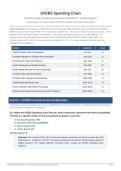
GFEBS Spending Chain
Purchase Order Questions and Answers (2026/2027) | Verified Answers
140 Questions | 10 Sections | End-to-End PO Lifecycle | DoD FMR & FAR Aligned
About this exam: This 140-question GFEBS Spending Chain Purchase Order certification prep exam reflects the 2026/2027
GFEBS release and current DoD FMR / FAR requirements. Cognitive mix: ~35% recall (T-codes, document types, roles), ~45%
application (PO processing, workflow, reconciliation), ~20% analysis (troubleshooting, variance, audit readiness). 70%
scenario-based, 30% direct recall. Each rationale cites T-codes (ME21N, ME22N, ME23N, ME54N, MIGO, MIRO, etc.),
document types (NB, FO, UB, K), account assignment categories (K, F, P, A, Q), release strategies, tolerance keys, and
Antideficiency Act compliance.
Section Questions Count
GFEBS Purchase Order Fundamentals Q1–Q15 15
Purchase Requisition to Purchase Order Conversion Q16–Q30 15
Purchase Order Types and Structures Q31–Q45 15
Funds Commitment and Budget Execution Q46–Q60 15
Vendor Master Data and Line Item Configuration Q61–Q75 15
Purchase Order Approval Workflows Q76–Q88 13
Purchase Order Changes and Amendments Q89–Q100 12
Goods Receipt and Service Entry Q101–Q112 12
Invoice Verification and Payment Processing Q113–Q125 13
Purchase Order Reporting, Closeout, and Audit Compliance Q126–Q140 15
Section 1: GFEBS Purchase Order Fundamentals
Competencies covered: PO definition, document types (NB/FO/UB/K), spending chain lifecycle, roles (initiator/approver/funds manager),
DoD FMR Volume 1 references, FAR alignment
Q1: Within the GFEBS Spending Chain lifecycle, which transaction represents the formal commitment
of funds to a specific vendor for the procurement of goods or services?
A. Purchase Requisition (PR)
B. Purchase Order (PO) [CORRECT]
C. Goods Receipt (GR)
D. Invoice Receipt (IR)
Correct Answer: B
Rationale: The Purchase Order (PO) is the formal external commitment of funds to a vendor (per DoD
FMR Volume 1, Chapter 9). The PR is an internal request pre-commitment; GR documents receipt; IR
triggers payment. PO creation (ME21N) consumes funds. Verified per GFEBS Spending Chain
blueprint.
GFEBS Spending Chain - Purchase Order (2026/2027) Verified Answers Page 1
, Q2: Which GFEBS transaction code is used to CREATE a Purchase Order in the EnjoySAP screen?
A. ME21N [CORRECT]
B. ME22N
C. ME23N
D. ME51N
Correct Answer: A
Rationale: ME21N = Create Purchase Order (EnjoySAP). ME22N = Change PO; ME23N = Display
PO; ME51N = Create Purchase Requisition. Verified per GFEBS PM navigation standards.
Q3: Which standard GFEBS PO document type is used for routine procurement of goods with one-time
delivery?
A. Framework Order (FO)
B. Standard PO (Document Type NB) [CORRECT]
C. Stock Transport Order (UB)
D. Consignment Order (K)
Correct Answer: B
Rationale: Document Type NB = Standard PO, used for routine goods/services with one-time delivery.
FO is for low-dollar repetitive buys; UB is for stock transfers between plants; K is for consignment.
Verified per GFEBS configuration.
Q4: In GFEBS, the spending chain positions the PO between which two transactional events?
A. Vendor Master and Contract
B. Purchase Requisition (PR) [internal request] and Goods Receipt (GR) [receipt of goods/services]
[CORRECT]
C. Invoice and Payment Run
D. Budget Plan and Funds Distribution
Correct Answer: B
Rationale: GFEBS Spending Chain: PR (internal) → PO (external commitment) → GR (receipt) → IR
(invoice) → Payment. The PO sits between the internal request (PR) and physical receipt (GR).
Verified per DoD FMR Vol. 1, Chapter 9.
Q5: Which GFEBS role is responsible for originating a Purchase Requisition that will eventually
convert to a PO?
A. Funds Manager
B. Initiator / Requestor [CORRECT]
C. Certifying Officer
D. Resource Manager
Correct Answer: B
Rationale: The Initiator (Requestor) originates the PR; the Funds Manager manages budget/funds
availability; the Certifying Officer validates payment legality; the Resource Manager has overall
accountability. Verified per GFEBS RBAC role matrix.
GFEBS Spending Chain - Purchase Order (2026/2027) Verified Answers Page 2
, Q6: Which GFEBS component ensures that a Purchase Order cannot be created in excess of available
budget authority?
A. Release Strategy
B. Funds Commitment and Availability Check (BCS – Budget Control System) [CORRECT]
C. Three-Way Match
D. Tolerance Limits
Correct Answer: B
Rationale: The Budget Control System (BCS) performs the funds availability check during PO
creation. If insufficient budget, the PO is blocked for release (Antideficiency Act compliance). Verified
per DoD FMR Vol. 11, Chapter 1.
Q7: The Antideficiency Act (31 USC 1341) prohibits which of the following?
A. Obligating or authorizing expenditures in excess of available budget authority [CORRECT]
B. Using MIPRs between agencies
C. Receiving goods before invoicing
D. Signing payment vouchers
Correct Answer: A
Rationale: The Antideficiency Act (31 USC 1341, 1342, 1517) prohibits obligations/expenditures
exceeding available appropriations. GFEBS BCS prevents this at PO creation. Verified per DoD FMR
Vol. 1, Chapter 1 and FAR Subpart 4.6.
Q8: Which statement BEST describes a Purchase Order in GFEBS financial terms?
A. An informal request for goods
B. A formal external commitment and obligating document that consumes budget authority
[CORRECT]
C. A record of payment
D. A document used only for reporting
Correct Answer: B
Rationale: A PO is a formal external commitment document that obligates funds and consumes
budget authority (DoD FMR Vol. 1, Ch. 9). It differs from a PR (internal request) and an IR (post-receipt
accounting). Verified per GFEBS business process.
Q9: Which GFEBS PO header tab contains the document type, vendor, and purchasing organization?
A. Item Overview
B. Header → Vendor Data / Organization Data [CORRECT]
C. Account Assignment tab
D. Status tab
Correct Answer: B
Rationale: Header tabs include Organization Data (Purch. Org, Group, Company Code), Vendor Data
(vendor number), and Document Date. The Item tab and Account Assignment tab are at item level.
Verified per GFEBS PM screen configuration.
GFEBS Spending Chain - Purchase Order (2026/2027) Verified Answers Page 3
, Q10: Which field on a GFEBS Purchase Order item uniquely identifies the cost-bearing object to which
the charge will post at GR/IR?
A. Material Number
B. Account Assignment Category (e.g., K for Cost Center, P for WBS Element) [CORRECT]
C. Plant
D. Storage Location
Correct Answer: B
Rationale: Account Assignment Category (K=Cost Center, F=Order, P=WBS Element, A=Asset,
Q=Project make-to-order) determines which cost object receives the posting. Verified per GFEBS
configuration.
Q11: Which statement is TRUE regarding GFEBS Purchase Orders and reference to contracts?
A. POs can never reference a contract
B. POs may be created with reference to a Contract (outline agreement) for streamlined pricing and
terms [CORRECT]
C. POs are contracts themselves
D. Contracts are not used in GFEBS
Correct Answer: B
Rationale: GFEBS supports creating POs with reference to a Contract (ME33K), which copies
negotiated terms and pricing. This streamlines processing per FAR Part 4. Verified per GFEBS
purchasing configuration.
Q12: Which statement BEST describes the difference between a Purchase Requisition and a Purchase
Order in GFEBS?
A. They are identical documents
B. A PR is an internal request pre-external commitment; a PO is the formal external commitment to a
vendor [CORRECT]
C. A PO is internal; a PR is external
D. Both are vendor documents
Correct Answer: B
Rationale: PR = internal requisition (no vendor, pre-obligation). PO = external commitment document
sent to vendor and consuming funds. PRs convert to POs via ME57/ME59N. Verified per GFEBS
lifecycle.
GFEBS Spending Chain - Purchase Order (2026/2027) Verified Answers Page 4
Purchase Order Questions and Answers (2026/2027) | Verified Answers
140 Questions | 10 Sections | End-to-End PO Lifecycle | DoD FMR & FAR Aligned
About this exam: This 140-question GFEBS Spending Chain Purchase Order certification prep exam reflects the 2026/2027
GFEBS release and current DoD FMR / FAR requirements. Cognitive mix: ~35% recall (T-codes, document types, roles), ~45%
application (PO processing, workflow, reconciliation), ~20% analysis (troubleshooting, variance, audit readiness). 70%
scenario-based, 30% direct recall. Each rationale cites T-codes (ME21N, ME22N, ME23N, ME54N, MIGO, MIRO, etc.),
document types (NB, FO, UB, K), account assignment categories (K, F, P, A, Q), release strategies, tolerance keys, and
Antideficiency Act compliance.
Section Questions Count
GFEBS Purchase Order Fundamentals Q1–Q15 15
Purchase Requisition to Purchase Order Conversion Q16–Q30 15
Purchase Order Types and Structures Q31–Q45 15
Funds Commitment and Budget Execution Q46–Q60 15
Vendor Master Data and Line Item Configuration Q61–Q75 15
Purchase Order Approval Workflows Q76–Q88 13
Purchase Order Changes and Amendments Q89–Q100 12
Goods Receipt and Service Entry Q101–Q112 12
Invoice Verification and Payment Processing Q113–Q125 13
Purchase Order Reporting, Closeout, and Audit Compliance Q126–Q140 15
Section 1: GFEBS Purchase Order Fundamentals
Competencies covered: PO definition, document types (NB/FO/UB/K), spending chain lifecycle, roles (initiator/approver/funds manager),
DoD FMR Volume 1 references, FAR alignment
Q1: Within the GFEBS Spending Chain lifecycle, which transaction represents the formal commitment
of funds to a specific vendor for the procurement of goods or services?
A. Purchase Requisition (PR)
B. Purchase Order (PO) [CORRECT]
C. Goods Receipt (GR)
D. Invoice Receipt (IR)
Correct Answer: B
Rationale: The Purchase Order (PO) is the formal external commitment of funds to a vendor (per DoD
FMR Volume 1, Chapter 9). The PR is an internal request pre-commitment; GR documents receipt; IR
triggers payment. PO creation (ME21N) consumes funds. Verified per GFEBS Spending Chain
blueprint.
GFEBS Spending Chain - Purchase Order (2026/2027) Verified Answers Page 1
, Q2: Which GFEBS transaction code is used to CREATE a Purchase Order in the EnjoySAP screen?
A. ME21N [CORRECT]
B. ME22N
C. ME23N
D. ME51N
Correct Answer: A
Rationale: ME21N = Create Purchase Order (EnjoySAP). ME22N = Change PO; ME23N = Display
PO; ME51N = Create Purchase Requisition. Verified per GFEBS PM navigation standards.
Q3: Which standard GFEBS PO document type is used for routine procurement of goods with one-time
delivery?
A. Framework Order (FO)
B. Standard PO (Document Type NB) [CORRECT]
C. Stock Transport Order (UB)
D. Consignment Order (K)
Correct Answer: B
Rationale: Document Type NB = Standard PO, used for routine goods/services with one-time delivery.
FO is for low-dollar repetitive buys; UB is for stock transfers between plants; K is for consignment.
Verified per GFEBS configuration.
Q4: In GFEBS, the spending chain positions the PO between which two transactional events?
A. Vendor Master and Contract
B. Purchase Requisition (PR) [internal request] and Goods Receipt (GR) [receipt of goods/services]
[CORRECT]
C. Invoice and Payment Run
D. Budget Plan and Funds Distribution
Correct Answer: B
Rationale: GFEBS Spending Chain: PR (internal) → PO (external commitment) → GR (receipt) → IR
(invoice) → Payment. The PO sits between the internal request (PR) and physical receipt (GR).
Verified per DoD FMR Vol. 1, Chapter 9.
Q5: Which GFEBS role is responsible for originating a Purchase Requisition that will eventually
convert to a PO?
A. Funds Manager
B. Initiator / Requestor [CORRECT]
C. Certifying Officer
D. Resource Manager
Correct Answer: B
Rationale: The Initiator (Requestor) originates the PR; the Funds Manager manages budget/funds
availability; the Certifying Officer validates payment legality; the Resource Manager has overall
accountability. Verified per GFEBS RBAC role matrix.
GFEBS Spending Chain - Purchase Order (2026/2027) Verified Answers Page 2
, Q6: Which GFEBS component ensures that a Purchase Order cannot be created in excess of available
budget authority?
A. Release Strategy
B. Funds Commitment and Availability Check (BCS – Budget Control System) [CORRECT]
C. Three-Way Match
D. Tolerance Limits
Correct Answer: B
Rationale: The Budget Control System (BCS) performs the funds availability check during PO
creation. If insufficient budget, the PO is blocked for release (Antideficiency Act compliance). Verified
per DoD FMR Vol. 11, Chapter 1.
Q7: The Antideficiency Act (31 USC 1341) prohibits which of the following?
A. Obligating or authorizing expenditures in excess of available budget authority [CORRECT]
B. Using MIPRs between agencies
C. Receiving goods before invoicing
D. Signing payment vouchers
Correct Answer: A
Rationale: The Antideficiency Act (31 USC 1341, 1342, 1517) prohibits obligations/expenditures
exceeding available appropriations. GFEBS BCS prevents this at PO creation. Verified per DoD FMR
Vol. 1, Chapter 1 and FAR Subpart 4.6.
Q8: Which statement BEST describes a Purchase Order in GFEBS financial terms?
A. An informal request for goods
B. A formal external commitment and obligating document that consumes budget authority
[CORRECT]
C. A record of payment
D. A document used only for reporting
Correct Answer: B
Rationale: A PO is a formal external commitment document that obligates funds and consumes
budget authority (DoD FMR Vol. 1, Ch. 9). It differs from a PR (internal request) and an IR (post-receipt
accounting). Verified per GFEBS business process.
Q9: Which GFEBS PO header tab contains the document type, vendor, and purchasing organization?
A. Item Overview
B. Header → Vendor Data / Organization Data [CORRECT]
C. Account Assignment tab
D. Status tab
Correct Answer: B
Rationale: Header tabs include Organization Data (Purch. Org, Group, Company Code), Vendor Data
(vendor number), and Document Date. The Item tab and Account Assignment tab are at item level.
Verified per GFEBS PM screen configuration.
GFEBS Spending Chain - Purchase Order (2026/2027) Verified Answers Page 3
, Q10: Which field on a GFEBS Purchase Order item uniquely identifies the cost-bearing object to which
the charge will post at GR/IR?
A. Material Number
B. Account Assignment Category (e.g., K for Cost Center, P for WBS Element) [CORRECT]
C. Plant
D. Storage Location
Correct Answer: B
Rationale: Account Assignment Category (K=Cost Center, F=Order, P=WBS Element, A=Asset,
Q=Project make-to-order) determines which cost object receives the posting. Verified per GFEBS
configuration.
Q11: Which statement is TRUE regarding GFEBS Purchase Orders and reference to contracts?
A. POs can never reference a contract
B. POs may be created with reference to a Contract (outline agreement) for streamlined pricing and
terms [CORRECT]
C. POs are contracts themselves
D. Contracts are not used in GFEBS
Correct Answer: B
Rationale: GFEBS supports creating POs with reference to a Contract (ME33K), which copies
negotiated terms and pricing. This streamlines processing per FAR Part 4. Verified per GFEBS
purchasing configuration.
Q12: Which statement BEST describes the difference between a Purchase Requisition and a Purchase
Order in GFEBS?
A. They are identical documents
B. A PR is an internal request pre-external commitment; a PO is the formal external commitment to a
vendor [CORRECT]
C. A PO is internal; a PR is external
D. Both are vendor documents
Correct Answer: B
Rationale: PR = internal requisition (no vendor, pre-obligation). PO = external commitment document
sent to vendor and consuming funds. PRs convert to POs via ME57/ME59N. Verified per GFEBS
lifecycle.
GFEBS Spending Chain - Purchase Order (2026/2027) Verified Answers Page 4


