
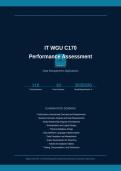
IT WGU C170
Performance Assessment SQL
2026/2027
Data Management Applications
110 10 30/50/20
Total Questions Exam Sections Recall/App/Analysis %
EXAMINATION DOMAINS
Performance Assessment Overview and Requirements
Business Scenario Analysis and Data Requirements
Entity-Relationship Diagram Development
Normalization and Logical Design
Physical Database Design
Data Definition Language Implementation
Data Population and Manipulation
Query Development for Reporting
Advanced Database Objects
Testing, Documentation, and Submission
Aligned with WGU C170 Data Management Applications performance assessment requirements.
,IT WGU C170 Performance Assessment 2026/2027 Data Management Applications
Verified Correct Answers with SQL Syntax Explanations and Rubric Alignment
WGU C170 | 110 Questions | Verified Answers Page 2
,IT WGU C170 Performance Assessment 2026/2027 Data Management Applications
EXAMINATION OVERVIEW
This comprehensive examination assesses mastery of the WGU C170 Data Management Applications Performance
Assessment. The exam consists of exactly 110 multiple-choice questions distributed across ten content domains spanning
the full database development lifecycle: performance assessment overview and requirements, business scenario analysis,
ERD design, normalization, physical design, DDL implementation, data population, query development, advanced
database objects, and testing/documentation/submission. Each item is accompanied by a verified correct answer and a
detailed rationale including SQL syntax explanations, ERD notation guidance, normalization principles, and rubric
alignment. Content reflects 2026-2027 updated WGU C170 performance assessment task requirements.
Cognitive level distribution: approximately 30% of items assess direct recall (syntax, definitions, task requirements); 50%
require application (writing queries, designing schemas, solving scenarios); and 20% demand analysis (query
optimization, normalization decisions, design trade-offs). Approximately 75% of items are scenario-based, requiring the
student to apply database concepts to realistic WGU C170 task scenarios. Special inclusions: ERD notation (Crow's Foot
and Chen), normalization to 3NF with anomaly identification, complete SQL implementation scenarios (CREATE
TABLE, INSERT, SELECT), query patterns for required reports (JOINs, subqueries, aggregates, GROUP BY,
HAVING), advanced objects (views, indexes, stored procedures, triggers), and submission verification against rubric
competencies.
SECTION STRUCTURE
Sec Domain Questions
1 Performance Assessment Overview and Requirements Q1 - Q10
2 Business Scenario Analysis and Data Requirements Q11 - Q20
3 Entity-Relationship Diagram Development Q21 - Q33
4 Normalization and Logical Design Q34 - Q46
5 Physical Database Design Q47 - Q57
6 Data Definition Language Implementation Q58 - Q69
7 Data Population and Manipulation Q70 - Q78
8 Query Development for Reporting Q79 - Q93
9 Advanced Database Objects Q94 - Q102
10 Testing, Documentation, and Submission Q103 - Q110
HOW TO USE THIS EXAMINATION
Each question is presented with four response options (A through D). The verified correct answer is identified by the
[CORRECT] tag in bold green and restated in the "Correct Answer" line. A detailed rationale follows every question
explaining the database reasoning, SQL syntax rules, design principles, and rubric alignment for the correct answer and
why the distractors are incorrect. Students preparing for the WGU C170 performance assessment should review both
correct and incorrect rationales to reinforce conceptual understanding and avoid common pitfalls (incorrect ERD notation,
missing constraints, wrong JOIN types, NULL handling errors, WHERE vs HAVING confusion) that evaluators
frequently flag.
WGU C170 | 110 Questions | Verified Answers Page 3
, IT WGU C170 Performance Assessment 2026/2027 Data Management Applications
SECTION 1: PERFORMANCE ASSESSMENT OVERVIEW AND
REQUIREMENTS
Task Structure, Rubric, Deliverables, and Competencies
Q1: A WGU C170 student is beginning the Data Management Applications Performance Assessment. Which
of the following best describes the required deliverables that must be submitted for evaluation?
A. Only the SQL script file containing CREATE, INSERT, and SELECT statements.
B. A completed ERD (entity-relationship diagram), a data dictionary, an SQL script file containing CREATE,
INSERT, and SELECT statements, and supporting documentation demonstrating rubric alignment. [CORRECT]
C. A written essay explaining database concepts.
D. A PowerPoint presentation summarizing the project.
Correct Answer: B. A completed ERD (entity-relationship diagram), a data dictionary, an SQL script file
containing CREATE, INSERT, and SELECT statements, and supporting documentation demonstrating rubric
alignment.
Rationale: The WGU C170 Performance Assessment requires multiple deliverables that demonstrate competency across the entire
database development lifecycle: (1) an ERD visually representing entities, attributes, and relationships; (2) a data dictionary
documenting tables, columns, data types, and constraints; (3) an SQL script file (typically .sql) containing CREATE TABLE statements
with constraints, INSERT statements populating sample data, and SELECT queries producing required reports; and (4) supporting
documentation showing how each rubric requirement is met. Submitting only the SQL script (A) omits the design artifacts evaluators use
to verify conceptual understanding. An essay (C) or presentation (D) does not meet the technical deliverable requirements.
Q2: Which competency area is NOT explicitly evaluated in the WGU C170 Performance Assessment rubric?
A. Entity-Relationship Diagram design with proper notation and cardinality.
B. Normalized table structures conforming to 3NF.
C. SQL implementation including DDL, DML, and SELECT queries for required reports.
D. Network infrastructure configuration and router setup. [CORRECT]
Correct Answer: D. Network infrastructure configuration and router setup.
Rationale: The WGU C170 rubric evaluates competencies aligned with the Data Management Applications course: ERD design (A),
normalized logical design (B), and SQL implementation including DDL/DML/queries (C). Network infrastructure and router
configuration (D) is a networking topic (covered in courses like WGU C172 or C173), not part of the database-focused C170 rubric.
Students must demonstrate competency in database design, implementation, and query development, not networking hardware
configuration.
Q3: A student receives the C170 performance assessment scenario describing a small business that needs
a database to track customers, orders, and products. What is the recommended first step in completing the
assessment?
A. Immediately write CREATE TABLE statements based on the scenario title.
B. Carefully read the business scenario, identify entities and their attributes, document business rules, and sketch a
preliminary ERD before any SQL is written. [CORRECT]
C. Open MySQL Workbench and start typing queries.
D. Submit a blank document to test the upload system.
Correct Answer: B. Carefully read the business scenario, identify entities and their attributes, document
business rules, and sketch a preliminary ERD before any SQL is written.
Rationale: The recommended workflow for the C170 PA follows the database development lifecycle: (1) Requirements analysis—read
the scenario thoroughly, identify business rules, entities, attributes, and relationships; (2) Conceptual design—sketch a preliminary
ERD; (3) Logical design—normalize to 3NF and refine the ERD; (4) Physical design—specify data types, constraints, naming
conventions; (5) Implementation—write CREATE TABLE, INSERT, and SELECT statements; (6) Testing—verify outputs; (7)
Documentation—prepare data dictionary and submission package. Starting with CREATE TABLE (A) or typing queries (C) skips
essential design steps and typically produces an unnormalized schema that fails rubric requirements. Submitting a blank document (D) is
wasted effort.
WGU C170 | 110 Questions | Verified Answers Page 4
Performance Assessment SQL
2026/2027
Data Management Applications
110 10 30/50/20
Total Questions Exam Sections Recall/App/Analysis %
EXAMINATION DOMAINS
Performance Assessment Overview and Requirements
Business Scenario Analysis and Data Requirements
Entity-Relationship Diagram Development
Normalization and Logical Design
Physical Database Design
Data Definition Language Implementation
Data Population and Manipulation
Query Development for Reporting
Advanced Database Objects
Testing, Documentation, and Submission
Aligned with WGU C170 Data Management Applications performance assessment requirements.
,IT WGU C170 Performance Assessment 2026/2027 Data Management Applications
Verified Correct Answers with SQL Syntax Explanations and Rubric Alignment
WGU C170 | 110 Questions | Verified Answers Page 2
,IT WGU C170 Performance Assessment 2026/2027 Data Management Applications
EXAMINATION OVERVIEW
This comprehensive examination assesses mastery of the WGU C170 Data Management Applications Performance
Assessment. The exam consists of exactly 110 multiple-choice questions distributed across ten content domains spanning
the full database development lifecycle: performance assessment overview and requirements, business scenario analysis,
ERD design, normalization, physical design, DDL implementation, data population, query development, advanced
database objects, and testing/documentation/submission. Each item is accompanied by a verified correct answer and a
detailed rationale including SQL syntax explanations, ERD notation guidance, normalization principles, and rubric
alignment. Content reflects 2026-2027 updated WGU C170 performance assessment task requirements.
Cognitive level distribution: approximately 30% of items assess direct recall (syntax, definitions, task requirements); 50%
require application (writing queries, designing schemas, solving scenarios); and 20% demand analysis (query
optimization, normalization decisions, design trade-offs). Approximately 75% of items are scenario-based, requiring the
student to apply database concepts to realistic WGU C170 task scenarios. Special inclusions: ERD notation (Crow's Foot
and Chen), normalization to 3NF with anomaly identification, complete SQL implementation scenarios (CREATE
TABLE, INSERT, SELECT), query patterns for required reports (JOINs, subqueries, aggregates, GROUP BY,
HAVING), advanced objects (views, indexes, stored procedures, triggers), and submission verification against rubric
competencies.
SECTION STRUCTURE
Sec Domain Questions
1 Performance Assessment Overview and Requirements Q1 - Q10
2 Business Scenario Analysis and Data Requirements Q11 - Q20
3 Entity-Relationship Diagram Development Q21 - Q33
4 Normalization and Logical Design Q34 - Q46
5 Physical Database Design Q47 - Q57
6 Data Definition Language Implementation Q58 - Q69
7 Data Population and Manipulation Q70 - Q78
8 Query Development for Reporting Q79 - Q93
9 Advanced Database Objects Q94 - Q102
10 Testing, Documentation, and Submission Q103 - Q110
HOW TO USE THIS EXAMINATION
Each question is presented with four response options (A through D). The verified correct answer is identified by the
[CORRECT] tag in bold green and restated in the "Correct Answer" line. A detailed rationale follows every question
explaining the database reasoning, SQL syntax rules, design principles, and rubric alignment for the correct answer and
why the distractors are incorrect. Students preparing for the WGU C170 performance assessment should review both
correct and incorrect rationales to reinforce conceptual understanding and avoid common pitfalls (incorrect ERD notation,
missing constraints, wrong JOIN types, NULL handling errors, WHERE vs HAVING confusion) that evaluators
frequently flag.
WGU C170 | 110 Questions | Verified Answers Page 3
, IT WGU C170 Performance Assessment 2026/2027 Data Management Applications
SECTION 1: PERFORMANCE ASSESSMENT OVERVIEW AND
REQUIREMENTS
Task Structure, Rubric, Deliverables, and Competencies
Q1: A WGU C170 student is beginning the Data Management Applications Performance Assessment. Which
of the following best describes the required deliverables that must be submitted for evaluation?
A. Only the SQL script file containing CREATE, INSERT, and SELECT statements.
B. A completed ERD (entity-relationship diagram), a data dictionary, an SQL script file containing CREATE,
INSERT, and SELECT statements, and supporting documentation demonstrating rubric alignment. [CORRECT]
C. A written essay explaining database concepts.
D. A PowerPoint presentation summarizing the project.
Correct Answer: B. A completed ERD (entity-relationship diagram), a data dictionary, an SQL script file
containing CREATE, INSERT, and SELECT statements, and supporting documentation demonstrating rubric
alignment.
Rationale: The WGU C170 Performance Assessment requires multiple deliverables that demonstrate competency across the entire
database development lifecycle: (1) an ERD visually representing entities, attributes, and relationships; (2) a data dictionary
documenting tables, columns, data types, and constraints; (3) an SQL script file (typically .sql) containing CREATE TABLE statements
with constraints, INSERT statements populating sample data, and SELECT queries producing required reports; and (4) supporting
documentation showing how each rubric requirement is met. Submitting only the SQL script (A) omits the design artifacts evaluators use
to verify conceptual understanding. An essay (C) or presentation (D) does not meet the technical deliverable requirements.
Q2: Which competency area is NOT explicitly evaluated in the WGU C170 Performance Assessment rubric?
A. Entity-Relationship Diagram design with proper notation and cardinality.
B. Normalized table structures conforming to 3NF.
C. SQL implementation including DDL, DML, and SELECT queries for required reports.
D. Network infrastructure configuration and router setup. [CORRECT]
Correct Answer: D. Network infrastructure configuration and router setup.
Rationale: The WGU C170 rubric evaluates competencies aligned with the Data Management Applications course: ERD design (A),
normalized logical design (B), and SQL implementation including DDL/DML/queries (C). Network infrastructure and router
configuration (D) is a networking topic (covered in courses like WGU C172 or C173), not part of the database-focused C170 rubric.
Students must demonstrate competency in database design, implementation, and query development, not networking hardware
configuration.
Q3: A student receives the C170 performance assessment scenario describing a small business that needs
a database to track customers, orders, and products. What is the recommended first step in completing the
assessment?
A. Immediately write CREATE TABLE statements based on the scenario title.
B. Carefully read the business scenario, identify entities and their attributes, document business rules, and sketch a
preliminary ERD before any SQL is written. [CORRECT]
C. Open MySQL Workbench and start typing queries.
D. Submit a blank document to test the upload system.
Correct Answer: B. Carefully read the business scenario, identify entities and their attributes, document
business rules, and sketch a preliminary ERD before any SQL is written.
Rationale: The recommended workflow for the C170 PA follows the database development lifecycle: (1) Requirements analysis—read
the scenario thoroughly, identify business rules, entities, attributes, and relationships; (2) Conceptual design—sketch a preliminary
ERD; (3) Logical design—normalize to 3NF and refine the ERD; (4) Physical design—specify data types, constraints, naming
conventions; (5) Implementation—write CREATE TABLE, INSERT, and SELECT statements; (6) Testing—verify outputs; (7)
Documentation—prepare data dictionary and submission package. Starting with CREATE TABLE (A) or typing queries (C) skips
essential design steps and typically produces an unnormalized schema that fails rubric requirements. Submitting a blank document (D) is
wasted effort.
WGU C170 | 110 Questions | Verified Answers Page 4


