
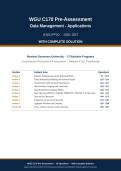
WGU C170 Pre-Assessment
Data Management - Applications
(FJO1) PFJO -
WITH COMPLETE SOLUTION
Western Governors University - IT Bachelor Programs
Comprehensive 95-Question Pre-Assessment - Database & SQL Fundamentals
Section Subject Area Questions
Section 1 Database Fundamentals and the Relational Model Q1 - Q12
Section 2 Entity-Relationship Modeling and Database Design Q13 - Q24
Section 3 Normalization and Functional Dependencies Q25 - Q35
Section 4 Data Definition Language and Constraints Q36 - Q45
Section 5 Data Manipulation Language (DML) Q46 - Q53
Section 6 Basic Querying (SELECT, WHERE, ORDER BY, DISTINCT, & Operators) Q54 - Q63
Section 7 Joins and Set Operations Q64 - Q73
Section 8 Subqueries and Advanced Querying Q74 - Q81
Section 9 Aggregate Functions and Grouping Q82 - Q88
Section 10 Views, Indexes, Security, and Transactions Q89 - Q95
WGU C170 Pre-Assessment - 95 Questions - With Complete Solution
Aligned with WGU FJO1/PFJO Pre-Assessment Blueprint and 2026/2027 Data Management Curriculum
,WGU C170 Pre-Assessment | Data Management - Applications (FJO1) PFJO | 2026/2027 With Complete Solution Edition 2026/2027
WGU C170 Pre-Assessment: Data
Management - Applications
(FJO1) PFJO - 2026/2027 With Complete Solution
This pre-assessment presents 95 practice questions aligned with the WGU C170 Data Management - Applications (FJO1 /
PFJO) pre-assessment blueprint. The exam covers ten content domains spanning database fundamentals and SQL: (1)
Database Fundamentals and the Relational Model; (2) Entity-Relationship Modeling and Database Design; (3) Normalization
and Functional Dependencies; (4) Data Definition Language and Constraints; (5) Data Manipulation Language; (6) Basic
Querying; (7) Joins and Set Operations; (8) Subqueries and Advanced Querying; (9) Aggregate Functions and Grouping; and
(10) Views, Indexes, Security, and Transactions. Each question is multiple choice with one verified correct answer; rationales
include SQL syntax rules, relational theory, normalization principles, query execution logic, and step-by-step solution
guidance consistent with the complete-solution format of the official WGU C170 pre-assessment. Approximately 70% of
questions are application/scenario-based (SQL writing, query analysis, design scenarios); 30% test direct recall of syntax,
definitions, and terminology. The 2026/2027 update reflects the current WGU C170 pre-assessment structure and FJO1/PFJO
competency weighting.
Section 1
Section 1: Database Fundamentals and the Relational Model (Database
Concepts, RDBMS, Tables, Keys, & Relationships)
Questions: Q1 - Q12 | Focus: DBMS/RDBMS definitions, relational model (relations, tuples, attributes, domains),
primary/foreign/candidate/composite keys, entity and referential integrity
Q1: Which of the following best defines a Database Management System (DBMS)?
A. A physical filing cabinet for paper records
B. Software that allows users to define, create, maintain, and control access to databases and their data
[CORRECT]
C. An end-user application used only for data entry
D. A programming language used to write operating systems
Correct Answer: B
Rationale: A DBMS is system software that manages data storage, retrieval, and access control, providing an interface between
the physical data, the database, and the applications using it. Choice A describes physical storage. Choice C describes an
application, not the DBMS itself. Choice D is unrelated.
Q2: A key advantage of a database approach over traditional file processing is:
A. Data is duplicated across multiple files to ensure availability
B. Reduced data redundancy, improved data consistency, and better data sharing across applications
[CORRECT]
C. Each application owns its own data, increasing independence
D. Programs and data are tightly coupled, reducing flexibility
Correct Answer: B
Western Governors University - IT Bachelor Programs Page 2
, Rationale: The database approach centralizes data, minimizing redundancy and inconsistency, supporting data sharing,
enforcing standards, and providing data independence (logical and physical). Choice A is the opposite (file systems tend to
have redundancy). Choice C and D describe file-system drawbacks that databases solve.
Q3: An RDBMS is best characterized as a DBMS that:
A. Stores data in object-oriented classes
B. Stores data in related tables (relations) and uses SQL for data access (based on Codd's relational
model) [CORRECT]
C. Stores data in NoSQL documents
D. Stores data in flat files only
Correct Answer: B
Rationale: A Relational DBMS (Oracle, SQL Server, MySQL, PostgreSQL) stores data in tables (relations) organized as
rows (tuples) and columns (attributes), and supports SQL access. Choice A describes OODBMS. Choice C describes
document DBs. Choice D describes file systems.
Q4: In the relational model, a 'tuple' refers to:
A. A column in a table
B. A single row (record) in a relation (table) [CORRECT]
C. A constraint between two tables
D. A user-defined function
Correct Answer: B
Rationale: In relational theory, a 'tuple' is one row/record in a relation. A relation is a table; tuples are the rows; attributes are
the columns; domain is the set of allowed values for an attribute. Choice A describes an attribute. Choice C is a constraint.
Choice D is unrelated.
Q5: Which statement about a primary key is correct?
A. It can contain NULL values
B. It uniquely identifies each row in a table and must be unique and NOT NULL [CORRECT]
C. It must always be a single column
D. It references a column in another table
Correct Answer: B
Rationale: A primary key uniquely identifies each row/tuple and must be UNIQUE and NOT NULL (entity integrity). It
may be a single column or a composite (multiple columns). Choice A is wrong (NULLs are prohibited). Choice C is wrong
(composite keys exist). Choice D describes a foreign key.
Q6: A foreign key is used to:
A. Uniquely identify rows in the same table
B. Establish a link (referential integrity) between two tables by referencing the primary key of another
table [CORRECT]
C. Encrypt sensitive data
D. Define the data type of a column
Correct Answer: B
Rationale: A foreign key is a column (or set of columns) in one table whose values reference the primary key of another
table, establishing referential integrity. Choice A describes a primary key. Choice C is encryption. Choice D is a data type
definition.
Data Management - Applications
(FJO1) PFJO -
WITH COMPLETE SOLUTION
Western Governors University - IT Bachelor Programs
Comprehensive 95-Question Pre-Assessment - Database & SQL Fundamentals
Section Subject Area Questions
Section 1 Database Fundamentals and the Relational Model Q1 - Q12
Section 2 Entity-Relationship Modeling and Database Design Q13 - Q24
Section 3 Normalization and Functional Dependencies Q25 - Q35
Section 4 Data Definition Language and Constraints Q36 - Q45
Section 5 Data Manipulation Language (DML) Q46 - Q53
Section 6 Basic Querying (SELECT, WHERE, ORDER BY, DISTINCT, & Operators) Q54 - Q63
Section 7 Joins and Set Operations Q64 - Q73
Section 8 Subqueries and Advanced Querying Q74 - Q81
Section 9 Aggregate Functions and Grouping Q82 - Q88
Section 10 Views, Indexes, Security, and Transactions Q89 - Q95
WGU C170 Pre-Assessment - 95 Questions - With Complete Solution
Aligned with WGU FJO1/PFJO Pre-Assessment Blueprint and 2026/2027 Data Management Curriculum
,WGU C170 Pre-Assessment | Data Management - Applications (FJO1) PFJO | 2026/2027 With Complete Solution Edition 2026/2027
WGU C170 Pre-Assessment: Data
Management - Applications
(FJO1) PFJO - 2026/2027 With Complete Solution
This pre-assessment presents 95 practice questions aligned with the WGU C170 Data Management - Applications (FJO1 /
PFJO) pre-assessment blueprint. The exam covers ten content domains spanning database fundamentals and SQL: (1)
Database Fundamentals and the Relational Model; (2) Entity-Relationship Modeling and Database Design; (3) Normalization
and Functional Dependencies; (4) Data Definition Language and Constraints; (5) Data Manipulation Language; (6) Basic
Querying; (7) Joins and Set Operations; (8) Subqueries and Advanced Querying; (9) Aggregate Functions and Grouping; and
(10) Views, Indexes, Security, and Transactions. Each question is multiple choice with one verified correct answer; rationales
include SQL syntax rules, relational theory, normalization principles, query execution logic, and step-by-step solution
guidance consistent with the complete-solution format of the official WGU C170 pre-assessment. Approximately 70% of
questions are application/scenario-based (SQL writing, query analysis, design scenarios); 30% test direct recall of syntax,
definitions, and terminology. The 2026/2027 update reflects the current WGU C170 pre-assessment structure and FJO1/PFJO
competency weighting.
Section 1
Section 1: Database Fundamentals and the Relational Model (Database
Concepts, RDBMS, Tables, Keys, & Relationships)
Questions: Q1 - Q12 | Focus: DBMS/RDBMS definitions, relational model (relations, tuples, attributes, domains),
primary/foreign/candidate/composite keys, entity and referential integrity
Q1: Which of the following best defines a Database Management System (DBMS)?
A. A physical filing cabinet for paper records
B. Software that allows users to define, create, maintain, and control access to databases and their data
[CORRECT]
C. An end-user application used only for data entry
D. A programming language used to write operating systems
Correct Answer: B
Rationale: A DBMS is system software that manages data storage, retrieval, and access control, providing an interface between
the physical data, the database, and the applications using it. Choice A describes physical storage. Choice C describes an
application, not the DBMS itself. Choice D is unrelated.
Q2: A key advantage of a database approach over traditional file processing is:
A. Data is duplicated across multiple files to ensure availability
B. Reduced data redundancy, improved data consistency, and better data sharing across applications
[CORRECT]
C. Each application owns its own data, increasing independence
D. Programs and data are tightly coupled, reducing flexibility
Correct Answer: B
Western Governors University - IT Bachelor Programs Page 2
, Rationale: The database approach centralizes data, minimizing redundancy and inconsistency, supporting data sharing,
enforcing standards, and providing data independence (logical and physical). Choice A is the opposite (file systems tend to
have redundancy). Choice C and D describe file-system drawbacks that databases solve.
Q3: An RDBMS is best characterized as a DBMS that:
A. Stores data in object-oriented classes
B. Stores data in related tables (relations) and uses SQL for data access (based on Codd's relational
model) [CORRECT]
C. Stores data in NoSQL documents
D. Stores data in flat files only
Correct Answer: B
Rationale: A Relational DBMS (Oracle, SQL Server, MySQL, PostgreSQL) stores data in tables (relations) organized as
rows (tuples) and columns (attributes), and supports SQL access. Choice A describes OODBMS. Choice C describes
document DBs. Choice D describes file systems.
Q4: In the relational model, a 'tuple' refers to:
A. A column in a table
B. A single row (record) in a relation (table) [CORRECT]
C. A constraint between two tables
D. A user-defined function
Correct Answer: B
Rationale: In relational theory, a 'tuple' is one row/record in a relation. A relation is a table; tuples are the rows; attributes are
the columns; domain is the set of allowed values for an attribute. Choice A describes an attribute. Choice C is a constraint.
Choice D is unrelated.
Q5: Which statement about a primary key is correct?
A. It can contain NULL values
B. It uniquely identifies each row in a table and must be unique and NOT NULL [CORRECT]
C. It must always be a single column
D. It references a column in another table
Correct Answer: B
Rationale: A primary key uniquely identifies each row/tuple and must be UNIQUE and NOT NULL (entity integrity). It
may be a single column or a composite (multiple columns). Choice A is wrong (NULLs are prohibited). Choice C is wrong
(composite keys exist). Choice D describes a foreign key.
Q6: A foreign key is used to:
A. Uniquely identify rows in the same table
B. Establish a link (referential integrity) between two tables by referencing the primary key of another
table [CORRECT]
C. Encrypt sensitive data
D. Define the data type of a column
Correct Answer: B
Rationale: A foreign key is a column (or set of columns) in one table whose values reference the primary key of another
table, establishing referential integrity. Choice A describes a primary key. Choice C is encryption. Choice D is a data type
definition.


