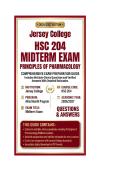
,HSC 204 Midterm Exam Principles of Pharmacology Questions And
Answers 2026/2027 Jersey College
Q1. Which patient requires the greatest caution before receiving
oral pseudoephedrine for nasal congestion?
A) A patient with mild seasonal rhinitis
B) A patient with poorly controlled hypertension
C) A patient with an uncomplicated sore throat
D) A patient with mild eczema
Correct Answer: B) A patient with poorly controlled hypertension
Rationale: Systemic sympathomimetic decongestants can increase heart
rate and blood pressure and should be used cautiously in patients with
cardiovascular disease.
Q2. What is the primary therapeutic action of dextromethorphan?
A) Liquefies thick bronchial secretions
B) Reduces nasal mucosal swelling
C) Dilates bronchial smooth muscle
D) Suppresses the cough reflex centrally
Correct Answer: D) Suppresses the cough reflex centrally
Rationale: Dextromethorphan acts on the cough center to reduce the urge
to cough.
Q3. Which instruction is appropriate for a patient taking guaifenesin
for a productive cough?
A) Maintain adequate fluid intake when not contraindicated
B) Avoid all oral fluids
C) Take the medication only for severe bronchospasm
D) Expect complete cough suppression
Correct Answer: A) Maintain adequate fluid intake when not contraindicated
Rationale: Hydration helps loosen respiratory secretions and supports the
expectorant effect of guaifenesin.
Q4. A patient has used oxymetazoline nasal spray several times
daily for more than a week and now reports worsening congestion.
Which problem is most likely?
,A) Acute bacterial sinusitis
B) Bronchospasm
C) Rebound nasal congestion from prolonged topical decongestant use
D) Opioid withdrawal
Correct Answer: C) Rebound nasal congestion from prolonged topical
decongestant use
Rationale: Prolonged use of topical adrenergic decongestants can produce
rebound vasodilation and worsening congestion.
Q5. Which adverse effect is most associated with first-generation
antihistamines such as diphenhydramine?
A) Severe hyperglycemia
B) Sedation
C) Persistent hypertension
D) Increased bronchial secretions
Correct Answer: B) Sedation
Rationale: First-generation antihistamines readily enter the central nervous
system and commonly cause drowsiness.
Q6. What is a major advantage of second-generation antihistamines
such as fexofenadine?
A) They generally cause less sedation than first-generation agents
B) They immediately reverse anaphylactic shock
C) They act as bronchodilators
D) They eliminate all nasal congestion
Correct Answer: A) They generally cause less sedation than first-generation
agents
Rationale: Second-generation antihistamines have limited penetration into
the central nervous system and are usually less sedating.
Q7. Which patient requires particular caution with diphenhydramine
because of its anticholinergic effects?
A) A young adult with a minor ankle sprain
B) A patient with uncomplicated bacterial pharyngitis
C) A patient with iron-deficiency anemia
D) An older adult with urinary retention and narrow-angle glaucoma
, Correct Answer: D) An older adult with urinary retention and narrow-angle
glaucoma
Rationale: Anticholinergic effects can worsen urinary retention and increase
intraocular pressure in susceptible patients.
Q8. Which instruction is appropriate when using an intranasal
corticosteroid for allergic rhinitis?
A) Aim the spray directly toward the nasal septum
B) Use the medication only during severe respiratory distress
C) Direct the spray slightly away from the septum and use it consistently as
prescribed
D) Expect maximal relief within seconds of the first dose
Correct Answer: C) Direct the spray slightly away from the septum and use it
consistently as prescribed
Rationale: Correct technique reduces nasal irritation, and regular use is
usually required for maximal anti-inflammatory benefit.
Q9. Which medication is most appropriate for rapid relief of acute
bronchospasm in asthma?
A) Albuterol
B) Montelukast
C) Fluticasone
D) Salmeterol alone
Correct Answer: A) Albuterol
Rationale: Albuterol is a short-acting beta2 agonist that rapidly relaxes
bronchial smooth muscle.
Q10. Which statement about salmeterol is correct?
A) It should be used as the sole treatment for sudden severe bronchospasm
B) It is a long-acting bronchodilator used for maintenance rather than
immediate rescue
C) It reverses acute anaphylaxis
D) It replaces inhaled corticosteroids in every patient
Correct Answer: B) It is a long-acting bronchodilator used for maintenance
rather than immediate rescue
Answers 2026/2027 Jersey College
Q1. Which patient requires the greatest caution before receiving
oral pseudoephedrine for nasal congestion?
A) A patient with mild seasonal rhinitis
B) A patient with poorly controlled hypertension
C) A patient with an uncomplicated sore throat
D) A patient with mild eczema
Correct Answer: B) A patient with poorly controlled hypertension
Rationale: Systemic sympathomimetic decongestants can increase heart
rate and blood pressure and should be used cautiously in patients with
cardiovascular disease.
Q2. What is the primary therapeutic action of dextromethorphan?
A) Liquefies thick bronchial secretions
B) Reduces nasal mucosal swelling
C) Dilates bronchial smooth muscle
D) Suppresses the cough reflex centrally
Correct Answer: D) Suppresses the cough reflex centrally
Rationale: Dextromethorphan acts on the cough center to reduce the urge
to cough.
Q3. Which instruction is appropriate for a patient taking guaifenesin
for a productive cough?
A) Maintain adequate fluid intake when not contraindicated
B) Avoid all oral fluids
C) Take the medication only for severe bronchospasm
D) Expect complete cough suppression
Correct Answer: A) Maintain adequate fluid intake when not contraindicated
Rationale: Hydration helps loosen respiratory secretions and supports the
expectorant effect of guaifenesin.
Q4. A patient has used oxymetazoline nasal spray several times
daily for more than a week and now reports worsening congestion.
Which problem is most likely?
,A) Acute bacterial sinusitis
B) Bronchospasm
C) Rebound nasal congestion from prolonged topical decongestant use
D) Opioid withdrawal
Correct Answer: C) Rebound nasal congestion from prolonged topical
decongestant use
Rationale: Prolonged use of topical adrenergic decongestants can produce
rebound vasodilation and worsening congestion.
Q5. Which adverse effect is most associated with first-generation
antihistamines such as diphenhydramine?
A) Severe hyperglycemia
B) Sedation
C) Persistent hypertension
D) Increased bronchial secretions
Correct Answer: B) Sedation
Rationale: First-generation antihistamines readily enter the central nervous
system and commonly cause drowsiness.
Q6. What is a major advantage of second-generation antihistamines
such as fexofenadine?
A) They generally cause less sedation than first-generation agents
B) They immediately reverse anaphylactic shock
C) They act as bronchodilators
D) They eliminate all nasal congestion
Correct Answer: A) They generally cause less sedation than first-generation
agents
Rationale: Second-generation antihistamines have limited penetration into
the central nervous system and are usually less sedating.
Q7. Which patient requires particular caution with diphenhydramine
because of its anticholinergic effects?
A) A young adult with a minor ankle sprain
B) A patient with uncomplicated bacterial pharyngitis
C) A patient with iron-deficiency anemia
D) An older adult with urinary retention and narrow-angle glaucoma
, Correct Answer: D) An older adult with urinary retention and narrow-angle
glaucoma
Rationale: Anticholinergic effects can worsen urinary retention and increase
intraocular pressure in susceptible patients.
Q8. Which instruction is appropriate when using an intranasal
corticosteroid for allergic rhinitis?
A) Aim the spray directly toward the nasal septum
B) Use the medication only during severe respiratory distress
C) Direct the spray slightly away from the septum and use it consistently as
prescribed
D) Expect maximal relief within seconds of the first dose
Correct Answer: C) Direct the spray slightly away from the septum and use it
consistently as prescribed
Rationale: Correct technique reduces nasal irritation, and regular use is
usually required for maximal anti-inflammatory benefit.
Q9. Which medication is most appropriate for rapid relief of acute
bronchospasm in asthma?
A) Albuterol
B) Montelukast
C) Fluticasone
D) Salmeterol alone
Correct Answer: A) Albuterol
Rationale: Albuterol is a short-acting beta2 agonist that rapidly relaxes
bronchial smooth muscle.
Q10. Which statement about salmeterol is correct?
A) It should be used as the sole treatment for sudden severe bronchospasm
B) It is a long-acting bronchodilator used for maintenance rather than
immediate rescue
C) It reverses acute anaphylaxis
D) It replaces inhaled corticosteroids in every patient
Correct Answer: B) It is a long-acting bronchodilator used for maintenance
rather than immediate rescue