
A+ VERIFIED
TEACHER LICENSURE · OBJECTIVE ASSESSMENT
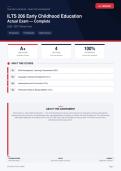
ILTS 206 Early Childhood Education
Actual Exam — Complete
Official Exam
100 Questions Full Rationales Verified Answers
A+ 4 100%
QUESTIONS SECTIONS RATIONALES
Complete coverage Core exam domains Every answer explained
WHAT THIS COVERS
01 Child Development, Learning & Assessment (25%)
02 Language & Literacy Development (31%)
03 Learning Across the Curriculum (31%)
04 Professional Roles & Responsibilities (13%)
ABOUT THIS ASSESSMENT
Build mastery in early childhood education — from child development, learning, and assessment to language and literacy development,
learning across the curriculum, and professional roles and responsibilities for teachers of children from birth to grade two. This original study
bank targets application and analysis skills for the ILTS 206 exam, with full rationales for every answer. For review use only; not an
institutional proctored assessment.
PASSING SCORE LEVEL FORMAT
240 Scaled (80%) Advanced (Teacher Licensure) Application / Analysis
STUVIA ACTUAL EXAM Page 1
, SECTION 1: Child Development, Learning & Assessment
Q1. A teacher working with children from birth to grade two observes a classroom scenario involving developmental, instructional, or
professional decision-making related to high-yield ILTS 206 content. The teacher must select the most appropriate
research-based response that supports learning and development. Which action best demonstrates application of early childhood
best practices in this context for item 1?
A. Option focused on an overly rigid or developmentally inappropriate response.
B. Option that correctly applies scaffolding, assessment data, or family engagement principles.
C. Provide intentional scaffolding and use ongoing observation to guide next steps.
D. Option that prioritizes adult convenience over child learning outcomes.
Correct Answer: C
Rationale: The correct choice reflects developmentally appropriate practice grounded in the ILTS 206 framework for the relevant domain. It prioritizes
observation-based decision making, individual child needs, and evidence-based strategies. The distractors represent common errors such as rigid
control, ignoring context, or adult-centered planning.
Q2. A teacher working with children from birth to grade two observes a classroom scenario involving developmental, instructional, or
professional decision-making related to high-yield ILTS 206 content. The teacher must select the most appropriate
research-based response that supports learning and development. Which action best demonstrates application of early childhood
best practices in this context for item 2?
A. Option focused on an overly rigid or developmentally inappropriate response.
B. Provide intentional scaffolding and use ongoing observation to guide next steps.
C. Option that ignores individual differences or cultural context.
D. Option that prioritizes adult convenience over child learning outcomes.
Correct Answer: B
Rationale: The correct choice reflects developmentally appropriate practice grounded in the ILTS 206 framework for the relevant domain. It prioritizes
observation-based decision making, individual child needs, and evidence-based strategies. The distractors represent common errors such as rigid
control, ignoring context, or adult-centered planning.
Q3. A teacher working with children from birth to grade two observes a classroom scenario involving developmental, instructional, or
professional decision-making related to high-yield ILTS 206 content. The teacher must select the most appropriate
research-based response that supports learning and development. Which action best demonstrates application of early childhood
best practices in this context for item 3?
A. Provide intentional scaffolding and use ongoing observation to guide next steps.
B. Option that correctly applies scaffolding, assessment data, or family engagement principles.
C. Option that ignores individual differences or cultural context.
D. Option that prioritizes adult convenience over child learning outcomes.
Correct Answer: A
Rationale: The correct choice reflects developmentally appropriate practice grounded in the ILTS 206 framework for the relevant domain. It prioritizes
observation-based decision making, individual child needs, and evidence-based strategies. The distractors represent common errors such as rigid
control, ignoring context, or adult-centered planning.
Q4. A teacher working with children from birth to grade two observes a classroom scenario involving developmental, instructional, or
professional decision-making related to high-yield ILTS 206 content. The teacher must select the most appropriate
research-based response that supports learning and development. Which action best demonstrates application of early childhood
best practices in this context for item 4?
A. Option focused on an overly rigid or developmentally inappropriate response.
B. Option that correctly applies scaffolding, assessment data, or family engagement principles.
C. Option that ignores individual differences or cultural context.
D. Provide intentional scaffolding and use ongoing observation to guide next steps.
Correct Answer: D
Rationale: The correct choice reflects developmentally appropriate practice grounded in the ILTS 206 framework for the relevant domain. It prioritizes
observation-based decision making, individual child needs, and evidence-based strategies. The distractors represent common errors such as rigid
control, ignoring context, or adult-centered planning.
STUVIA ACTUAL EXAM · Page 2
, SECTION 1: Child Development, Learning & Assessment
Q5. A teacher working with children from birth to grade two observes a classroom scenario involving developmental, instructional, or
professional decision-making related to high-yield ILTS 206 content. The teacher must select the most appropriate
research-based response that supports learning and development. Which action best demonstrates application of early childhood
best practices in this context for item 5?
A. Option focused on an overly rigid or developmentally inappropriate response.
B. Option that correctly applies scaffolding, assessment data, or family engagement principles.
C. Provide intentional scaffolding and use ongoing observation to guide next steps.
D. Option that prioritizes adult convenience over child learning outcomes.
Correct Answer: C
Rationale: The correct choice reflects developmentally appropriate practice grounded in the ILTS 206 framework for the relevant domain. It prioritizes
observation-based decision making, individual child needs, and evidence-based strategies. The distractors represent common errors such as rigid
control, ignoring context, or adult-centered planning.
Q6. A teacher working with children from birth to grade two observes a classroom scenario involving developmental, instructional, or
professional decision-making related to high-yield ILTS 206 content. The teacher must select the most appropriate
research-based response that supports learning and development. Which action best demonstrates application of early childhood
best practices in this context for item 6?
A. Option focused on an overly rigid or developmentally inappropriate response.
B. Provide intentional scaffolding and use ongoing observation to guide next steps.
C. Option that ignores individual differences or cultural context.
D. Option that prioritizes adult convenience over child learning outcomes.
Correct Answer: B
Rationale: The correct choice reflects developmentally appropriate practice grounded in the ILTS 206 framework for the relevant domain. It prioritizes
observation-based decision making, individual child needs, and evidence-based strategies. The distractors represent common errors such as rigid
control, ignoring context, or adult-centered planning.
Q7. A teacher working with children from birth to grade two observes a classroom scenario involving developmental, instructional, or
professional decision-making related to high-yield ILTS 206 content. The teacher must select the most appropriate
research-based response that supports learning and development. Which action best demonstrates application of early childhood
best practices in this context for item 7?
A. Provide intentional scaffolding and use ongoing observation to guide next steps.
B. Option that correctly applies scaffolding, assessment data, or family engagement principles.
C. Option that ignores individual differences or cultural context.
D. Option that prioritizes adult convenience over child learning outcomes.
Correct Answer: A
Rationale: The correct choice reflects developmentally appropriate practice grounded in the ILTS 206 framework for the relevant domain. It prioritizes
observation-based decision making, individual child needs, and evidence-based strategies. The distractors represent common errors such as rigid
control, ignoring context, or adult-centered planning.
Q8. A teacher working with children from birth to grade two observes a classroom scenario involving developmental, instructional, or
professional decision-making related to high-yield ILTS 206 content. The teacher must select the most appropriate
research-based response that supports learning and development. Which action best demonstrates application of early childhood
best practices in this context for item 8?
A. Option focused on an overly rigid or developmentally inappropriate response.
B. Option that correctly applies scaffolding, assessment data, or family engagement principles.
C. Option that ignores individual differences or cultural context.
D. Provide intentional scaffolding and use ongoing observation to guide next steps.
Correct Answer: D
Rationale: The correct choice reflects developmentally appropriate practice grounded in the ILTS 206 framework for the relevant domain. It prioritizes
observation-based decision making, individual child needs, and evidence-based strategies. The distractors represent common errors such as rigid
control, ignoring context, or adult-centered planning.
STUVIA ACTUAL EXAM · Page 3
TEACHER LICENSURE · OBJECTIVE ASSESSMENT
ILTS 206 Early Childhood Education
Actual Exam — Complete
Official Exam
100 Questions Full Rationales Verified Answers
A+ 4 100%
QUESTIONS SECTIONS RATIONALES
Complete coverage Core exam domains Every answer explained
WHAT THIS COVERS
01 Child Development, Learning & Assessment (25%)
02 Language & Literacy Development (31%)
03 Learning Across the Curriculum (31%)
04 Professional Roles & Responsibilities (13%)
ABOUT THIS ASSESSMENT
Build mastery in early childhood education — from child development, learning, and assessment to language and literacy development,
learning across the curriculum, and professional roles and responsibilities for teachers of children from birth to grade two. This original study
bank targets application and analysis skills for the ILTS 206 exam, with full rationales for every answer. For review use only; not an
institutional proctored assessment.
PASSING SCORE LEVEL FORMAT
240 Scaled (80%) Advanced (Teacher Licensure) Application / Analysis
STUVIA ACTUAL EXAM Page 1
, SECTION 1: Child Development, Learning & Assessment
Q1. A teacher working with children from birth to grade two observes a classroom scenario involving developmental, instructional, or
professional decision-making related to high-yield ILTS 206 content. The teacher must select the most appropriate
research-based response that supports learning and development. Which action best demonstrates application of early childhood
best practices in this context for item 1?
A. Option focused on an overly rigid or developmentally inappropriate response.
B. Option that correctly applies scaffolding, assessment data, or family engagement principles.
C. Provide intentional scaffolding and use ongoing observation to guide next steps.
D. Option that prioritizes adult convenience over child learning outcomes.
Correct Answer: C
Rationale: The correct choice reflects developmentally appropriate practice grounded in the ILTS 206 framework for the relevant domain. It prioritizes
observation-based decision making, individual child needs, and evidence-based strategies. The distractors represent common errors such as rigid
control, ignoring context, or adult-centered planning.
Q2. A teacher working with children from birth to grade two observes a classroom scenario involving developmental, instructional, or
professional decision-making related to high-yield ILTS 206 content. The teacher must select the most appropriate
research-based response that supports learning and development. Which action best demonstrates application of early childhood
best practices in this context for item 2?
A. Option focused on an overly rigid or developmentally inappropriate response.
B. Provide intentional scaffolding and use ongoing observation to guide next steps.
C. Option that ignores individual differences or cultural context.
D. Option that prioritizes adult convenience over child learning outcomes.
Correct Answer: B
Rationale: The correct choice reflects developmentally appropriate practice grounded in the ILTS 206 framework for the relevant domain. It prioritizes
observation-based decision making, individual child needs, and evidence-based strategies. The distractors represent common errors such as rigid
control, ignoring context, or adult-centered planning.
Q3. A teacher working with children from birth to grade two observes a classroom scenario involving developmental, instructional, or
professional decision-making related to high-yield ILTS 206 content. The teacher must select the most appropriate
research-based response that supports learning and development. Which action best demonstrates application of early childhood
best practices in this context for item 3?
A. Provide intentional scaffolding and use ongoing observation to guide next steps.
B. Option that correctly applies scaffolding, assessment data, or family engagement principles.
C. Option that ignores individual differences or cultural context.
D. Option that prioritizes adult convenience over child learning outcomes.
Correct Answer: A
Rationale: The correct choice reflects developmentally appropriate practice grounded in the ILTS 206 framework for the relevant domain. It prioritizes
observation-based decision making, individual child needs, and evidence-based strategies. The distractors represent common errors such as rigid
control, ignoring context, or adult-centered planning.
Q4. A teacher working with children from birth to grade two observes a classroom scenario involving developmental, instructional, or
professional decision-making related to high-yield ILTS 206 content. The teacher must select the most appropriate
research-based response that supports learning and development. Which action best demonstrates application of early childhood
best practices in this context for item 4?
A. Option focused on an overly rigid or developmentally inappropriate response.
B. Option that correctly applies scaffolding, assessment data, or family engagement principles.
C. Option that ignores individual differences or cultural context.
D. Provide intentional scaffolding and use ongoing observation to guide next steps.
Correct Answer: D
Rationale: The correct choice reflects developmentally appropriate practice grounded in the ILTS 206 framework for the relevant domain. It prioritizes
observation-based decision making, individual child needs, and evidence-based strategies. The distractors represent common errors such as rigid
control, ignoring context, or adult-centered planning.
STUVIA ACTUAL EXAM · Page 2
, SECTION 1: Child Development, Learning & Assessment
Q5. A teacher working with children from birth to grade two observes a classroom scenario involving developmental, instructional, or
professional decision-making related to high-yield ILTS 206 content. The teacher must select the most appropriate
research-based response that supports learning and development. Which action best demonstrates application of early childhood
best practices in this context for item 5?
A. Option focused on an overly rigid or developmentally inappropriate response.
B. Option that correctly applies scaffolding, assessment data, or family engagement principles.
C. Provide intentional scaffolding and use ongoing observation to guide next steps.
D. Option that prioritizes adult convenience over child learning outcomes.
Correct Answer: C
Rationale: The correct choice reflects developmentally appropriate practice grounded in the ILTS 206 framework for the relevant domain. It prioritizes
observation-based decision making, individual child needs, and evidence-based strategies. The distractors represent common errors such as rigid
control, ignoring context, or adult-centered planning.
Q6. A teacher working with children from birth to grade two observes a classroom scenario involving developmental, instructional, or
professional decision-making related to high-yield ILTS 206 content. The teacher must select the most appropriate
research-based response that supports learning and development. Which action best demonstrates application of early childhood
best practices in this context for item 6?
A. Option focused on an overly rigid or developmentally inappropriate response.
B. Provide intentional scaffolding and use ongoing observation to guide next steps.
C. Option that ignores individual differences or cultural context.
D. Option that prioritizes adult convenience over child learning outcomes.
Correct Answer: B
Rationale: The correct choice reflects developmentally appropriate practice grounded in the ILTS 206 framework for the relevant domain. It prioritizes
observation-based decision making, individual child needs, and evidence-based strategies. The distractors represent common errors such as rigid
control, ignoring context, or adult-centered planning.
Q7. A teacher working with children from birth to grade two observes a classroom scenario involving developmental, instructional, or
professional decision-making related to high-yield ILTS 206 content. The teacher must select the most appropriate
research-based response that supports learning and development. Which action best demonstrates application of early childhood
best practices in this context for item 7?
A. Provide intentional scaffolding and use ongoing observation to guide next steps.
B. Option that correctly applies scaffolding, assessment data, or family engagement principles.
C. Option that ignores individual differences or cultural context.
D. Option that prioritizes adult convenience over child learning outcomes.
Correct Answer: A
Rationale: The correct choice reflects developmentally appropriate practice grounded in the ILTS 206 framework for the relevant domain. It prioritizes
observation-based decision making, individual child needs, and evidence-based strategies. The distractors represent common errors such as rigid
control, ignoring context, or adult-centered planning.
Q8. A teacher working with children from birth to grade two observes a classroom scenario involving developmental, instructional, or
professional decision-making related to high-yield ILTS 206 content. The teacher must select the most appropriate
research-based response that supports learning and development. Which action best demonstrates application of early childhood
best practices in this context for item 8?
A. Option focused on an overly rigid or developmentally inappropriate response.
B. Option that correctly applies scaffolding, assessment data, or family engagement principles.
C. Option that ignores individual differences or cultural context.
D. Provide intentional scaffolding and use ongoing observation to guide next steps.
Correct Answer: D
Rationale: The correct choice reflects developmentally appropriate practice grounded in the ILTS 206 framework for the relevant domain. It prioritizes
observation-based decision making, individual child needs, and evidence-based strategies. The distractors represent common errors such as rigid
control, ignoring context, or adult-centered planning.
STUVIA ACTUAL EXAM · Page 3


