
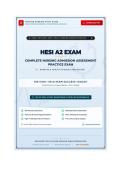
,HESI A2 Complete Nursing Admission
Assessment Practice Exam + 150 Questions &
Rationales
1. Read the following passage and answer the question.
*"The inflammatory response is the body's immediate reaction to tissue injury or infection.
Within minutes of injury, blood vessels dilate and become more permeable, allowing white
blood cells to migrate to the affected area. This process, while protective, can cause the classic
signs of inflammation: redness, heat, swelling, and pain."*
According to the passage, what is the immediate cause of redness at an injury site?
A. White blood cells attacking pathogens
B. Blood vessels dilating
C. Nerve endings becoming activated
D. Tissue releasing histamine
Correct Answer: B. The passage explicitly states that blood vessels dilate, which causes redness.
Rationale: The passage links vasodilation directly to redness. Histamine is not mentioned in the
passage, and white blood cells are described as migrating, not causing redness.
,2. Based on the passage in Question 1, which of the following is NOT listed as a classic sign of
inflammation?
A. Heat
B. Fever
C. Swelling
D. Pain
Correct Answer: B. Fever is not mentioned in the passage. The classic signs listed are redness,
heat, swelling, and pain.
Rationale: Fever is a systemic response, not a local sign of inflammation. The passage
specifically lists four local signs.
3. Based on the passage in Question 1, what happens to blood vessel permeability during
inflammation?
A. It decreases to protect surrounding tissue
B. It remains constant
C. It increases to allow white blood cells to migrate
D. It is unrelated to white blood cell movement
Correct Answer: C. The passage states that blood vessels "become more permeable, allowing
white blood cells to migrate."
Rationale: Increased permeability facilitates the movement of immune cells to the injury site.
, 4. Based on the passage in Question 1, how quickly does the inflammatory response begin?
A. Within seconds
B. Within minutes
C. Within hours
D. Within days
Correct Answer: B. The passage states "within minutes of injury."
Rationale: The passage provides a specific timeframe: minutes, not seconds, hours, or days.
5. A patient education brochure states: *"Regular physical activity strengthens the heart muscle,
lowers blood pressure, and improves overall cardiovascular function. Walking briskly for 30
minutes a day can reduce the risk of heart disease by up to 40%."*
Which sentence best states the main idea?
A. Walking briskly for 30 minutes a day can reduce heart disease risk by 40%.
B. Regular physical activity strengthens the heart muscle, lowers blood pressure, and improves
overall cardiovascular function.
C. Many people find it helpful to track their steps with a pedometer.
D. Always consult a healthcare provider before beginning a new exercise program.
Assessment Practice Exam + 150 Questions &
Rationales
1. Read the following passage and answer the question.
*"The inflammatory response is the body's immediate reaction to tissue injury or infection.
Within minutes of injury, blood vessels dilate and become more permeable, allowing white
blood cells to migrate to the affected area. This process, while protective, can cause the classic
signs of inflammation: redness, heat, swelling, and pain."*
According to the passage, what is the immediate cause of redness at an injury site?
A. White blood cells attacking pathogens
B. Blood vessels dilating
C. Nerve endings becoming activated
D. Tissue releasing histamine
Correct Answer: B. The passage explicitly states that blood vessels dilate, which causes redness.
Rationale: The passage links vasodilation directly to redness. Histamine is not mentioned in the
passage, and white blood cells are described as migrating, not causing redness.
,2. Based on the passage in Question 1, which of the following is NOT listed as a classic sign of
inflammation?
A. Heat
B. Fever
C. Swelling
D. Pain
Correct Answer: B. Fever is not mentioned in the passage. The classic signs listed are redness,
heat, swelling, and pain.
Rationale: Fever is a systemic response, not a local sign of inflammation. The passage
specifically lists four local signs.
3. Based on the passage in Question 1, what happens to blood vessel permeability during
inflammation?
A. It decreases to protect surrounding tissue
B. It remains constant
C. It increases to allow white blood cells to migrate
D. It is unrelated to white blood cell movement
Correct Answer: C. The passage states that blood vessels "become more permeable, allowing
white blood cells to migrate."
Rationale: Increased permeability facilitates the movement of immune cells to the injury site.
, 4. Based on the passage in Question 1, how quickly does the inflammatory response begin?
A. Within seconds
B. Within minutes
C. Within hours
D. Within days
Correct Answer: B. The passage states "within minutes of injury."
Rationale: The passage provides a specific timeframe: minutes, not seconds, hours, or days.
5. A patient education brochure states: *"Regular physical activity strengthens the heart muscle,
lowers blood pressure, and improves overall cardiovascular function. Walking briskly for 30
minutes a day can reduce the risk of heart disease by up to 40%."*
Which sentence best states the main idea?
A. Walking briskly for 30 minutes a day can reduce heart disease risk by 40%.
B. Regular physical activity strengthens the heart muscle, lowers blood pressure, and improves
overall cardiovascular function.
C. Many people find it helpful to track their steps with a pedometer.
D. Always consult a healthcare provider before beginning a new exercise program.


