

🏫
Hoorcolleges
Hoorcollege 1
Information processing model
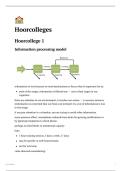
information is loss because we need mechanisms to focus what is important for us.
each of the stages, information is filtered out → not to final stages in our
cognition
there are stimulus in our environment, it reaches our senses → to sensory memory
(information is converted that our brain can interpret it). a lot of information is loss
in this stage
if you pay attention to a stimulus, you are trying to avoid other information.
mere presence effect: smartphone-induced brain drain by ignoring notifications or
by ignoring temptation to check phone.
perhaps no fixed limits to attentional capacity
buts:
1 hour training session, 5 days a week, 17 days
may be specific to well-learned tasks
not for everyone
value directed remembering:
Hoorcolleges 1
, participants studied lists of words that ranged in value from 1 to 10
without distractions
while listening to music (passively distracted)
while completing a digit detection task (divided attentionn)
between subject design
20 words/list, 2 words/value/3s on screen (conditions)
divided attention: listened to digits, signal 3 consecutive odd digits.
monitor digits, as soon as they hear 379, they needed to press.
though participants recalled fewer words following digit detection than in the
other conditions, there were no significant differences between conditions in
terms of selectively remembering the most valuable words.
best performed: when they only focussed on the words
Hoorcolleges 2
, the familiar music was taking more attention than the unfamiliar music
the rising line: they were able to remember the highly value words
extra information that is not in ‘slim academy’:
people are active information processors
we are equipped with a machine for input, processing, and storage
information is filtered at each stage, except in the later stages of our cognition
stimuli → senses → sensory memory (information is converted so that our brains
can interpret it. Much information is lost at this stage)
in the value-directed remembering study, the familiar music drew more attention
than the unfamiliar music.
Hoorcollege 2
prospective memory: remembering to perform a planned action or recall a planned
intention at some future point in time:
memory for future
time based: at a specific point in time
you have to remember that you have something to do at Friday (time-based)
event-based: when specific circumstances occur
something popped up, that is the cue for you to do something
retrospective memory: recall of things from the past
Steve Titus:
1980
brown hair with beard around 30
lie detection test
the girl said a difference in time frame
she thought it was steve titus, but it wasn’t him she felt really guilty
it was Parker
titus died
Hoorcolleges 3
, everyone loses in this story, both men die and she was wrong
>75.000 people a year in US accused of crime based on eye-witness testimonies.
memory researchers have been arguing against this practice since 1970s.
in this college the most about long term memory, it differs from the rest in duration
(can go back years) and capacity (unlimited)
short term has 4 chunks at the time.
sometimes, something recalls you back to a memory from long ago, you didn’t know
you had it. (long term)
long term consists of:
declarative/explicit memory: a specific element of recall, you have to think about
it to recall it. not resistant to forgetting.
semantic memory: memory for facts (meaning of words or who is president,
capital of France)
episodic: autobiographic memory. memory for events that you personally
experienced in your life. it is tied to location and time.
procedural memory: memory for skills (riding a bike or playing guitar)
automatic through practise
no intentional recall
resistant to forgetting
Bias in retrieval
1. participants saw a movie of two cars in an accident
they needed to act like they were an eye witness
how fast were the cars going when they..
Hoorcolleges 4
Hoorcolleges
Hoorcollege 1
Information processing model
information is loss because we need mechanisms to focus what is important for us.
each of the stages, information is filtered out → not to final stages in our
cognition
there are stimulus in our environment, it reaches our senses → to sensory memory
(information is converted that our brain can interpret it). a lot of information is loss
in this stage
if you pay attention to a stimulus, you are trying to avoid other information.
mere presence effect: smartphone-induced brain drain by ignoring notifications or
by ignoring temptation to check phone.
perhaps no fixed limits to attentional capacity
buts:
1 hour training session, 5 days a week, 17 days
may be specific to well-learned tasks
not for everyone
value directed remembering:
Hoorcolleges 1
, participants studied lists of words that ranged in value from 1 to 10
without distractions
while listening to music (passively distracted)
while completing a digit detection task (divided attentionn)
between subject design
20 words/list, 2 words/value/3s on screen (conditions)
divided attention: listened to digits, signal 3 consecutive odd digits.
monitor digits, as soon as they hear 379, they needed to press.
though participants recalled fewer words following digit detection than in the
other conditions, there were no significant differences between conditions in
terms of selectively remembering the most valuable words.
best performed: when they only focussed on the words
Hoorcolleges 2
, the familiar music was taking more attention than the unfamiliar music
the rising line: they were able to remember the highly value words
extra information that is not in ‘slim academy’:
people are active information processors
we are equipped with a machine for input, processing, and storage
information is filtered at each stage, except in the later stages of our cognition
stimuli → senses → sensory memory (information is converted so that our brains
can interpret it. Much information is lost at this stage)
in the value-directed remembering study, the familiar music drew more attention
than the unfamiliar music.
Hoorcollege 2
prospective memory: remembering to perform a planned action or recall a planned
intention at some future point in time:
memory for future
time based: at a specific point in time
you have to remember that you have something to do at Friday (time-based)
event-based: when specific circumstances occur
something popped up, that is the cue for you to do something
retrospective memory: recall of things from the past
Steve Titus:
1980
brown hair with beard around 30
lie detection test
the girl said a difference in time frame
she thought it was steve titus, but it wasn’t him she felt really guilty
it was Parker
titus died
Hoorcolleges 3
, everyone loses in this story, both men die and she was wrong
>75.000 people a year in US accused of crime based on eye-witness testimonies.
memory researchers have been arguing against this practice since 1970s.
in this college the most about long term memory, it differs from the rest in duration
(can go back years) and capacity (unlimited)
short term has 4 chunks at the time.
sometimes, something recalls you back to a memory from long ago, you didn’t know
you had it. (long term)
long term consists of:
declarative/explicit memory: a specific element of recall, you have to think about
it to recall it. not resistant to forgetting.
semantic memory: memory for facts (meaning of words or who is president,
capital of France)
episodic: autobiographic memory. memory for events that you personally
experienced in your life. it is tied to location and time.
procedural memory: memory for skills (riding a bike or playing guitar)
automatic through practise
no intentional recall
resistant to forgetting
Bias in retrieval
1. participants saw a movie of two cars in an accident
they needed to act like they were an eye witness
how fast were the cars going when they..
Hoorcolleges 4


