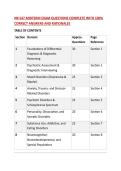
NR 547 MIDTERM EXAM QUESTIONS COMPLETE WITH 100%
CORRECT ANSWERS AND RATIONALES
TABLE OF CONTENTS
Section Domain Approx. Page
Questions Reference
1 Foundations of Differential 30 Section 1
Diagnosis & Diagnostic
Reasoning
2 Psychiatric Assessment & 30 Section 2
Diagnostic Interviewing
3 Mood Disorders (Depressive & 25 Section 3
Bipolar)
4 Anxiety, Trauma- and Stressor- 25 Section 4
Related Disorders
5 Psychotic Disorders & 25 Section 5
Schizophrenia Spectrum
6 Personality, Dissociative, and 20 Section 6
Somatic Disorders
7 Substance Use, Addictive, and 25 Section 7
Eating Disorders
8 Neurocognitive, 20 Section 8
Neurodevelopmental, and
Special Populations
,SECTION 1: FOUNDATIONS OF DIFFERENTIAL DIAGNOSIS &
DIAGNOSTIC REASONING (Questions 1-30)
Q1. What is a differential diagnosis?
A) The final diagnosis after all testing is complete
B) The provider's initial hypothesis—a working list of potential
problems associated with the chief complaint
C) A treatment plan based on presenting symptoms
D) A medication prescription guideline for psychiatric disorders
Correct Answer: B
Rationale: A differential diagnosis is the provider's initial hypothesis and
a working list of potential problems that can be associated with the
initial or chief complaint. The DSM-5-TR provides guidance for
identifying psychiatric diagnoses, and the differential is refined as more
information becomes available.
Q2. What is the FIRST step in creating a differential diagnosis?
A) Identify the most likely diagnosis based on presenting symptoms
B) Rule out malingering or factitious disorder
C) Order comprehensive laboratory tests
D) Begin treatment immediately to address acute symptoms
Correct Answer: B
Rationale: The initial step in forming a differential diagnosis is to
determine if the patient is intentionally producing symptoms for
external gain (malingering) or internal psychological reasons (factitious
disorder). Only after ruling out these possibilities should the clinician
systematically rule out substance-induced etiologies and then
medical/psychiatric conditions.
,Q3. What is the SECOND step in creating a differential diagnosis?
A) Identify the most likely psychiatric diagnosis
B) Rule out substance or medication-induced etiology
C) Begin evidence-based treatment
D) Order diagnostic imaging studies
Correct Answer: B
Rationale: The second step is to rule out substance or medication-
induced etiology, as many psychiatric symptoms can be directly caused
by intoxication, withdrawal, or adverse effects of prescribed
medications, supplements, or illicit drugs.
Q4. Which factor best distinguishes adjustment disorder from major
depressive disorder?
A) Presence of suicidal ideation
B) Temporal link to an identifiable stressor and proportionate severity
C) Duration of 2 weeks
D) Family history of depression
Correct Answer: B
Rationale: Adjustment disorder follows a stressor within 3 months and
is proportionate, whereas MDD meets full syndromal criteria. The key
differentiator is the temporal link to a specific stressor and the
proportionate nature of the emotional response.
Q5. A patient exaggerates symptoms to obtain disability benefits. This
is most consistent with:
A) Factitious disorder
B) Malingering
C) Somatic symptom disorder
D) Conversion disorder
, Correct Answer: B
Rationale: Malingering involves intentional symptom production for
external gain, such as money or benefits. This is distinct from factitious
disorder, which involves intentional symptom production for internal
gain (assuming the sick role).
Q6. A patient intentionally produces symptoms to assume the sick role
without external reward. This is:
A) Malingering
B) Factitious disorder
C) Illness anxiety disorder
D) Delusional disorder
Correct Answer: B
Rationale: Factitious disorder involves intentional falsification of
symptoms for internal gain, such as assuming the sick role. The primary
motivation is psychological, not external reward.
Q7. The Cultural Formulation Interview is used to:
A) Diagnose personality disorders
B) Understand cultural factors affecting diagnosis and care
C) Replace DSM-5-TR criteria
D) Determine suicide risk only
Correct Answer: B
Rationale: The Cultural Formulation Interview (CFI) in DSM-5-TR Section
III assesses cultural identity, cultural explanations of illness, cultural
factors related to stress and coping, and cultural features of the
clinician-patient relationship.
Q8. Which component of the mental status exam assesses the
patient's awareness of their illness and need for treatment?
CORRECT ANSWERS AND RATIONALES
TABLE OF CONTENTS
Section Domain Approx. Page
Questions Reference
1 Foundations of Differential 30 Section 1
Diagnosis & Diagnostic
Reasoning
2 Psychiatric Assessment & 30 Section 2
Diagnostic Interviewing
3 Mood Disorders (Depressive & 25 Section 3
Bipolar)
4 Anxiety, Trauma- and Stressor- 25 Section 4
Related Disorders
5 Psychotic Disorders & 25 Section 5
Schizophrenia Spectrum
6 Personality, Dissociative, and 20 Section 6
Somatic Disorders
7 Substance Use, Addictive, and 25 Section 7
Eating Disorders
8 Neurocognitive, 20 Section 8
Neurodevelopmental, and
Special Populations
,SECTION 1: FOUNDATIONS OF DIFFERENTIAL DIAGNOSIS &
DIAGNOSTIC REASONING (Questions 1-30)
Q1. What is a differential diagnosis?
A) The final diagnosis after all testing is complete
B) The provider's initial hypothesis—a working list of potential
problems associated with the chief complaint
C) A treatment plan based on presenting symptoms
D) A medication prescription guideline for psychiatric disorders
Correct Answer: B
Rationale: A differential diagnosis is the provider's initial hypothesis and
a working list of potential problems that can be associated with the
initial or chief complaint. The DSM-5-TR provides guidance for
identifying psychiatric diagnoses, and the differential is refined as more
information becomes available.
Q2. What is the FIRST step in creating a differential diagnosis?
A) Identify the most likely diagnosis based on presenting symptoms
B) Rule out malingering or factitious disorder
C) Order comprehensive laboratory tests
D) Begin treatment immediately to address acute symptoms
Correct Answer: B
Rationale: The initial step in forming a differential diagnosis is to
determine if the patient is intentionally producing symptoms for
external gain (malingering) or internal psychological reasons (factitious
disorder). Only after ruling out these possibilities should the clinician
systematically rule out substance-induced etiologies and then
medical/psychiatric conditions.
,Q3. What is the SECOND step in creating a differential diagnosis?
A) Identify the most likely psychiatric diagnosis
B) Rule out substance or medication-induced etiology
C) Begin evidence-based treatment
D) Order diagnostic imaging studies
Correct Answer: B
Rationale: The second step is to rule out substance or medication-
induced etiology, as many psychiatric symptoms can be directly caused
by intoxication, withdrawal, or adverse effects of prescribed
medications, supplements, or illicit drugs.
Q4. Which factor best distinguishes adjustment disorder from major
depressive disorder?
A) Presence of suicidal ideation
B) Temporal link to an identifiable stressor and proportionate severity
C) Duration of 2 weeks
D) Family history of depression
Correct Answer: B
Rationale: Adjustment disorder follows a stressor within 3 months and
is proportionate, whereas MDD meets full syndromal criteria. The key
differentiator is the temporal link to a specific stressor and the
proportionate nature of the emotional response.
Q5. A patient exaggerates symptoms to obtain disability benefits. This
is most consistent with:
A) Factitious disorder
B) Malingering
C) Somatic symptom disorder
D) Conversion disorder
, Correct Answer: B
Rationale: Malingering involves intentional symptom production for
external gain, such as money or benefits. This is distinct from factitious
disorder, which involves intentional symptom production for internal
gain (assuming the sick role).
Q6. A patient intentionally produces symptoms to assume the sick role
without external reward. This is:
A) Malingering
B) Factitious disorder
C) Illness anxiety disorder
D) Delusional disorder
Correct Answer: B
Rationale: Factitious disorder involves intentional falsification of
symptoms for internal gain, such as assuming the sick role. The primary
motivation is psychological, not external reward.
Q7. The Cultural Formulation Interview is used to:
A) Diagnose personality disorders
B) Understand cultural factors affecting diagnosis and care
C) Replace DSM-5-TR criteria
D) Determine suicide risk only
Correct Answer: B
Rationale: The Cultural Formulation Interview (CFI) in DSM-5-TR Section
III assesses cultural identity, cultural explanations of illness, cultural
factors related to stress and coping, and cultural features of the
clinician-patient relationship.
Q8. Which component of the mental status exam assesses the
patient's awareness of their illness and need for treatment?