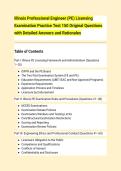
Illinois Professional Engineer (PE) Licensing
Examination Practice Test 150 Original Questions
with Detailed Answers and Rationales
Table of Contents
Part I: Illinois PE Licensing Framework and Administration (Questions
1–20)
● IDFPR and the PE Board
● The Two-Part Examination System (FE and PE)
● Education Requirements (ABET/EAC and Non-Approved Programs)
● Experience Requirements
● Application Process and Timelines
● Licensure by Endorsement
Part II: Illinois PE Examination Rules and Procedures (Questions 21–40)
● NCEES Examinations
● Examination Retake Policies
● Examination Windows and Testing Limits
● Civil/Structural Examination Restrictions
● Scoring and Reporting
● Examination Review Policies
Part III: Engineering Ethics and Professional Conduct (Questions 41–65)
● Licensee's Obligation to the Public
● Competence and Qualifications
● Conflicts of Interest
● Confidentiality and Disclosure
, ● Reporting Violations
● Ethical Duties Regarding Design Errors
Part IV: Illinois PE Seal, Signature, and Technical Submissions (Questions
66–85)
● Seal Requirements and Contents
● Signature and License Expiration Date
● Technical Submissions and Cover Sheets
● Computer-Generated Seals
● Unlawful Use of the Seal
Part V: Continuing Education and License Renewal (Questions 86–105)
● Professional Development Hours (PDHs)
● Biennial Renewal Requirements
● Exemptions and Extensions
● Recordkeeping and Audits
● Inactive Status and Reinstatement
Part VI: Professional Design Firms and Business Entities (Questions
106–120)
● Registration of Design Firms
● Sole Proprietorships
● Corporations and LLCs
● Design Firm Registration Numbers
● Loss of Registration
Part VII: Technical Engineering Fundamentals (Questions 121–150)
● Mathematics and Statics
● Mechanics of Materials
● Fluid Mechanics
● Electrical Circuits
● Structural Analysis
, ● Engineering Economics
Part I: Illinois PE Licensing Framework and
Administration
IDFPR and the PE Board
1. Question: The primary purpose of the Illinois Department of Financial
and Professional Regulation (IDFPR) in relation to PE licensing is to:
A) Develop engineering textbooks
B) Regulate the practice and licensing of engineers to ensure public safety
and professional competency
C) Provide engineering scholarships
D) Design public infrastructure
Answer: B
Rationale: The IDFPR oversees professional licensure to ensure public
safety and professional competency in engineering practice. The Division of
Professional Regulation within the IDFPR administers the licensing process
for professional engineers in Illinois.
2. Question: The Illinois PE licensing process is governed by which state
statute?
A) The Structural Engineering Practice Act of 1989
B) The Professional Engineering Practice Act of 1989 (225 ILCS 325)
C) The Illinois Administrative Code, Title 68, Part 1380
D) Both B and C
, Answer: D
Rationale: The Professional Engineering Practice Act of 1989 (225 ILCS
325) is the primary statute governing PE licensure in Illinois. The Illinois
Administrative Code, Title 68, Part 1380 contains the administrative rules
that implement the Act. Both are binding on licensees and applicants.
The Two-Part Examination System
3. Question: The examination for licensure as a professional engineer in
Illinois is divided into:
A) One comprehensive examination
B) Two parts: Part I (Fundamentals of Engineering) and Part II (Principles
and Practice of Engineering)
C) Three parts: Fundamentals, Principles, and Practice
D) Four parts based on engineering discipline
Answer: B
Rationale: Under Section 1380.260 of the Administrative Rules, the
examination for licensure as a PE is divided into two parts. Part I is the
Fundamentals of Engineering (FE) examination, and Part II is the Principles
and Practice of Engineering (PE) examination.
4. Question: An applicant who wishes only to be enrolled as an Engineer
Intern in Illinois must take:
A) Part I (FE) only
B) Part II (PE) only
C) Both Part I and Part II
D) Neither Part I nor Part II
Examination Practice Test 150 Original Questions
with Detailed Answers and Rationales
Table of Contents
Part I: Illinois PE Licensing Framework and Administration (Questions
1–20)
● IDFPR and the PE Board
● The Two-Part Examination System (FE and PE)
● Education Requirements (ABET/EAC and Non-Approved Programs)
● Experience Requirements
● Application Process and Timelines
● Licensure by Endorsement
Part II: Illinois PE Examination Rules and Procedures (Questions 21–40)
● NCEES Examinations
● Examination Retake Policies
● Examination Windows and Testing Limits
● Civil/Structural Examination Restrictions
● Scoring and Reporting
● Examination Review Policies
Part III: Engineering Ethics and Professional Conduct (Questions 41–65)
● Licensee's Obligation to the Public
● Competence and Qualifications
● Conflicts of Interest
● Confidentiality and Disclosure
, ● Reporting Violations
● Ethical Duties Regarding Design Errors
Part IV: Illinois PE Seal, Signature, and Technical Submissions (Questions
66–85)
● Seal Requirements and Contents
● Signature and License Expiration Date
● Technical Submissions and Cover Sheets
● Computer-Generated Seals
● Unlawful Use of the Seal
Part V: Continuing Education and License Renewal (Questions 86–105)
● Professional Development Hours (PDHs)
● Biennial Renewal Requirements
● Exemptions and Extensions
● Recordkeeping and Audits
● Inactive Status and Reinstatement
Part VI: Professional Design Firms and Business Entities (Questions
106–120)
● Registration of Design Firms
● Sole Proprietorships
● Corporations and LLCs
● Design Firm Registration Numbers
● Loss of Registration
Part VII: Technical Engineering Fundamentals (Questions 121–150)
● Mathematics and Statics
● Mechanics of Materials
● Fluid Mechanics
● Electrical Circuits
● Structural Analysis
, ● Engineering Economics
Part I: Illinois PE Licensing Framework and
Administration
IDFPR and the PE Board
1. Question: The primary purpose of the Illinois Department of Financial
and Professional Regulation (IDFPR) in relation to PE licensing is to:
A) Develop engineering textbooks
B) Regulate the practice and licensing of engineers to ensure public safety
and professional competency
C) Provide engineering scholarships
D) Design public infrastructure
Answer: B
Rationale: The IDFPR oversees professional licensure to ensure public
safety and professional competency in engineering practice. The Division of
Professional Regulation within the IDFPR administers the licensing process
for professional engineers in Illinois.
2. Question: The Illinois PE licensing process is governed by which state
statute?
A) The Structural Engineering Practice Act of 1989
B) The Professional Engineering Practice Act of 1989 (225 ILCS 325)
C) The Illinois Administrative Code, Title 68, Part 1380
D) Both B and C
, Answer: D
Rationale: The Professional Engineering Practice Act of 1989 (225 ILCS
325) is the primary statute governing PE licensure in Illinois. The Illinois
Administrative Code, Title 68, Part 1380 contains the administrative rules
that implement the Act. Both are binding on licensees and applicants.
The Two-Part Examination System
3. Question: The examination for licensure as a professional engineer in
Illinois is divided into:
A) One comprehensive examination
B) Two parts: Part I (Fundamentals of Engineering) and Part II (Principles
and Practice of Engineering)
C) Three parts: Fundamentals, Principles, and Practice
D) Four parts based on engineering discipline
Answer: B
Rationale: Under Section 1380.260 of the Administrative Rules, the
examination for licensure as a PE is divided into two parts. Part I is the
Fundamentals of Engineering (FE) examination, and Part II is the Principles
and Practice of Engineering (PE) examination.
4. Question: An applicant who wishes only to be enrolled as an Engineer
Intern in Illinois must take:
A) Part I (FE) only
B) Part II (PE) only
C) Both Part I and Part II
D) Neither Part I nor Part II