
NIHSS STROKE SCALE 2026/2027...
NIHSS STROKE SCALE
Study online at https://quizlet.com/_dea64d
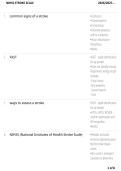
1. common signs of a stroke •Confusion
•Slurred speech
•Facial droop
•Extremity weakness
and/or numbness
•Vision disturbance
•Dysphasia
•Ataxia
2. FAST •FAST - rapid identification
for lay people
•Does not identify sensory
impairment, vertigo or gait
changes
-Facial droop
-Arm weakness
-Slurred speech
-Time
3. ways to assess a stroke •FAST - rapid identification
for lay people
•CPSS, LAPSS, ROSIER -
used for prehospital and
ER recognition
•NIHSS
4. NIHSS (National Institutes of Health Stroke Scale) •Reliable and valid
•Used to objectively quan-
tify the stroke impair-
ments
•Also used in emergent
situations to determine
1/8
1 of 8
, NIHSS STROKE SCALE 2026/2027...
NIHSS STROKE SCALE
Study online at https://quizlet.com/_dea64d
treatment planning (the
need for tPA) in the 3 - 4.5
hour window, along with
clinical decision making
•Predictor of short and
long-term outcomes
•Does not capture all
stroke symptoms - ver-
tebrobasilar stroke can
cause vertigo, nausea and
vomiting, headache, ocu-
lomotor signs
5. 1. Level of Consciousness 1-11 of the NIHSS
2. Best Gaze
3. Visual Fields
4. Facial Paresis
5. Motor Arm
6. Motor Leg
7. Limb Ataxia
8. Sensory
9. Best Language
10. Speech
11. Extinction and Inattention
6. 1. Level of Consciousness Divided into 3 sections:
•Responsiveness
•Questions
•Commands
7. 0 = alert; responsive 1a. LOC Responsiveness
1 = not alert; arousable by verbal or minor stimuli to (scaled 0-3)
2/8
2 of 8
NIHSS STROKE SCALE
Study online at https://quizlet.com/_dea64d
1. common signs of a stroke •Confusion
•Slurred speech
•Facial droop
•Extremity weakness
and/or numbness
•Vision disturbance
•Dysphasia
•Ataxia
2. FAST •FAST - rapid identification
for lay people
•Does not identify sensory
impairment, vertigo or gait
changes
-Facial droop
-Arm weakness
-Slurred speech
-Time
3. ways to assess a stroke •FAST - rapid identification
for lay people
•CPSS, LAPSS, ROSIER -
used for prehospital and
ER recognition
•NIHSS
4. NIHSS (National Institutes of Health Stroke Scale) •Reliable and valid
•Used to objectively quan-
tify the stroke impair-
ments
•Also used in emergent
situations to determine
1/8
1 of 8
, NIHSS STROKE SCALE 2026/2027...
NIHSS STROKE SCALE
Study online at https://quizlet.com/_dea64d
treatment planning (the
need for tPA) in the 3 - 4.5
hour window, along with
clinical decision making
•Predictor of short and
long-term outcomes
•Does not capture all
stroke symptoms - ver-
tebrobasilar stroke can
cause vertigo, nausea and
vomiting, headache, ocu-
lomotor signs
5. 1. Level of Consciousness 1-11 of the NIHSS
2. Best Gaze
3. Visual Fields
4. Facial Paresis
5. Motor Arm
6. Motor Leg
7. Limb Ataxia
8. Sensory
9. Best Language
10. Speech
11. Extinction and Inattention
6. 1. Level of Consciousness Divided into 3 sections:
•Responsiveness
•Questions
•Commands
7. 0 = alert; responsive 1a. LOC Responsiveness
1 = not alert; arousable by verbal or minor stimuli to (scaled 0-3)
2/8
2 of 8


