
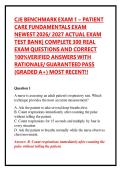
CJE BENCHMARK EXAM 1 – PATIENT
CARE FUNDAMENTALS EXAM
NEWEST 2026/ 2027 ACTUAL EXAM
TEST BANK| COMPLETE 300 REAL
EXAM QUESTIONS AND CORRECT
100%VERIFIED ANSWERS WITH
RATIONALE/ GUARANTEED PASS
(GRADED A+) MOST RECENT!!
Question 1
A nurse is assessing an adult patient's respiratory rate. Which
technique provides the most accurate measurement?
A. Ask the patient to take several deep breaths first.
B. Count respirations immediately after counting the pulse
without telling the patient.
C. Count respirations for 15 seconds and multiply by four in
every situation.
D. Ask the patient to breathe normally while the nurse observes
chest movement.
Answer: B. Count respirations immediately after counting the
pulse without telling the patient.
,Rationale: Patients may consciously alter their breathing if they
know respirations are being counted. Observing respirations
immediately after assessing the pulse helps obtain a more
natural respiratory rate.
Question 2
Which action is most effective for preventing the transmission
of microorganisms in a healthcare setting?
A. Wearing gloves for every patient interaction
B. Performing appropriate hand hygiene
C. Wearing a surgical mask during routine care
D. Keeping patients in private rooms
_Answer: B. Performing appropriate hand hygiene.
Rationale: Hand hygiene is a fundamental component of
standard precautions and is one of the most important measures
for preventing transmission of infection.
Question 3
A patient is at increased risk for falls. Which intervention should
the nurse implement first?
A. Place frequently used items within the patient's reach.
B. Raise all four side rails.
C. Keep the patient's room completely dark at night.
D. Restrict the patient's activity.
,_Answer: A. Place frequently used items within the patient's
reach.
Rationale: Keeping essential items within reach reduces
unnecessary attempts to get out of bed and promotes patient
safety without unnecessarily restricting mobility.
Question 4
Which finding should the nurse recognize as a potential
indication of impaired oxygenation?
A. Respiratory rate of 16/min
B. Warm extremities
C. New onset of cyanosis
D. Regular pulse rhythm
_Answer: C. New onset of cyanosis.
Rationale: Cyanosis can indicate inadequate oxygenation and
requires prompt assessment of the patient's respiratory status.
Question 5
A nurse is preparing to transfer a patient from the bed to a
wheelchair. Which action is appropriate?
A. Leave the wheelchair unlocked during the transfer.
B. Position the wheelchair close to the bed and lock its wheels.
, C. Have the patient stand before applying nonskid footwear.
D. Pull the patient by the arms.
_Answer: B. Position the wheelchair close to the bed and
lock its wheels.
Rationale: Locking the wheelchair and positioning it
appropriately reduces the risk of movement and falls during
transfer.
Question 6
Which patient position generally promotes maximum lung
expansion?
A. Prone
B. Supine
C. High-Fowler's
D. Trendelenburg
_Answer: C. High-Fowler's.
Rationale: Elevating the upper body allows greater chest
expansion and can facilitate ventilation.
Question 7
A nurse is caring for a patient with a pressure injury risk. Which
intervention is most appropriate?
CARE FUNDAMENTALS EXAM
NEWEST 2026/ 2027 ACTUAL EXAM
TEST BANK| COMPLETE 300 REAL
EXAM QUESTIONS AND CORRECT
100%VERIFIED ANSWERS WITH
RATIONALE/ GUARANTEED PASS
(GRADED A+) MOST RECENT!!
Question 1
A nurse is assessing an adult patient's respiratory rate. Which
technique provides the most accurate measurement?
A. Ask the patient to take several deep breaths first.
B. Count respirations immediately after counting the pulse
without telling the patient.
C. Count respirations for 15 seconds and multiply by four in
every situation.
D. Ask the patient to breathe normally while the nurse observes
chest movement.
Answer: B. Count respirations immediately after counting the
pulse without telling the patient.
,Rationale: Patients may consciously alter their breathing if they
know respirations are being counted. Observing respirations
immediately after assessing the pulse helps obtain a more
natural respiratory rate.
Question 2
Which action is most effective for preventing the transmission
of microorganisms in a healthcare setting?
A. Wearing gloves for every patient interaction
B. Performing appropriate hand hygiene
C. Wearing a surgical mask during routine care
D. Keeping patients in private rooms
_Answer: B. Performing appropriate hand hygiene.
Rationale: Hand hygiene is a fundamental component of
standard precautions and is one of the most important measures
for preventing transmission of infection.
Question 3
A patient is at increased risk for falls. Which intervention should
the nurse implement first?
A. Place frequently used items within the patient's reach.
B. Raise all four side rails.
C. Keep the patient's room completely dark at night.
D. Restrict the patient's activity.
,_Answer: A. Place frequently used items within the patient's
reach.
Rationale: Keeping essential items within reach reduces
unnecessary attempts to get out of bed and promotes patient
safety without unnecessarily restricting mobility.
Question 4
Which finding should the nurse recognize as a potential
indication of impaired oxygenation?
A. Respiratory rate of 16/min
B. Warm extremities
C. New onset of cyanosis
D. Regular pulse rhythm
_Answer: C. New onset of cyanosis.
Rationale: Cyanosis can indicate inadequate oxygenation and
requires prompt assessment of the patient's respiratory status.
Question 5
A nurse is preparing to transfer a patient from the bed to a
wheelchair. Which action is appropriate?
A. Leave the wheelchair unlocked during the transfer.
B. Position the wheelchair close to the bed and lock its wheels.
, C. Have the patient stand before applying nonskid footwear.
D. Pull the patient by the arms.
_Answer: B. Position the wheelchair close to the bed and
lock its wheels.
Rationale: Locking the wheelchair and positioning it
appropriately reduces the risk of movement and falls during
transfer.
Question 6
Which patient position generally promotes maximum lung
expansion?
A. Prone
B. Supine
C. High-Fowler's
D. Trendelenburg
_Answer: C. High-Fowler's.
Rationale: Elevating the upper body allows greater chest
expansion and can facilitate ventilation.
Question 7
A nurse is caring for a patient with a pressure injury risk. Which
intervention is most appropriate?


