

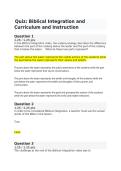
Quiz: Biblical Integration and
Curriculum and Instruction
Question 1
1..25 pts
In the Biblical Integration video, the iceberg analogy describes the difference
between the part of the iceberg above the water and the part of the iceberg
that is below the water. What do these two parts represent?
The part above the water represents the visible actions of the students while
the part below the water represents their values and beliefs.
The part above the water represents the public statements of the students while the part
below the water represents their secret conversations.
The part above the water represents the beliefs and thoughts of the students while the
part below the water represents the beliefs and thoughts of their parents and
communities.
The part above the water represents the good and praiseworthy actions of the students
while the part below the water represents the sinful and hidden behaviors.
Question 2
1..25 pts
In order to be considered Biblical integration, a teacher must use the actual
words of the Bible in the lesson.
True
False
Question 3
1..25 pts
The challenge at the end of the Biblical Integration video was to
, be growing as a Christian, applying to Bible to your own life, so as to be a
living example and model, spontaneously taking opportunities as they arise.
be a bold witness for the gospel of Jesus, even at the risk of losing your job.
keep a Bible on your desk and use it often in your lessons
be careful not to offend anyone by being too opinionated
Question 4
1..25 pts
Which of the following statements about the role of textbooks in curriculum is most accurate?
The curriculum plan, not the textbook, tends to most determine the knowledge base for individual
courses.
Textbooks tend to help address the curriculum to the special needs of particular groups of students.
Textbooks influence the nature and sequence of a curriculum.
Textbooks tend not to affect students' learning experiences.
Question 5
1..25 pts
The __________ curriculum places an emphasis on moral and ethical development.
core
values-centered
student- centered
subject-centered
Question 6
1..25 pts
Curriculum and Instruction
Question 1
1..25 pts
In the Biblical Integration video, the iceberg analogy describes the difference
between the part of the iceberg above the water and the part of the iceberg
that is below the water. What do these two parts represent?
The part above the water represents the visible actions of the students while
the part below the water represents their values and beliefs.
The part above the water represents the public statements of the students while the part
below the water represents their secret conversations.
The part above the water represents the beliefs and thoughts of the students while the
part below the water represents the beliefs and thoughts of their parents and
communities.
The part above the water represents the good and praiseworthy actions of the students
while the part below the water represents the sinful and hidden behaviors.
Question 2
1..25 pts
In order to be considered Biblical integration, a teacher must use the actual
words of the Bible in the lesson.
True
False
Question 3
1..25 pts
The challenge at the end of the Biblical Integration video was to
, be growing as a Christian, applying to Bible to your own life, so as to be a
living example and model, spontaneously taking opportunities as they arise.
be a bold witness for the gospel of Jesus, even at the risk of losing your job.
keep a Bible on your desk and use it often in your lessons
be careful not to offend anyone by being too opinionated
Question 4
1..25 pts
Which of the following statements about the role of textbooks in curriculum is most accurate?
The curriculum plan, not the textbook, tends to most determine the knowledge base for individual
courses.
Textbooks tend to help address the curriculum to the special needs of particular groups of students.
Textbooks influence the nature and sequence of a curriculum.
Textbooks tend not to affect students' learning experiences.
Question 5
1..25 pts
The __________ curriculum places an emphasis on moral and ethical development.
core
values-centered
student- centered
subject-centered
Question 6
1..25 pts


