
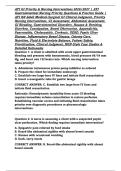
ATI GI Priority & Nursing Interventions 2026/2027 | ATI
Gastrointestinal Nursing Priority Questions & Practice Guide |
ATI RN Adult Medical-Surgical GI Clinical Judgment, Priority
Nursing Interventions, GI Assessment, Abdominal Assessment,
GI Bleeding, Gastrointestinal Disorders, Nausea & Vomiting,
Diarrhea, Constipation, Bowel Obstruction, Appendicitis,
Pancreatitis, Cholecystitis, Cirrhosis, GERD, Peptic Ulcer
Disease, Inflammatory Bowel Disease, Ostomy Care,
Nutrition, Fluid & Electrolyte Balance, Patient Safety,
Prioritization, Clinical Judgment, NGN-Style Case Studies &
Detailed Rationales
Question 1: A client is admitted with acute upper gastrointestinal
bleeding and presents with hematemesis, blood pressure 88/54 mm
Hg, and heart rate 122 beats/min. Which nursing intervention
takes priority?
A. Administer intravenous proton pump inhibitor as ordered
B. Prepare the client for immediate endoscopy
C. Establish two large-bore IV lines and initiate fluid resuscitation
D. Insert a nasogastric tube for gastric lavage
CORRECT ANSWER: C. Establish two large-bore IV lines and
initiate fluid resuscitation
Rationale: Hemodynamic instability from acute GI bleeding
requires immediate volume resuscitation to restore perfusion.
Establishing vascular access and initiating fluid resuscitation takes
priority over diagnostic procedures or pharmacologic
interventions.
Question 2: A nurse is assessing a client with a suspected peptic
ulcer perforation. Which finding requires immediate intervention?
A. Epigastric pain relieved by food intake
B. Board-like abdominal rigidity with absent bowel sounds
C. Nausea with occasional vomiting
D. Dark, tarry stools
CORRECT ANSWER: B. Board-like abdominal rigidity with absent
bowel sounds
,Rationale: Board-like rigidity and absent bowel sounds indicate
peritoneal irritation from perforation, a surgical emergency
requiring immediate intervention. This finding suggests content has
leaked into the peritoneal cavity.
Question 3: A client with cirrhosis develops melena and coffee-
ground emesis. The nurse correctly identifies these findings as
consistent with:
A. Lower gastrointestinal bleeding
B. Upper gastrointestinal bleeding
C. Hemorrhoidal bleeding
D. Colonic diverticular bleeding
CORRECT ANSWER: B. Upper gastrointestinal bleeding
Rationale: Melena and coffee-ground emesis both indicate upper GI
bleeding proximal to the ligament of Treitz where blood is digested
by gastric acid and intestinal bacteria.
Question 4: A nurse is preparing a client for an
esophagogastroduodenoscopy (EGD). Which pre-procedure nursing
action is most important?
A. Administer a bowel preparation the night before
B. Insert a urinary catheter before the procedure
C. Apply a topical anesthetic to the abdomen
D. Ensure the client has been NPO for at least 6-8 hours
CORRECT ANSWER: D. Ensure the client has been NPO for at least
6-8 hours
Rationale: NPO status for 6-8 hours is essential before EGD to
reduce aspiration risk and ensure adequate visualization of the
upper GI mucosa.
Question 5: After an upper endoscopy, which nursing assessment is
the priority?
,A. Assess the return of the gag reflex before allowing oral intake
B. Monitor for abdominal distension
C. Check the surgical incision site
D. Monitor urine output hourly
CORRECT ANSWER: A. Assess the return of the gag reflex before
allowing oral intake
Rationale: Throat anesthesia used during EGD suppresses the gag
reflex; oral intake must be withheld until the gag reflex returns
fully to prevent aspiration.
Question 6: A client with peptic ulcer disease is prescribed triple
therapy including a proton-pump inhibitor, clarithromycin, and
amoxicillin. The nurse explains that the primary purpose of this
regimen is to:
A. Provide only symptomatic pain relief
B. Eradicate Helicobacter pylori infection and promote ulcer
healing
C. Replace the need for dietary modification
D. Prevent all future episodes of gastroesophageal reflux
CORRECT ANSWER: B. Eradicate Helicobacter pylori infection and
promote ulcer healing
Rationale: H. pylori is a major cause of peptic ulcer disease. Triple
therapy aims to eradicate the organism and allow mucosal healing,
reducing recurrence risk.
Question 7: A client who underwent partial gastrectomy two days
ago has a nasogastric tube to low intermittent suction. The nurse
notes bright red drainage and heart rate of 118 beats/min. The
most appropriate immediate action is to:
A. Assess vital signs fully, maintain IV access, and notify the
surgeon of possible postoperative hemorrhage
B. Increase the suction pressure to continuous high suction
C. Irrigate the NG tube vigorously with 100 mL of water
D. Remove the NG tube and encourage ambulation
, CORRECT ANSWER: A. Assess vital signs fully, maintain IV access,
and notify the surgeon of possible postoperative hemorrhage
Rationale: Sudden bright-red NG drainage with tachycardia
suggests active bleeding. The nurse stabilizes and notifies the
surgical team promptly rather than manipulating the tube
aggressively.
Question 8: A client with a hiatal hernia reports increased
heartburn when lying flat after meals. The nurse reinforces which
lifestyle measure as most helpful?
A. Eating large meals late in the evening
B. Wearing tight abdominal binders
C. Drinking carbonated beverages with meals
D. Elevating the head of the bed and remaining upright for 2-3
hours after eating
CORRECT ANSWER: D. Elevating the head of the bed and
remaining upright for 2-3 hours after eating
Rationale: Gravity reduces reflux. Elevating the head of the bed,
eating smaller earlier meals, and remaining upright after eating are
standard nonpharmacologic measures for GERD symptoms.
Question 9: A client is receiving continuous IV pantoprazole for a
suspected bleeding peptic ulcer. The nurse understands that the
primary pharmacologic goal of this therapy is to:
A. Stimulate gastric acid secretion to promote clotting
B. Raise gastric pH to stabilize clot formation and reduce further
acid injury
C. Neutralize acid already present in the stomach
D. Promote gastric emptying to reduce acid exposure
CORRECT ANSWER: B. Raise gastric pH to stabilize clot formation
and reduce further acid injury
Gastrointestinal Nursing Priority Questions & Practice Guide |
ATI RN Adult Medical-Surgical GI Clinical Judgment, Priority
Nursing Interventions, GI Assessment, Abdominal Assessment,
GI Bleeding, Gastrointestinal Disorders, Nausea & Vomiting,
Diarrhea, Constipation, Bowel Obstruction, Appendicitis,
Pancreatitis, Cholecystitis, Cirrhosis, GERD, Peptic Ulcer
Disease, Inflammatory Bowel Disease, Ostomy Care,
Nutrition, Fluid & Electrolyte Balance, Patient Safety,
Prioritization, Clinical Judgment, NGN-Style Case Studies &
Detailed Rationales
Question 1: A client is admitted with acute upper gastrointestinal
bleeding and presents with hematemesis, blood pressure 88/54 mm
Hg, and heart rate 122 beats/min. Which nursing intervention
takes priority?
A. Administer intravenous proton pump inhibitor as ordered
B. Prepare the client for immediate endoscopy
C. Establish two large-bore IV lines and initiate fluid resuscitation
D. Insert a nasogastric tube for gastric lavage
CORRECT ANSWER: C. Establish two large-bore IV lines and
initiate fluid resuscitation
Rationale: Hemodynamic instability from acute GI bleeding
requires immediate volume resuscitation to restore perfusion.
Establishing vascular access and initiating fluid resuscitation takes
priority over diagnostic procedures or pharmacologic
interventions.
Question 2: A nurse is assessing a client with a suspected peptic
ulcer perforation. Which finding requires immediate intervention?
A. Epigastric pain relieved by food intake
B. Board-like abdominal rigidity with absent bowel sounds
C. Nausea with occasional vomiting
D. Dark, tarry stools
CORRECT ANSWER: B. Board-like abdominal rigidity with absent
bowel sounds
,Rationale: Board-like rigidity and absent bowel sounds indicate
peritoneal irritation from perforation, a surgical emergency
requiring immediate intervention. This finding suggests content has
leaked into the peritoneal cavity.
Question 3: A client with cirrhosis develops melena and coffee-
ground emesis. The nurse correctly identifies these findings as
consistent with:
A. Lower gastrointestinal bleeding
B. Upper gastrointestinal bleeding
C. Hemorrhoidal bleeding
D. Colonic diverticular bleeding
CORRECT ANSWER: B. Upper gastrointestinal bleeding
Rationale: Melena and coffee-ground emesis both indicate upper GI
bleeding proximal to the ligament of Treitz where blood is digested
by gastric acid and intestinal bacteria.
Question 4: A nurse is preparing a client for an
esophagogastroduodenoscopy (EGD). Which pre-procedure nursing
action is most important?
A. Administer a bowel preparation the night before
B. Insert a urinary catheter before the procedure
C. Apply a topical anesthetic to the abdomen
D. Ensure the client has been NPO for at least 6-8 hours
CORRECT ANSWER: D. Ensure the client has been NPO for at least
6-8 hours
Rationale: NPO status for 6-8 hours is essential before EGD to
reduce aspiration risk and ensure adequate visualization of the
upper GI mucosa.
Question 5: After an upper endoscopy, which nursing assessment is
the priority?
,A. Assess the return of the gag reflex before allowing oral intake
B. Monitor for abdominal distension
C. Check the surgical incision site
D. Monitor urine output hourly
CORRECT ANSWER: A. Assess the return of the gag reflex before
allowing oral intake
Rationale: Throat anesthesia used during EGD suppresses the gag
reflex; oral intake must be withheld until the gag reflex returns
fully to prevent aspiration.
Question 6: A client with peptic ulcer disease is prescribed triple
therapy including a proton-pump inhibitor, clarithromycin, and
amoxicillin. The nurse explains that the primary purpose of this
regimen is to:
A. Provide only symptomatic pain relief
B. Eradicate Helicobacter pylori infection and promote ulcer
healing
C. Replace the need for dietary modification
D. Prevent all future episodes of gastroesophageal reflux
CORRECT ANSWER: B. Eradicate Helicobacter pylori infection and
promote ulcer healing
Rationale: H. pylori is a major cause of peptic ulcer disease. Triple
therapy aims to eradicate the organism and allow mucosal healing,
reducing recurrence risk.
Question 7: A client who underwent partial gastrectomy two days
ago has a nasogastric tube to low intermittent suction. The nurse
notes bright red drainage and heart rate of 118 beats/min. The
most appropriate immediate action is to:
A. Assess vital signs fully, maintain IV access, and notify the
surgeon of possible postoperative hemorrhage
B. Increase the suction pressure to continuous high suction
C. Irrigate the NG tube vigorously with 100 mL of water
D. Remove the NG tube and encourage ambulation
, CORRECT ANSWER: A. Assess vital signs fully, maintain IV access,
and notify the surgeon of possible postoperative hemorrhage
Rationale: Sudden bright-red NG drainage with tachycardia
suggests active bleeding. The nurse stabilizes and notifies the
surgical team promptly rather than manipulating the tube
aggressively.
Question 8: A client with a hiatal hernia reports increased
heartburn when lying flat after meals. The nurse reinforces which
lifestyle measure as most helpful?
A. Eating large meals late in the evening
B. Wearing tight abdominal binders
C. Drinking carbonated beverages with meals
D. Elevating the head of the bed and remaining upright for 2-3
hours after eating
CORRECT ANSWER: D. Elevating the head of the bed and
remaining upright for 2-3 hours after eating
Rationale: Gravity reduces reflux. Elevating the head of the bed,
eating smaller earlier meals, and remaining upright after eating are
standard nonpharmacologic measures for GERD symptoms.
Question 9: A client is receiving continuous IV pantoprazole for a
suspected bleeding peptic ulcer. The nurse understands that the
primary pharmacologic goal of this therapy is to:
A. Stimulate gastric acid secretion to promote clotting
B. Raise gastric pH to stabilize clot formation and reduce further
acid injury
C. Neutralize acid already present in the stomach
D. Promote gastric emptying to reduce acid exposure
CORRECT ANSWER: B. Raise gastric pH to stabilize clot formation
and reduce further acid injury


