
Waves
WAVES
― Waves are regular disturbances that are repeated as it travels through a medium or
through space.
― They transport energy from one place to another without transporting matter.
― Waves differ from pulses:
- waves are caused by regular vibrations at its source
- a pulse are caused by a single disturbance
TRANSVERSE WAVE
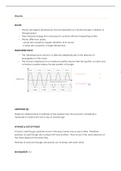
― The vibrating source moves in a direction perpendicular to the direction of
propagation of the wave
― The (wave) is displaced to a maximum position above their rest position at crests and
a minimum position below the rest position at troughs
amplitude
wavelength (λ)
AMPLITUDE (A)
Maximum displacement of particles of the medium from the rest point. Amplitude is
measured in meters from rest to top of crest/trough
IN PHASE & OUT OF PHASE
At each crest/trough, particles move in the exact same way as each other. Therefore,
particles at crest/trough are in phase with one another – they move in the same direction at
the same speed at the same time.
Particles at crest and troughs are exactly out of phase with each other.
WAVELENGTH (λ)
, Distance between two consecutive points on the wave that are in phase. Wavelength is
measured in meters
PERIOD (T)
Time taken for one complete wave to pass a point (time taken for one complete vibration).
Period is measured in seconds (s)
FREQUENCY (f)
Number of complete waves that pass a point in one second. Its measured in hertz (Hz).
1 1
T= f =
f T
Frequency is the inverse of Period and Period is the inverse of Frequency
VELOCITY (v)
― the displacement of the wave front per unit time.
― Wave moves through it medium (or through space) at a constant speed. Change in
position of the wave front is called displacement.
displacement ( λ)
v=
time (T )
THE WAVE EQUATION
v=fλ
ELECTROMAGNETIC RADIATION
MICHAEL FARADAY (1791 – 1867)
Discovered that a changing magnetic field is able to set up an induced current / electric
field and formulated his law of electromagnetic induction. He also produced the first
WAVES
― Waves are regular disturbances that are repeated as it travels through a medium or
through space.
― They transport energy from one place to another without transporting matter.
― Waves differ from pulses:
- waves are caused by regular vibrations at its source
- a pulse are caused by a single disturbance
TRANSVERSE WAVE
― The vibrating source moves in a direction perpendicular to the direction of
propagation of the wave
― The (wave) is displaced to a maximum position above their rest position at crests and
a minimum position below the rest position at troughs
amplitude
wavelength (λ)
AMPLITUDE (A)
Maximum displacement of particles of the medium from the rest point. Amplitude is
measured in meters from rest to top of crest/trough
IN PHASE & OUT OF PHASE
At each crest/trough, particles move in the exact same way as each other. Therefore,
particles at crest/trough are in phase with one another – they move in the same direction at
the same speed at the same time.
Particles at crest and troughs are exactly out of phase with each other.
WAVELENGTH (λ)
, Distance between two consecutive points on the wave that are in phase. Wavelength is
measured in meters
PERIOD (T)
Time taken for one complete wave to pass a point (time taken for one complete vibration).
Period is measured in seconds (s)
FREQUENCY (f)
Number of complete waves that pass a point in one second. Its measured in hertz (Hz).
1 1
T= f =
f T
Frequency is the inverse of Period and Period is the inverse of Frequency
VELOCITY (v)
― the displacement of the wave front per unit time.
― Wave moves through it medium (or through space) at a constant speed. Change in
position of the wave front is called displacement.
displacement ( λ)
v=
time (T )
THE WAVE EQUATION
v=fλ
ELECTROMAGNETIC RADIATION
MICHAEL FARADAY (1791 – 1867)
Discovered that a changing magnetic field is able to set up an induced current / electric
field and formulated his law of electromagnetic induction. He also produced the first



