
BIOL 252 Human Anatomy & Physiology II w/Lab | Module 2 Exam
Review 70+ Questions and Answers -Summary | LockDown Browser
| Portage Learning
1. The liquid portion of whole blood is called:
Plasma
Serum
Lymph
Interstitial fluid
2. Which formed element is primarily responsible for oxygen transport?
Erythrocyte
Platelet
Neutrophil
Monocyte
3. The oxygen-binding protein inside erythrocytes is:
Hemoglobin
Albumin
Fibrinogen
Globulin
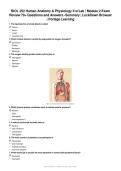
Real anatomical teaching-model photograph.
4. Which plasma protein contributes most to colloid osmotic pressure?
Albumin
Fibrin
Hemoglobin
Immunoglobulin E
5. A mature erythrocyte normally lacks a:
Nucleus
Cell membrane
Cytoskeleton
Hemoglobin
6. The main function of platelets is to participate in:
Hemostasis
Gas exchange
Antibody secretion
Hormone transport
7. Which leukocyte is usually the most abundant in normal adult peripheral blood?
Neutrophil
Eosinophil
BIOL 252 Module 2 • Original exam-style review • Page 1
, Basophil
Monocyte
8. Which leukocyte is especially associated with antibody production after differentiation into plasma cells?
Lymphocyte
Neutrophil
Basophil
Eosinophil
Real peripheral blood-smear photograph.
9. Which leukocyte is most strongly associated with parasitic infections and allergic responses?
Eosinophil
Neutrophil
Monocyte
Platelet
10. Basophils release mediators including:
Histamine and heparin
Hemoglobin and albumin
Fibrin and plasmin
Bile and bilirubin
11. A monocyte that enters tissues commonly differentiates into a:
Macrophage
Platelet
Megakaryocyte
Erythrocyte
12. The process by which blood cells are formed is called:
Hematopoiesis
Hemolysis
Hemostasis
Agglutination
13. The primary site of hematopoiesis in healthy adults is:
Red bone marrow
Yellow bone marrow
Spleen
Thymus
14. A low hematocrit most directly suggests a reduced proportion of:
Erythrocytes
Platelets
Plasma proteins
Leukocytes
BIOL 252 Module 2 • Original exam-style review • Page 2
, 15. Which molecule binds iron in hemoglobin's heme group?
Oxygen
Carbon dioxide
Sodium
Calcium
16. Most carbon dioxide in blood is transported as:
Bicarbonate ions
Dissolved gas only
Carbaminohemoglobin only
Carbonic acid stored in erythrocytes
17. A rise in blood pH tends to shift the oxyhemoglobin dissociation curve:
To the left
To the right
Vertically upward
Not at all
18. An increase in temperature in active skeletal muscle tends to promote hemoglobin:
Releasing oxygen
Binding more oxygen
Binding more calcium
Converting to fibrin
Original heart anatomy schematic.
19. The buffy coat of centrifuged blood contains mainly:
Leukocytes and platelets
Erythrocytes only
Plasma proteins only
Hemoglobin only
20. Serum differs from plasma because serum lacks most:
Clotting factors
Electrolytes
Water
Albumin
21. Which blood type has A antigens and anti-B antibodies in the plasma?
Type A
Type B
Type AB
Type O
22. Which blood type has neither A nor B antigens on erythrocytes?
Type O
BIOL 252 Module 2 • Original exam-style review • Page 3
Review 70+ Questions and Answers -Summary | LockDown Browser
| Portage Learning
1. The liquid portion of whole blood is called:
Plasma
Serum
Lymph
Interstitial fluid
2. Which formed element is primarily responsible for oxygen transport?
Erythrocyte
Platelet
Neutrophil
Monocyte
3. The oxygen-binding protein inside erythrocytes is:
Hemoglobin
Albumin
Fibrinogen
Globulin
Real anatomical teaching-model photograph.
4. Which plasma protein contributes most to colloid osmotic pressure?
Albumin
Fibrin
Hemoglobin
Immunoglobulin E
5. A mature erythrocyte normally lacks a:
Nucleus
Cell membrane
Cytoskeleton
Hemoglobin
6. The main function of platelets is to participate in:
Hemostasis
Gas exchange
Antibody secretion
Hormone transport
7. Which leukocyte is usually the most abundant in normal adult peripheral blood?
Neutrophil
Eosinophil
BIOL 252 Module 2 • Original exam-style review • Page 1
, Basophil
Monocyte
8. Which leukocyte is especially associated with antibody production after differentiation into plasma cells?
Lymphocyte
Neutrophil
Basophil
Eosinophil
Real peripheral blood-smear photograph.
9. Which leukocyte is most strongly associated with parasitic infections and allergic responses?
Eosinophil
Neutrophil
Monocyte
Platelet
10. Basophils release mediators including:
Histamine and heparin
Hemoglobin and albumin
Fibrin and plasmin
Bile and bilirubin
11. A monocyte that enters tissues commonly differentiates into a:
Macrophage
Platelet
Megakaryocyte
Erythrocyte
12. The process by which blood cells are formed is called:
Hematopoiesis
Hemolysis
Hemostasis
Agglutination
13. The primary site of hematopoiesis in healthy adults is:
Red bone marrow
Yellow bone marrow
Spleen
Thymus
14. A low hematocrit most directly suggests a reduced proportion of:
Erythrocytes
Platelets
Plasma proteins
Leukocytes
BIOL 252 Module 2 • Original exam-style review • Page 2
, 15. Which molecule binds iron in hemoglobin's heme group?
Oxygen
Carbon dioxide
Sodium
Calcium
16. Most carbon dioxide in blood is transported as:
Bicarbonate ions
Dissolved gas only
Carbaminohemoglobin only
Carbonic acid stored in erythrocytes
17. A rise in blood pH tends to shift the oxyhemoglobin dissociation curve:
To the left
To the right
Vertically upward
Not at all
18. An increase in temperature in active skeletal muscle tends to promote hemoglobin:
Releasing oxygen
Binding more oxygen
Binding more calcium
Converting to fibrin
Original heart anatomy schematic.
19. The buffy coat of centrifuged blood contains mainly:
Leukocytes and platelets
Erythrocytes only
Plasma proteins only
Hemoglobin only
20. Serum differs from plasma because serum lacks most:
Clotting factors
Electrolytes
Water
Albumin
21. Which blood type has A antigens and anti-B antibodies in the plasma?
Type A
Type B
Type AB
Type O
22. Which blood type has neither A nor B antigens on erythrocytes?
Type O
BIOL 252 Module 2 • Original exam-style review • Page 3


