
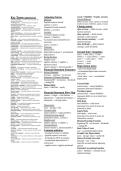
Key Terms (alphabetical) Adjusting Entries Assets = liabilities + Equity Account
Accrual Accounting — records revenue when earned and Deferrals: Normal Balances:
expenses when incurred Debits increase: assets, expenses, dividends
Accounting Cycle — steps from transaction recording to Prepaid expenses (used):
preparing financial statements
expense ↑, asset ↓ Credits increase: liabilities, equity, revenue
Accounting Equation — assets = liabilities + equity
Accounts Payable — amounts owed to creditors Unearned revenue (earned): Closing entries:
Accounts Receivable — amounts customers owe the business
Adjusting Entries — end‑of‑period updates for accruals and liability ↓, revenue ↑ close revenue → debit revenue, credit
deferrals
Accruals: income summary
Adjusted Trial Balance — trial balance after adjusting entries
Asset — resource providing future economic benefit Accrued expenses (owed): close expenses → debit income
Balance Sheet — reports assets, liabilities, and equity at a point in
time expense ↑, liability ↑ summary, credit expenses
Book Value — asset cost minus accumulated depreciation
Accrued revenue (earned but not close income summary → credit
Cash Basis Accounting — records revenue when cash received,
expenses when paid received): retained earnings
Chart of Accounts — list of all account names and numbers
Closing Entries — entries that reset temporary accounts to zero asset ↑, revenue ↑ close dividends → debit retained
Common Stock — basic ownership shares issued by a corporation
Estimates: earnings, credit dividends
Comparability — information can be compared across periods or
companies Depreciation:
Consistency Principle — same accounting methods each period
Contra Account — account that reduces another account balance depreciation expense ↑, accumulated Journal Entry Templates
Conservatism Principle — avoid overstating assets or income asset ↑ → debit; asset ↓ → credit
Cost Principle — record assets at their original purchase cost
depreciation ↑
Credit — right side of a journal entry; increases liabilities& equity Reclassification: liability ↑ → credit; liability ↓ → debit
Current Assets — assets expected to be used within one year equity ↑ → credit; equity ↓ → debit
Current Liabilities — obligations due within one year Supplies used:
Debit — left side of a journal entry; increases assets and expenses
supplies expense ↑, supplies ↓ revenue ↑ → credit
Deferred Revenue — cash received before earning revenue expense ↑ → debit
Depreciation (Straight‑Line) — cost minus salvage divided by Interest accrued:
useful life
Dividends — distributions of earnings to shareholders interest expense ↑, interest payable ↑ Depreciation notes:
Double‑Entry Accounting — every transaction affects at least
two accounts Financial Statement Structures - land is not depreciated
Economic Entity Assumption — business is separate from owner - accumulated depreciation increases
Income Statement:
Equity — owner claims on assets after liabilities with credit
Expense — cost incurred to generate revenue revenues – expenses = net income
Fiscal Year — 12‑month accounting period - book value = cost – accumulated
Financial Statements — income statement, balance sheet, Statement of Retained Earnings:
statement of equity depreciation
GAAP — generally accepted accounting principles
beginning RE + net income – dividends
General Journal — chronological record of transactions = ending RE
General Ledger — collection of all accounts and balances Current Ratio
Going Concern Assumption — business will continue operating Balance Sheet:
Historical Cost — assets recorded at purchase price current assets ÷ current liabilities
assets = liabilities + equity
Income Statement — reports revenues and expenses over period
Interest — cost of borrowing money
(measures short‑term liquidity)
Internal Controls — procedures to protect assets and ensure Working Capital
reliable reporting
Inventory — goods held for sale (definition only for Exam 1)
Financial Statement Flow Map current assets – current liabilities
Journal Entry — record of a transaction’s debits and credits journal → ledger → trial balance → (measures ability to cover short‑term
Liability — obligation owed to others
Liquidity — ability to meet short‑term obligations
adjustments → adjusted trial balance → obligations)
Matching Principle — expenses recorded in same period as statements → closing entries Debt Ratio
related revenue
Materiality — only significant information must be reported
Net Income — revenues minus expenses
total liabilities ÷ total assets
Net Loss — expenses exceed revenues
Depreciation: (measures how much of assets are
Notes Payable — written promise to pay a creditor (cost – salvage) ÷ life financed by debt)
Notes Receivable — written promise from a customer to pay
Objectivity Principle — financial information must be supported Accrued wages: Equity Ratio
by evidence
Owner’s Equity — owner’s residual interest in the business
wages expense ↑, wages payable ↑ total equity ÷ total assets
Paid‑In Capital — amounts invested by owners Unearned revenue earned: (measures how much of assets are
Permanent Accounts — accounts that carry balances to next
period unearned revenue ↓, revenue ↑ financed by owners)
Posting — transferring journal entries to ledger accounts
Prepaid Expense — paid in advance; asset until used
Supplies used: Retained Earnings Formula
Retained Earnings — accumulated net income minus dividends supplies expense ↑, supplies ↓ beginning RE + net income – dividends
Revenue — income earned from operations
Reversing Entries — optional entries to simplify next period’s Accrued interest: = ending RE
recording
T‑Account — visual representation of debits and credits
interest expense ↑, interest payable ↑ Book Value of Asset
Temporary Accounts — revenues, expenses, dividends; closed
each period
Common mistakes: cost – accumulated depreciation
Time Period Assumption — business activities divided into - unearned revenue is a liability Straight‑Line Depreciation
periods
Trial Balance — list of accounts and balances to check equality of - prepaid expense is an asset (cost – salvage value) ÷ useful life
debits/credits
Unearned Revenue — liability for cash received before earning
- dividends are NOT an expense Interest Formula (Accrual)
revenue - accumulated depreciation is a principal × rate × time
Working Capital — current assets minus current liabilities
contra‑asset (used for accrued interest adjusting
- supplies used ≠ supplies purchased entries)
Expanded Accounting Equation
assets = liabilities + common stock +
retained earnings
Accrual Accounting — records revenue when earned and Deferrals: Normal Balances:
expenses when incurred Debits increase: assets, expenses, dividends
Accounting Cycle — steps from transaction recording to Prepaid expenses (used):
preparing financial statements
expense ↑, asset ↓ Credits increase: liabilities, equity, revenue
Accounting Equation — assets = liabilities + equity
Accounts Payable — amounts owed to creditors Unearned revenue (earned): Closing entries:
Accounts Receivable — amounts customers owe the business
Adjusting Entries — end‑of‑period updates for accruals and liability ↓, revenue ↑ close revenue → debit revenue, credit
deferrals
Accruals: income summary
Adjusted Trial Balance — trial balance after adjusting entries
Asset — resource providing future economic benefit Accrued expenses (owed): close expenses → debit income
Balance Sheet — reports assets, liabilities, and equity at a point in
time expense ↑, liability ↑ summary, credit expenses
Book Value — asset cost minus accumulated depreciation
Accrued revenue (earned but not close income summary → credit
Cash Basis Accounting — records revenue when cash received,
expenses when paid received): retained earnings
Chart of Accounts — list of all account names and numbers
Closing Entries — entries that reset temporary accounts to zero asset ↑, revenue ↑ close dividends → debit retained
Common Stock — basic ownership shares issued by a corporation
Estimates: earnings, credit dividends
Comparability — information can be compared across periods or
companies Depreciation:
Consistency Principle — same accounting methods each period
Contra Account — account that reduces another account balance depreciation expense ↑, accumulated Journal Entry Templates
Conservatism Principle — avoid overstating assets or income asset ↑ → debit; asset ↓ → credit
Cost Principle — record assets at their original purchase cost
depreciation ↑
Credit — right side of a journal entry; increases liabilities& equity Reclassification: liability ↑ → credit; liability ↓ → debit
Current Assets — assets expected to be used within one year equity ↑ → credit; equity ↓ → debit
Current Liabilities — obligations due within one year Supplies used:
Debit — left side of a journal entry; increases assets and expenses
supplies expense ↑, supplies ↓ revenue ↑ → credit
Deferred Revenue — cash received before earning revenue expense ↑ → debit
Depreciation (Straight‑Line) — cost minus salvage divided by Interest accrued:
useful life
Dividends — distributions of earnings to shareholders interest expense ↑, interest payable ↑ Depreciation notes:
Double‑Entry Accounting — every transaction affects at least
two accounts Financial Statement Structures - land is not depreciated
Economic Entity Assumption — business is separate from owner - accumulated depreciation increases
Income Statement:
Equity — owner claims on assets after liabilities with credit
Expense — cost incurred to generate revenue revenues – expenses = net income
Fiscal Year — 12‑month accounting period - book value = cost – accumulated
Financial Statements — income statement, balance sheet, Statement of Retained Earnings:
statement of equity depreciation
GAAP — generally accepted accounting principles
beginning RE + net income – dividends
General Journal — chronological record of transactions = ending RE
General Ledger — collection of all accounts and balances Current Ratio
Going Concern Assumption — business will continue operating Balance Sheet:
Historical Cost — assets recorded at purchase price current assets ÷ current liabilities
assets = liabilities + equity
Income Statement — reports revenues and expenses over period
Interest — cost of borrowing money
(measures short‑term liquidity)
Internal Controls — procedures to protect assets and ensure Working Capital
reliable reporting
Inventory — goods held for sale (definition only for Exam 1)
Financial Statement Flow Map current assets – current liabilities
Journal Entry — record of a transaction’s debits and credits journal → ledger → trial balance → (measures ability to cover short‑term
Liability — obligation owed to others
Liquidity — ability to meet short‑term obligations
adjustments → adjusted trial balance → obligations)
Matching Principle — expenses recorded in same period as statements → closing entries Debt Ratio
related revenue
Materiality — only significant information must be reported
Net Income — revenues minus expenses
total liabilities ÷ total assets
Net Loss — expenses exceed revenues
Depreciation: (measures how much of assets are
Notes Payable — written promise to pay a creditor (cost – salvage) ÷ life financed by debt)
Notes Receivable — written promise from a customer to pay
Objectivity Principle — financial information must be supported Accrued wages: Equity Ratio
by evidence
Owner’s Equity — owner’s residual interest in the business
wages expense ↑, wages payable ↑ total equity ÷ total assets
Paid‑In Capital — amounts invested by owners Unearned revenue earned: (measures how much of assets are
Permanent Accounts — accounts that carry balances to next
period unearned revenue ↓, revenue ↑ financed by owners)
Posting — transferring journal entries to ledger accounts
Prepaid Expense — paid in advance; asset until used
Supplies used: Retained Earnings Formula
Retained Earnings — accumulated net income minus dividends supplies expense ↑, supplies ↓ beginning RE + net income – dividends
Revenue — income earned from operations
Reversing Entries — optional entries to simplify next period’s Accrued interest: = ending RE
recording
T‑Account — visual representation of debits and credits
interest expense ↑, interest payable ↑ Book Value of Asset
Temporary Accounts — revenues, expenses, dividends; closed
each period
Common mistakes: cost – accumulated depreciation
Time Period Assumption — business activities divided into - unearned revenue is a liability Straight‑Line Depreciation
periods
Trial Balance — list of accounts and balances to check equality of - prepaid expense is an asset (cost – salvage value) ÷ useful life
debits/credits
Unearned Revenue — liability for cash received before earning
- dividends are NOT an expense Interest Formula (Accrual)
revenue - accumulated depreciation is a principal × rate × time
Working Capital — current assets minus current liabilities
contra‑asset (used for accrued interest adjusting
- supplies used ≠ supplies purchased entries)
Expanded Accounting Equation
assets = liabilities + common stock +
retained earnings


