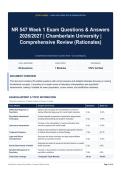
[STUDY GUIDE] • HIGH-YIELD PRACTICE & REVIEW EDITION
NR 547 Week 1 Exam Questions & Answers
2026/2027 | Chamberlain University |
Comprehensive Review (Rationales)
Comprehensive Examination Question Bank • Concept Mapping
TOTAL QUESTIONS EXAM TOPICS RATIONALES
29 Questions 7 Modules 100% Verified
DOCUMENT OVERVIEW
This document contains 29 verified questions with correct answers and detailed rationales focusing on nursing
foundational concepts. It provides an in-depth review of laboratory interpretations and psychiatric
assessments, making it suitable for exam preparation, course review, and certification readiness.
EXAM BLUEPRINT & TOPIC DISTRIBUTION
Systematic breakdown of subject domains and exam coverage.
Topic Module Scope & Core Focus Questions Share (%)
Differential Diagnosis in Explores the processes and considerations involved in
Psychiatry making differential diagnoses for mental health disorders. 3 Qs 10.3%
Psychiatric Assessment Covers essential components of psychiatric assessments,
Techniques including history-taking and symptom evaluation. 4 Qs 13.8%
Focuses on the interpretation of various laboratory tests
Laboratory Interpretation relevant to general and mental health. 8 Qs 27.6%
Analyzes case scenarios to determine appropriate treatment
Treatment Decisions or referral actions based on clinical findings. 7 Qs 24.1%
Legal and Ethical Discusses the ethical principles and legal responsibilities
Considerations pertinent to psychiatric practice. 3 Qs 10.3%
Examines the impact of social and structural factors on mental
Social Determinants of Health health outcomes. 2 Qs 6.9%
Symptom Management in Focuses on the principles of symptom-directed treatment for
Psychiatry psychiatric conditions. 2 Qs 6.9%
Total Exam Coverage 7 Integrated Topic Modules 29 Qs 100.0%
Confidential • Student Study Edition • Practice & Review Guide Page 1 of 14
, STUDENT STUDY & MASTERY EDITION PRACTICE & REVIEW GUIDE
TOPIC 1: DIFFERENTIAL DIAGNOSIS IN PSYCHIATRY
3 Questions • 10.3% of Exam • Explores the processes and considerations involved in making differential diagnoses for mental health
disorders.
QUESTION 1
Differential diagnosis
Answer: The provider's initial hypothesis
-a working list of potential problems that can be associated with the initial or chief complaint
-Diagnostic and Statistical Manual of Mental Disorders (DSM-5-TR)
• provides guidance for identifying psychiatric diagnoses.
Rationale: A differential diagnosis is an initial hypothesis representing a working list of potential problems associated with a
patient's chief complaint. This process involves considering various possibilities to determine the most likely diagnosis.
QUESTION 2
A 52-year-old client presents to the emergency department following a car accident.
The emergency department (ED) physician is concerned that the client may have
intentionally crashed her car and requests a stat PMHNP consult. In speaking with the
PMHNP, the client describes persistent feelings of sadness and hopelessness. She
states that she often wonders if her husband would be happier if she wasn't around
anymore since she's never happy and sometimes thinks about what it would be like to
just take a handful of sleeping pills and go to sleep forever. The client reports a
previous suicide attempt when she was 16 but denies that she is considering killing
herself right now. Based on the client's ASQ score, what is the most appropriate
response? No action is necessary as the client is not currently considering suicide.
Provide a brief suicide safety assessment. Alert the client's primary care physician.
Provide a STAT safety and full mental health evaluation.
Answer: Provide a brief suicide safety assessment.
Rationale: While the client's responses do not indicate a need for a stat full safety and mental health evaluation, the client
requires a brief suicide safety assessment to determine whether a full mental health evaluation in necessary. It is also
important to notify the client's physician or the clinician responsible for the client's care.
Confidential • Student Study Edition • Practice & Review Guide Page 2 of 14
NR 547 Week 1 Exam Questions & Answers
2026/2027 | Chamberlain University |
Comprehensive Review (Rationales)
Comprehensive Examination Question Bank • Concept Mapping
TOTAL QUESTIONS EXAM TOPICS RATIONALES
29 Questions 7 Modules 100% Verified
DOCUMENT OVERVIEW
This document contains 29 verified questions with correct answers and detailed rationales focusing on nursing
foundational concepts. It provides an in-depth review of laboratory interpretations and psychiatric
assessments, making it suitable for exam preparation, course review, and certification readiness.
EXAM BLUEPRINT & TOPIC DISTRIBUTION
Systematic breakdown of subject domains and exam coverage.
Topic Module Scope & Core Focus Questions Share (%)
Differential Diagnosis in Explores the processes and considerations involved in
Psychiatry making differential diagnoses for mental health disorders. 3 Qs 10.3%
Psychiatric Assessment Covers essential components of psychiatric assessments,
Techniques including history-taking and symptom evaluation. 4 Qs 13.8%
Focuses on the interpretation of various laboratory tests
Laboratory Interpretation relevant to general and mental health. 8 Qs 27.6%
Analyzes case scenarios to determine appropriate treatment
Treatment Decisions or referral actions based on clinical findings. 7 Qs 24.1%
Legal and Ethical Discusses the ethical principles and legal responsibilities
Considerations pertinent to psychiatric practice. 3 Qs 10.3%
Examines the impact of social and structural factors on mental
Social Determinants of Health health outcomes. 2 Qs 6.9%
Symptom Management in Focuses on the principles of symptom-directed treatment for
Psychiatry psychiatric conditions. 2 Qs 6.9%
Total Exam Coverage 7 Integrated Topic Modules 29 Qs 100.0%
Confidential • Student Study Edition • Practice & Review Guide Page 1 of 14
, STUDENT STUDY & MASTERY EDITION PRACTICE & REVIEW GUIDE
TOPIC 1: DIFFERENTIAL DIAGNOSIS IN PSYCHIATRY
3 Questions • 10.3% of Exam • Explores the processes and considerations involved in making differential diagnoses for mental health
disorders.
QUESTION 1
Differential diagnosis
Answer: The provider's initial hypothesis
-a working list of potential problems that can be associated with the initial or chief complaint
-Diagnostic and Statistical Manual of Mental Disorders (DSM-5-TR)
• provides guidance for identifying psychiatric diagnoses.
Rationale: A differential diagnosis is an initial hypothesis representing a working list of potential problems associated with a
patient's chief complaint. This process involves considering various possibilities to determine the most likely diagnosis.
QUESTION 2
A 52-year-old client presents to the emergency department following a car accident.
The emergency department (ED) physician is concerned that the client may have
intentionally crashed her car and requests a stat PMHNP consult. In speaking with the
PMHNP, the client describes persistent feelings of sadness and hopelessness. She
states that she often wonders if her husband would be happier if she wasn't around
anymore since she's never happy and sometimes thinks about what it would be like to
just take a handful of sleeping pills and go to sleep forever. The client reports a
previous suicide attempt when she was 16 but denies that she is considering killing
herself right now. Based on the client's ASQ score, what is the most appropriate
response? No action is necessary as the client is not currently considering suicide.
Provide a brief suicide safety assessment. Alert the client's primary care physician.
Provide a STAT safety and full mental health evaluation.
Answer: Provide a brief suicide safety assessment.
Rationale: While the client's responses do not indicate a need for a stat full safety and mental health evaluation, the client
requires a brief suicide safety assessment to determine whether a full mental health evaluation in necessary. It is also
important to notify the client's physician or the clinician responsible for the client's care.
Confidential • Student Study Edition • Practice & Review Guide Page 2 of 14