[STUDY GUIDE] • HIGH-YIELD PRACTICE & REVIEW EDITION
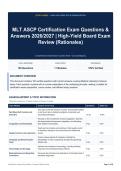
MLT ASCP Certification Exam Questions &
Answers 2026/2027 | High-Yield Board Exam
Review (Rationales)
Comprehensive Examination Question Bank • Concept Mapping
TOTAL QUESTIONS EXAM TOPICS RATIONALES
100 Questions 11 Modules 100% Verified
DOCUMENT OVERVIEW
This document contains 100 verified questions with correct answers covering Medical Laboratory Science
topics. Each question is paired with a concise explanation of the underlying principle, making it suitable for
certification exam preparation, course review, and efficient study sessions.
EXAM BLUEPRINT & TOPIC DISTRIBUTION
Systematic breakdown of subject domains and exam coverage.
Topic Module Scope & Core Focus Questions Share (%)
This topic covers the structure, function, and disorders related
Red Blood Cell Function and to red blood cells, including hemoglobin composition and
Disorders associated pathologies. 10 Qs 10.0%
Focuses on the mechanisms of blood coagulation, disorders
like disseminated intravascular coagulation, and laboratory
Coagulation and Hemostasis tests related to hemostasis. 9 Qs 9.0%
Examines the principles and practices of total quality control
in laboratory settings to ensure accurate and reliable test
Quality Control in the Laboratory results. 9 Qs 9.0%
Covers various aspects of urinalysis, including the
Urinalysis and Renal Function interpretation of urine components and tests for glomerular
Tests filtration rate. 9 Qs 9.0%
Explores the principles of immunology, including antibody
Immunology and Serology responses and serological testing methods. 9 Qs 9.0%
Electrophoresis and Separation Discusses the principles and applications of electrophoresis in
Techniques laboratory diagnostics. 9 Qs 9.0%
Confidential • Student Study Edition • Practice & Review Guide Page 1 of 50
,STUDENT STUDY & MASTERY EDITION PRACTICE & REVIEW GUIDE
Microbiology and Infectious Addresses the identification and characteristics of various
Diseases pathogens and their relevance in clinical settings. 9 Qs 9.0%
Blood Group Systems and Covers the various blood group systems, compatibility testing,
Transfusion Medicine and implications for transfusion practices. 9 Qs 9.0%
Endocrine and Metabolic Focuses on tests related to metabolic functions and endocrine
Disorders disorders, including those affecting blood chemistry. 9 Qs 9.0%
Laboratory Management and Examines the operational aspects of laboratory management,
Operations including workflow efficiency and resource allocation. 9 Qs 9.0%
Clinical Chemistry and Covers the principles of clinical chemistry, including the
Biochemistry analysis of body fluids and interpretation of biochemical tests. 9 Qs 9.0%
Total Exam Coverage 11 Integrated Topic Modules 100 Qs 100.0%
Confidential • Student Study Edition • Practice & Review Guide Page 2 of 50
,STUDENT STUDY & MASTERY EDITION PRACTICE & REVIEW GUIDE
TOPIC 1: RED BLOOD CELL FUNCTION AND DISORDERS
10 Questions • 10.0% of Exam • This topic covers the structure, function, and disorders related to red blood cells, including
hemoglobin composition and associated pathologies.
QUESTION 1
After experiencing extreme fatigue and polyuria, a patient's basic metabolic panel is
analyzed in the laboratory. The result of the glucose is too high for the instrument to
read. The laboratorian performs a dilution using 0.25 mL of patient sample to 750
microliters of diluent. The result now reads 325 mg/dL. How should the techologist
report this patient's glucose result?
[A] 325 mg/dL
[B] 1300 mg/dL
[C] 975 mg/dL
[D] 1625 mg/dL.
Answer: B;
The correct answer for this question is 1300 mg/dL. The laboratorian performed a 1:4 dilution by adding 0.25
mL (or 250 microliters) of patient sample to 750 microliters of diluent. This creates a total volume of 1000
microliters. So, the patient sample is 250 microliters of the 1000 microliter mixed sample, or a ratio of 1:4.
Therefore, the result given by the chemistry analyzer must be multiplied by a dilution factor of 4. 325 mg/dL x
4 = 1300 mg/dL.
QUESTION 2
An individual with type AB blood will demonstrate the complete absence of which of
the following antigen sites?
[A] A
[B] B
[C] H
[D] None of the above.
Answer: D;
The A and B antigens are present on the red cells of an AB patient. H antigen is a precursor to the ABO
antigens.
Confidential • Student Study Edition • Practice & Review Guide Page 3 of 50
, STUDENT STUDY & MASTERY EDITION PRACTICE & REVIEW GUIDE
QUESTION 3
Which of the following media would you use to isolate Francisella tularensis:
[A] Sheep-blood agar
[B] Lowenstein-Jensen media
[C] Bordet-Gengou media
[D] Cysteine-blood agar.
Answer: D;
Although cysteine-blood agar was traditionally used, F. tularensis will also grow on commercially available
Thayer-Martin and chocolate agar which have been enriched with supplemental nutrients.
QUESTION 4
The presence of hyaline, septate hyphae, and a young conidiophore with a foot cell and
a swollen vesicle in a fungus culture are excellent clues indicative of:
[A] Acremonium
[B] Aspergillus
[C] Paecilomyces
[D] Penicillium
[E] Scopulariopsis.
Answer: B;
The presence of hyaline, septate hyphae, and a young conidiophore with a foot cell and a swollen vesicle in a
fungus culture are excellent clues indicative of Aspergillus. Aspergillus has the ability to infect primarily
immunocompromised hosts, and causes pneumonia and/or disseminates to other organs. Clinical specimens
should be inoculated onto primary isolation media, such as Sabouraud's dextrose agar. Aspergillus spp. are
fast growing and can be white, yellow, yellow-brown, brown to black or green in color.
QUESTION 5
A normal hemoglobin molecule is comprised of the following:
Confidential • Student Study Edition • Practice & Review Guide Page 4 of 50
MLT ASCP Certification Exam Questions &
Answers 2026/2027 | High-Yield Board Exam
Review (Rationales)
Comprehensive Examination Question Bank • Concept Mapping
TOTAL QUESTIONS EXAM TOPICS RATIONALES
100 Questions 11 Modules 100% Verified
DOCUMENT OVERVIEW
This document contains 100 verified questions with correct answers covering Medical Laboratory Science
topics. Each question is paired with a concise explanation of the underlying principle, making it suitable for
certification exam preparation, course review, and efficient study sessions.
EXAM BLUEPRINT & TOPIC DISTRIBUTION
Systematic breakdown of subject domains and exam coverage.
Topic Module Scope & Core Focus Questions Share (%)
This topic covers the structure, function, and disorders related
Red Blood Cell Function and to red blood cells, including hemoglobin composition and
Disorders associated pathologies. 10 Qs 10.0%
Focuses on the mechanisms of blood coagulation, disorders
like disseminated intravascular coagulation, and laboratory
Coagulation and Hemostasis tests related to hemostasis. 9 Qs 9.0%
Examines the principles and practices of total quality control
in laboratory settings to ensure accurate and reliable test
Quality Control in the Laboratory results. 9 Qs 9.0%
Covers various aspects of urinalysis, including the
Urinalysis and Renal Function interpretation of urine components and tests for glomerular
Tests filtration rate. 9 Qs 9.0%
Explores the principles of immunology, including antibody
Immunology and Serology responses and serological testing methods. 9 Qs 9.0%
Electrophoresis and Separation Discusses the principles and applications of electrophoresis in
Techniques laboratory diagnostics. 9 Qs 9.0%
Confidential • Student Study Edition • Practice & Review Guide Page 1 of 50
,STUDENT STUDY & MASTERY EDITION PRACTICE & REVIEW GUIDE
Microbiology and Infectious Addresses the identification and characteristics of various
Diseases pathogens and their relevance in clinical settings. 9 Qs 9.0%
Blood Group Systems and Covers the various blood group systems, compatibility testing,
Transfusion Medicine and implications for transfusion practices. 9 Qs 9.0%
Endocrine and Metabolic Focuses on tests related to metabolic functions and endocrine
Disorders disorders, including those affecting blood chemistry. 9 Qs 9.0%
Laboratory Management and Examines the operational aspects of laboratory management,
Operations including workflow efficiency and resource allocation. 9 Qs 9.0%
Clinical Chemistry and Covers the principles of clinical chemistry, including the
Biochemistry analysis of body fluids and interpretation of biochemical tests. 9 Qs 9.0%
Total Exam Coverage 11 Integrated Topic Modules 100 Qs 100.0%
Confidential • Student Study Edition • Practice & Review Guide Page 2 of 50
,STUDENT STUDY & MASTERY EDITION PRACTICE & REVIEW GUIDE
TOPIC 1: RED BLOOD CELL FUNCTION AND DISORDERS
10 Questions • 10.0% of Exam • This topic covers the structure, function, and disorders related to red blood cells, including
hemoglobin composition and associated pathologies.
QUESTION 1
After experiencing extreme fatigue and polyuria, a patient's basic metabolic panel is
analyzed in the laboratory. The result of the glucose is too high for the instrument to
read. The laboratorian performs a dilution using 0.25 mL of patient sample to 750
microliters of diluent. The result now reads 325 mg/dL. How should the techologist
report this patient's glucose result?
[A] 325 mg/dL
[B] 1300 mg/dL
[C] 975 mg/dL
[D] 1625 mg/dL.
Answer: B;
The correct answer for this question is 1300 mg/dL. The laboratorian performed a 1:4 dilution by adding 0.25
mL (or 250 microliters) of patient sample to 750 microliters of diluent. This creates a total volume of 1000
microliters. So, the patient sample is 250 microliters of the 1000 microliter mixed sample, or a ratio of 1:4.
Therefore, the result given by the chemistry analyzer must be multiplied by a dilution factor of 4. 325 mg/dL x
4 = 1300 mg/dL.
QUESTION 2
An individual with type AB blood will demonstrate the complete absence of which of
the following antigen sites?
[A] A
[B] B
[C] H
[D] None of the above.
Answer: D;
The A and B antigens are present on the red cells of an AB patient. H antigen is a precursor to the ABO
antigens.
Confidential • Student Study Edition • Practice & Review Guide Page 3 of 50
, STUDENT STUDY & MASTERY EDITION PRACTICE & REVIEW GUIDE
QUESTION 3
Which of the following media would you use to isolate Francisella tularensis:
[A] Sheep-blood agar
[B] Lowenstein-Jensen media
[C] Bordet-Gengou media
[D] Cysteine-blood agar.
Answer: D;
Although cysteine-blood agar was traditionally used, F. tularensis will also grow on commercially available
Thayer-Martin and chocolate agar which have been enriched with supplemental nutrients.
QUESTION 4
The presence of hyaline, septate hyphae, and a young conidiophore with a foot cell and
a swollen vesicle in a fungus culture are excellent clues indicative of:
[A] Acremonium
[B] Aspergillus
[C] Paecilomyces
[D] Penicillium
[E] Scopulariopsis.
Answer: B;
The presence of hyaline, septate hyphae, and a young conidiophore with a foot cell and a swollen vesicle in a
fungus culture are excellent clues indicative of Aspergillus. Aspergillus has the ability to infect primarily
immunocompromised hosts, and causes pneumonia and/or disseminates to other organs. Clinical specimens
should be inoculated onto primary isolation media, such as Sabouraud's dextrose agar. Aspergillus spp. are
fast growing and can be white, yellow, yellow-brown, brown to black or green in color.
QUESTION 5
A normal hemoglobin molecule is comprised of the following:
Confidential • Student Study Edition • Practice & Review Guide Page 4 of 50