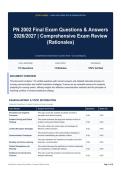
[STUDY GUIDE] • HIGH-YIELD PRACTICE & REVIEW EDITION
PN 2002 Final Exam Questions & Answers
2026/2027 | Comprehensive Exam Review
(Rationales)
Comprehensive Examination Question Bank • Concept Mapping
TOTAL QUESTIONS EXAM TOPICS RATIONALES
112 Questions 13 Modules 100% Verified
DOCUMENT OVERVIEW
This document contains 112 verified questions with correct answers and detailed rationales focused on
nursing communication and conflict resolution strategies. It serves as an essential resource for students
preparing for nursing exams, offering insights into effective communication methods and the principles of
resolving conflicts in diverse healthcare settings.
EXAM BLUEPRINT & TOPIC DISTRIBUTION
Systematic breakdown of subject domains and exam coverage.
Topic Module Scope & Core Focus Questions Share (%)
Perception and Cognitive This topic covers the cognitive processes involved in
Processes perception and decision-making. 9 Qs 8.0%
Problem Solving and Critical This section examines the steps and methods involved in
Thinking problem solving and critical thinking. 9 Qs 8.0%
This topic outlines the various steps and strategies for
Conflict Resolution Strategies effective conflict resolution. 9 Qs 8.0%
This section focuses on the communication strategies to
Communication Techniques enhance understanding and address conflicts. 9 Qs 8.0%
This topic addresses the importance of empathy and active
Empathy and Active Listening listening in communication. 9 Qs 8.0%
Cultural Competency and This section discusses the significance of cultural awareness
Diversity and competency in healthcare settings. 9 Qs 8.0%
Feedback and Constructive This topic covers the principles of providing and receiving
Criticism feedback effectively. 9 Qs 8.0%
Confidential • Student Study Edition • Practice & Review Guide Page 1 of 39
,STUDENT STUDY & MASTERY EDITION PRACTICE & REVIEW GUIDE
Communication Barriers and This section identifies barriers to communication and
Strategies strategies to overcome them. 9 Qs 8.0%
This topic focuses on communication strategies specific to
Dementia Care Communication clients with cognitive impairments. 8 Qs 7.1%
This section examines the emotional needs of clients and the
Emotional Needs and Support support provided by healthcare professionals. 8 Qs 7.1%
Assertiveness in This topic discusses the principles and techniques of
Communication assertive communication. 8 Qs 7.1%
This section explores different types of conflict and effective
Conflict Types and Management management strategies. 8 Qs 7.1%
Legal and Ethical This topic addresses important legal and ethical aspects
Considerations related to informed consent and representation. 8 Qs 7.1%
Total Exam Coverage 13 Integrated Topic Modules 112 Qs 100.0%
Confidential • Student Study Edition • Practice & Review Guide Page 2 of 39
,STUDENT STUDY & MASTERY EDITION PRACTICE & REVIEW GUIDE
TOPIC 1: PERCEPTION AND COGNITIVE PROCESSES
9 Questions • 8.0% of Exam • This topic covers the cognitive processes involved in perception and decision-making.
QUESTION 1
Perception
Answer: A cognitive process by which a person transforms external sensory data into personalized images
of reality.
Rationale: Perception is the cognitive process by which the brain interprets sensory information from the
environment. This interpretation is not a passive reception of data but an active construction of reality, influenced by an
individual's past experiences, beliefs, and expectations.
QUESTION 2
Problem solving
Answer: A comprehensive, sequential, cognitive process used to solve a problem by reducing the difference
between current and desired condit.
Rationale: Problem-solving is a cognitive process that involves a series of steps to address a challenge. It is characterized
by its systematic nature, moving from identifying the current situation to defining the desired outcome.
QUESTION 3
Critical Thinking
Answer: Analytical process in which you purposefully use specific thinking skills to make clinical decisions.
Rationale: Critical thinking is a deliberate and systematic approach to decision-making. It involves the conscious application
of specific cognitive skills to analyze information and arrive at a reasoned conclusion.
Confidential • Student Study Edition • Practice & Review Guide Page 3 of 39
, STUDENT STUDY & MASTERY EDITION PRACTICE & REVIEW GUIDE
QUESTION 4
Perception is based on information acquires through five senses of sight, hearing,
taste, touch and smell. Perception is a process of mentally organizing and interpreting
sensory information to arrive to a meaningful conclusion. Factors that influence
perception are:
• Culture
• Education
• Personal Background
Answer: Is based on information acquires through five senses of sight, hearing, taste, touch and smell.
Perception is a process of mentally organizing and interpreting sensory information to arrive to a meaningful
conclusion. Factors that influence perception are:
- Culture
- Education
- Personal Background.
Rationale: Perception is defined as the process of organizing and interpreting sensory information to form a meaningful
understanding of the environment. This process relies on information gathered through the five senses: sight, hearing, taste,
touch, and smell.
QUESTION 5
Why should you avoid "Affective Conflict"?
[a] Personal antagonism is fueled by differences of opinion
[b] Destructive to group performance and cohesion
[c] All of the above
[d] None of the above
Answer: C. All of the above.
Rationale: Affective conflict, also known as relationship conflict, is characterized by personal animosity, tension, and friction
among group members. This type of conflict is detrimental to group performance because it distracts from task
accomplishment and erodes trust and respect among individuals, thereby hindering cohesion.
Confidential • Student Study Edition • Practice & Review Guide Page 4 of 39
PN 2002 Final Exam Questions & Answers
2026/2027 | Comprehensive Exam Review
(Rationales)
Comprehensive Examination Question Bank • Concept Mapping
TOTAL QUESTIONS EXAM TOPICS RATIONALES
112 Questions 13 Modules 100% Verified
DOCUMENT OVERVIEW
This document contains 112 verified questions with correct answers and detailed rationales focused on
nursing communication and conflict resolution strategies. It serves as an essential resource for students
preparing for nursing exams, offering insights into effective communication methods and the principles of
resolving conflicts in diverse healthcare settings.
EXAM BLUEPRINT & TOPIC DISTRIBUTION
Systematic breakdown of subject domains and exam coverage.
Topic Module Scope & Core Focus Questions Share (%)
Perception and Cognitive This topic covers the cognitive processes involved in
Processes perception and decision-making. 9 Qs 8.0%
Problem Solving and Critical This section examines the steps and methods involved in
Thinking problem solving and critical thinking. 9 Qs 8.0%
This topic outlines the various steps and strategies for
Conflict Resolution Strategies effective conflict resolution. 9 Qs 8.0%
This section focuses on the communication strategies to
Communication Techniques enhance understanding and address conflicts. 9 Qs 8.0%
This topic addresses the importance of empathy and active
Empathy and Active Listening listening in communication. 9 Qs 8.0%
Cultural Competency and This section discusses the significance of cultural awareness
Diversity and competency in healthcare settings. 9 Qs 8.0%
Feedback and Constructive This topic covers the principles of providing and receiving
Criticism feedback effectively. 9 Qs 8.0%
Confidential • Student Study Edition • Practice & Review Guide Page 1 of 39
,STUDENT STUDY & MASTERY EDITION PRACTICE & REVIEW GUIDE
Communication Barriers and This section identifies barriers to communication and
Strategies strategies to overcome them. 9 Qs 8.0%
This topic focuses on communication strategies specific to
Dementia Care Communication clients with cognitive impairments. 8 Qs 7.1%
This section examines the emotional needs of clients and the
Emotional Needs and Support support provided by healthcare professionals. 8 Qs 7.1%
Assertiveness in This topic discusses the principles and techniques of
Communication assertive communication. 8 Qs 7.1%
This section explores different types of conflict and effective
Conflict Types and Management management strategies. 8 Qs 7.1%
Legal and Ethical This topic addresses important legal and ethical aspects
Considerations related to informed consent and representation. 8 Qs 7.1%
Total Exam Coverage 13 Integrated Topic Modules 112 Qs 100.0%
Confidential • Student Study Edition • Practice & Review Guide Page 2 of 39
,STUDENT STUDY & MASTERY EDITION PRACTICE & REVIEW GUIDE
TOPIC 1: PERCEPTION AND COGNITIVE PROCESSES
9 Questions • 8.0% of Exam • This topic covers the cognitive processes involved in perception and decision-making.
QUESTION 1
Perception
Answer: A cognitive process by which a person transforms external sensory data into personalized images
of reality.
Rationale: Perception is the cognitive process by which the brain interprets sensory information from the
environment. This interpretation is not a passive reception of data but an active construction of reality, influenced by an
individual's past experiences, beliefs, and expectations.
QUESTION 2
Problem solving
Answer: A comprehensive, sequential, cognitive process used to solve a problem by reducing the difference
between current and desired condit.
Rationale: Problem-solving is a cognitive process that involves a series of steps to address a challenge. It is characterized
by its systematic nature, moving from identifying the current situation to defining the desired outcome.
QUESTION 3
Critical Thinking
Answer: Analytical process in which you purposefully use specific thinking skills to make clinical decisions.
Rationale: Critical thinking is a deliberate and systematic approach to decision-making. It involves the conscious application
of specific cognitive skills to analyze information and arrive at a reasoned conclusion.
Confidential • Student Study Edition • Practice & Review Guide Page 3 of 39
, STUDENT STUDY & MASTERY EDITION PRACTICE & REVIEW GUIDE
QUESTION 4
Perception is based on information acquires through five senses of sight, hearing,
taste, touch and smell. Perception is a process of mentally organizing and interpreting
sensory information to arrive to a meaningful conclusion. Factors that influence
perception are:
• Culture
• Education
• Personal Background
Answer: Is based on information acquires through five senses of sight, hearing, taste, touch and smell.
Perception is a process of mentally organizing and interpreting sensory information to arrive to a meaningful
conclusion. Factors that influence perception are:
- Culture
- Education
- Personal Background.
Rationale: Perception is defined as the process of organizing and interpreting sensory information to form a meaningful
understanding of the environment. This process relies on information gathered through the five senses: sight, hearing, taste,
touch, and smell.
QUESTION 5
Why should you avoid "Affective Conflict"?
[a] Personal antagonism is fueled by differences of opinion
[b] Destructive to group performance and cohesion
[c] All of the above
[d] None of the above
Answer: C. All of the above.
Rationale: Affective conflict, also known as relationship conflict, is characterized by personal animosity, tension, and friction
among group members. This type of conflict is detrimental to group performance because it distracts from task
accomplishment and erodes trust and respect among individuals, thereby hindering cohesion.
Confidential • Student Study Edition • Practice & Review Guide Page 4 of 39