
The Human Body in Health and Illness
7th Edition — 250 Original Exam-Style Questions
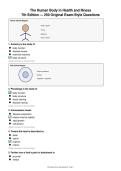
Human clinical diagram
Head / superior
Thorax
Abdomen
Pelvis / inferior
1. Anatomy is the study of
body function
disease causes
chemical reactions
body structure
Chapter: Introduction to the Human Body
Cell clinical diagram
Plasma membrane
Nucleus
Cytoplasm / organelles
2. Physiology is the study of
body function
body structure
tissue staining
disease naming
Chapter: Introduction to the Human Body
3. Homeostasis means
disease progression
relative internal stability
rapid growth
cell division
Chapter: Introduction to the Human Body
4. Toward the head is described as
distal
lateral
superior
inferior
Chapter: Introduction to the Human Body
5. Farther from a limb's point of attachment is
proximal
medial
250 original exam-style questions • Page 1
, superficial
distal
Chapter: Introduction to the Human Body
6. A plane dividing right and left portions is
sagittal
frontal
transverse
oblique
Chapter: Introduction to the Human Body
7. The diaphragm separates the
pleural cavities
thoracic and abdominal cavities
cranial and thoracic cavities
abdominal and pelvic cavities
Chapter: Introduction to the Human Body
8. The smallest living unit is the
organ
organ system
cell
tissue
Chapter: Introduction to the Human Body
9. Organs working together form an
atom
tissue
membrane
organ system
Chapter: Introduction to the Human Body
10. The negatively charged atomic particle is the
electron
proton
neutron
nucleus
Chapter: Basic Chemistry
11. Atomic number equals the number of
energy levels
protons
neutrons
electrons plus neutrons
Chapter: Basic Chemistry
12. Electron transfer forms a(n)
hydrogen bond
peptide bond
ionic bond
covalent bond
250 original exam-style questions • Page 2
,Chapter: Basic Chemistry
13. Electron sharing forms a(n)
ionic bond
hydrogen bond
glycosidic bond
covalent bond
Chapter: Basic Chemistry
14. A pH of 3 is
acidic
neutral
basic
isotonic
Chapter: Basic Chemistry
Heart clinical diagram
RA LA
RV LV
Four-chamber flow diagram
15. All organic compounds contain
chlorine
carbon
sodium
calcium
Chapter: Basic Chemistry
16. A positively charged ion is a
isotope
molecule
cation
anion
Chapter: Basic Chemistry
17. The major solvent in the body is
lipid
protein
glycogen
water
Chapter: Basic Chemistry
18. A substance speeding a reaction without being consumed is an
enzyme
electrolyte
isotope
buffer
Chapter: Basic Chemistry
250 original exam-style questions • Page 3
, 19. Most cellular DNA is located in the
Golgi apparatus
nucleus
ribosome
lysosome
Chapter: Cells
20. Protein synthesis occurs at
lysosomes
peroxisomes
ribosomes
centrioles
Chapter: Cells
21. Most ATP production occurs in
nucleus
Golgi apparatus
lysosomes
mitochondria
Chapter: Cells
22. The plasma membrane is
selectively permeable
completely impermeable
made only of protein
a rigid cell wall
Chapter: Cells
23. Water movement across a selectively permeable membrane is
phagocytosis
osmosis
filtration
exocytosis
Chapter: Cells
Nephron clinical diagram
Tubule
Renal corpuscle
Collecting duct
24. Movement down a concentration gradient is
endocytosis
pinocytosis
diffusion
active transport
Chapter: Cells
25. Engulfing a large particle is
250 original exam-style questions • Page 4
7th Edition — 250 Original Exam-Style Questions
Human clinical diagram
Head / superior
Thorax
Abdomen
Pelvis / inferior
1. Anatomy is the study of
body function
disease causes
chemical reactions
body structure
Chapter: Introduction to the Human Body
Cell clinical diagram
Plasma membrane
Nucleus
Cytoplasm / organelles
2. Physiology is the study of
body function
body structure
tissue staining
disease naming
Chapter: Introduction to the Human Body
3. Homeostasis means
disease progression
relative internal stability
rapid growth
cell division
Chapter: Introduction to the Human Body
4. Toward the head is described as
distal
lateral
superior
inferior
Chapter: Introduction to the Human Body
5. Farther from a limb's point of attachment is
proximal
medial
250 original exam-style questions • Page 1
, superficial
distal
Chapter: Introduction to the Human Body
6. A plane dividing right and left portions is
sagittal
frontal
transverse
oblique
Chapter: Introduction to the Human Body
7. The diaphragm separates the
pleural cavities
thoracic and abdominal cavities
cranial and thoracic cavities
abdominal and pelvic cavities
Chapter: Introduction to the Human Body
8. The smallest living unit is the
organ
organ system
cell
tissue
Chapter: Introduction to the Human Body
9. Organs working together form an
atom
tissue
membrane
organ system
Chapter: Introduction to the Human Body
10. The negatively charged atomic particle is the
electron
proton
neutron
nucleus
Chapter: Basic Chemistry
11. Atomic number equals the number of
energy levels
protons
neutrons
electrons plus neutrons
Chapter: Basic Chemistry
12. Electron transfer forms a(n)
hydrogen bond
peptide bond
ionic bond
covalent bond
250 original exam-style questions • Page 2
,Chapter: Basic Chemistry
13. Electron sharing forms a(n)
ionic bond
hydrogen bond
glycosidic bond
covalent bond
Chapter: Basic Chemistry
14. A pH of 3 is
acidic
neutral
basic
isotonic
Chapter: Basic Chemistry
Heart clinical diagram
RA LA
RV LV
Four-chamber flow diagram
15. All organic compounds contain
chlorine
carbon
sodium
calcium
Chapter: Basic Chemistry
16. A positively charged ion is a
isotope
molecule
cation
anion
Chapter: Basic Chemistry
17. The major solvent in the body is
lipid
protein
glycogen
water
Chapter: Basic Chemistry
18. A substance speeding a reaction without being consumed is an
enzyme
electrolyte
isotope
buffer
Chapter: Basic Chemistry
250 original exam-style questions • Page 3
, 19. Most cellular DNA is located in the
Golgi apparatus
nucleus
ribosome
lysosome
Chapter: Cells
20. Protein synthesis occurs at
lysosomes
peroxisomes
ribosomes
centrioles
Chapter: Cells
21. Most ATP production occurs in
nucleus
Golgi apparatus
lysosomes
mitochondria
Chapter: Cells
22. The plasma membrane is
selectively permeable
completely impermeable
made only of protein
a rigid cell wall
Chapter: Cells
23. Water movement across a selectively permeable membrane is
phagocytosis
osmosis
filtration
exocytosis
Chapter: Cells
Nephron clinical diagram
Tubule
Renal corpuscle
Collecting duct
24. Movement down a concentration gradient is
endocytosis
pinocytosis
diffusion
active transport
Chapter: Cells
25. Engulfing a large particle is
250 original exam-style questions • Page 4


