NR 507 MIDTERM EXAM (CHAMBERLAIN)
NEWEST 2026 ACTUAL EXAM| NR507
ADVANCED PATHOPHYSIOLOGY WEEK 4
MIDTERM EXAM WITH COMPLETE 100 REAL
EXAM QUESTIONS AND CORRECT VERIFIED
ANSWERS/ ALREADY GRADED A+ (MOST
RECENT!!)
original
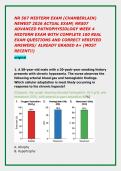
1. A 58-year-old male with a 30-pack-year smoking history
presents with chronic hypoxemia. The nurse observes the
following arterial blood gas and hemoglobin findings.
Which cellular adaptation is most likely occurring in
response to his chronic hypoxia?
[Diagram: Bar graph showing elevated hemoglobin 18.5 g/dL and
hematocrit 55%, with arterial oxygen saturation 88%]
A. Atrophy
B. Hypertrophy
,C. Hyperplasia
D. Metaplasia
C
RATIONALE: Chronic hypoxia stimulates the kidney to produce
erythropoietin, which causes hyperplasia of erythroid precursors
in the bone marrow, leading to increased red blood cell
production. This is a compensatory adaptation to improve
oxygen-carrying capacity.
2. A 45-year-old female with a history of chronic acid
reflux is found to have Barrett esophagus. The nurse
observes the following histologic diagram. Which cellular
adaptation is this?
[Diagram: Microscopic illustration showing squamous epithelium
replaced by columnar epithelium with goblet cells]
A. Hyperplasia
B. Dysplasia
C. Metaplasia
D. Anaplasia
C
, RATIONALE: Barrett esophagus is an example of metaplasia,
the reversible replacement of one mature cell type (squamous)
by another (columnar), as an adaptive response to chronic
irritation from acid reflux.
3. A 62-year-old male with poorly controlled hypertension
is found to have left ventricular wall thickening. The nurse
observes the following echocardiogram diagram. Which
cellular adaptation does this represent?
[Diagram: Cross-section of heart showing thickened left
ventricular wall with enlarged myocytes]
A. Hyperplasia
B. Atrophy
C. Hypertrophy
D. Metaplasia
C
RATIONALE: Cardiac myocytes are terminally differentiated
cells that cannot divide. In response to chronic pressure overload
from hypertension, they increase in size (hypertrophy) by adding
structural proteins.
, 4. A 35-year-old female presents with a painless breast
mass. The nurse observes the following biopsy diagram.
Which cellular change is most concerning for malignancy?
[Diagram: Microscopic illustration showing cells with increased
nuclear-to-cytoplasmic ratio, hyperchromatic nuclei, and
disorganized arrangement]
A. Atrophy
B. Metaplasia
C. Dysplasia
D. Hypertrophy
C
RATIONALE: Dysplasia is characterized by disordered cellular
growth with increased nuclear-to-cytoplasmic ratio,
hyperchromatic nuclei, and loss of normal orientation. It is a
premalignant condition that can progress to cancer.
5. A 70-year-old male with chronic kidney disease has a
serum potassium of 6.5 mEq/L. The nurse observes the
following ECG tracing. What is the most concerning
finding?
NEWEST 2026 ACTUAL EXAM| NR507
ADVANCED PATHOPHYSIOLOGY WEEK 4
MIDTERM EXAM WITH COMPLETE 100 REAL
EXAM QUESTIONS AND CORRECT VERIFIED
ANSWERS/ ALREADY GRADED A+ (MOST
RECENT!!)
original
1. A 58-year-old male with a 30-pack-year smoking history
presents with chronic hypoxemia. The nurse observes the
following arterial blood gas and hemoglobin findings.
Which cellular adaptation is most likely occurring in
response to his chronic hypoxia?
[Diagram: Bar graph showing elevated hemoglobin 18.5 g/dL and
hematocrit 55%, with arterial oxygen saturation 88%]
A. Atrophy
B. Hypertrophy
,C. Hyperplasia
D. Metaplasia
C
RATIONALE: Chronic hypoxia stimulates the kidney to produce
erythropoietin, which causes hyperplasia of erythroid precursors
in the bone marrow, leading to increased red blood cell
production. This is a compensatory adaptation to improve
oxygen-carrying capacity.
2. A 45-year-old female with a history of chronic acid
reflux is found to have Barrett esophagus. The nurse
observes the following histologic diagram. Which cellular
adaptation is this?
[Diagram: Microscopic illustration showing squamous epithelium
replaced by columnar epithelium with goblet cells]
A. Hyperplasia
B. Dysplasia
C. Metaplasia
D. Anaplasia
C
, RATIONALE: Barrett esophagus is an example of metaplasia,
the reversible replacement of one mature cell type (squamous)
by another (columnar), as an adaptive response to chronic
irritation from acid reflux.
3. A 62-year-old male with poorly controlled hypertension
is found to have left ventricular wall thickening. The nurse
observes the following echocardiogram diagram. Which
cellular adaptation does this represent?
[Diagram: Cross-section of heart showing thickened left
ventricular wall with enlarged myocytes]
A. Hyperplasia
B. Atrophy
C. Hypertrophy
D. Metaplasia
C
RATIONALE: Cardiac myocytes are terminally differentiated
cells that cannot divide. In response to chronic pressure overload
from hypertension, they increase in size (hypertrophy) by adding
structural proteins.
, 4. A 35-year-old female presents with a painless breast
mass. The nurse observes the following biopsy diagram.
Which cellular change is most concerning for malignancy?
[Diagram: Microscopic illustration showing cells with increased
nuclear-to-cytoplasmic ratio, hyperchromatic nuclei, and
disorganized arrangement]
A. Atrophy
B. Metaplasia
C. Dysplasia
D. Hypertrophy
C
RATIONALE: Dysplasia is characterized by disordered cellular
growth with increased nuclear-to-cytoplasmic ratio,
hyperchromatic nuclei, and loss of normal orientation. It is a
premalignant condition that can progress to cancer.
5. A 70-year-old male with chronic kidney disease has a
serum potassium of 6.5 mEq/L. The nurse observes the
following ECG tracing. What is the most concerning
finding?