
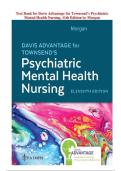
Test Bank for Davis Advantage for Townsend's Psychiatric Mental Health Nursing, 11th Edition by Morgan
Test Bank for Davis Advantage for Townsend's Psychiatric Mental Health Nursing, 11th Edition by Morgan Prepare for psychiatric and mental health nursing coursework with this comprehensive Test Bank for Davis Advantage for Townsend's Psychiatric Mental Health Nursing, 11th Edition by Morgan. Designed as a supplemental study and practice resource, this material can help nursing students reinforce essential psychiatric nursing concepts, review important terminology, develop clinical reasoning skills, and prepare for quizzes, examinations, assignments, and classroom discussions. Psychiatric mental health nursing requires students to combine knowledge of human behavior, therapeutic communication, mental health conditions, patient safety, nursing interventions, medications, and ethical practice. A structured question-based study resource can help learners actively recall important information and identify areas that require additional review. Comprehensive Psychiatric Mental Health Nursing Review This resource is designed to complement the concepts presented in Davis Advantage for Townsend's Psychiatric Mental Health Nursing, 11th Edition. Students can use practice questions alongside their textbook, lecture notes, instructor materials, and other approved resources. Rather than relying solely on passive reading, question-based study encourages students to retrieve information and apply concepts. This can help strengthen understanding of psychiatric assessment, therapeutic relationships, nursing interventions, patient education, and clinical decision-making. Psychiatric Assessment Assessment is an essential component of psychiatric nursing practice. Students need to understand how nurses collect information about a patient's mental, emotional, behavioral, and psychosocial status. Practice questions can help learners review concepts involving psychiatric assessment, mental status examination, patient history, observation, communication, risk assessment, and documentation. Therapeutic Communication Therapeutic communication is a fundamental skill in mental health nursing. Nurses must establish professional relationships while demonstrating empathy, respect, active listening, and appropriate boundaries. Students can use question-based practice to reinforce concepts involving therapeutic communication techniques, communication barriers, interpersonal relationships, and appropriate responses to patients experiencing emotional or psychological difficulties. Mental Health Conditions Psychiatric nursing education includes the study of numerous mental health conditions and their associated signs, symptoms, treatment approaches, and nursing considerations. Review may include concepts related to: Anxiety-related conditions Depressive disorders Bipolar disorders Schizophrenia and psychotic disorders Personality disorders Trauma-related conditions Substance-related disorders Neurocognitive conditions Eating disorders Stress-related conditions Behavioral and emotional concerns Practice questions can help students distinguish between clinical presentations and consider appropriate nursing priorities. Nursing Interventions and Patient Care Mental health nurses provide individualized care based on assessment findings, patient needs, safety considerations, and treatment goals. Students can use practice questions to review nursing interventions, patient education, therapeutic approaches, and evaluation of care. Scenario-based questions may encourage learners to consider what information is most important and which nursing action should be prioritized. Psychopharmacology Review Medication management is another important area of psychiatric nursing. Students need to understand medication classes, therapeutic purposes, common adverse effects, safety considerations, patient teaching, and nursing responsibilities. A practice resource can help students review psychiatric medications while reinforcing the relationship between medication therapy, assessment findings, patient education, and monitoring. Students should always verify medication information using current authoritative references because prescribing information and clinical recommendations can change. Patient Safety Safety is a central consideration in psychiatric nursing. Nurses may care for patients experiencing suicidal thoughts, self-harm risk, aggression, severe confusion, substance-related complications, or other situations requiring careful assessment and intervention. Practice questions can reinforce concepts related to risk assessment, environmental safety, observation, communication, documentation, and appropriate escalation of concerns. Clinical Judgment and Prioritization Psychiatric nursing questions often require students to interpret patient information rather than simply recall definitions. Practicing clinical scenarios can help learners develop a systematic approach to identifying relevant findings and determining appropriate nursing priorities. Students can practice asking: What information is most important? What should the nurse assess first? What response is therapeutic? What intervention promotes safety? What finding requires further evaluation? What patient education is appropriate? When should the healthcare team be notified? These approaches can make study sessions more active and focused. Ethical and Legal Considerations Mental health nursing also involves important ethical and legal responsibilities. Students may need to understand patient rights, confidentiality, informed consent, professional boundaries, advocacy, autonomy, and other principles affecting psychiatric care. Reviewing these concepts through practice questions can help learners connect ethical principles with realistic nursing situations. Substance Use and Recovery Substance-related disorders are another important area of psychiatric mental health nursing. Students can use practice questions to review assessment, withdrawal considerations, patient safety, therapeutic communication, treatment approaches, education, and recovery-oriented care. Understanding substance-use concepts can help learners approach patients with appropriate professional communication and evidence-based nursing principles. Useful for Nursing Students This study resource may benefit: Nursing students Psychiatric mental health nursing students Undergraduate nursing learners Students preparing for nursing quizzes Students preparing for examinations Nursing study groups Learners reviewing mental health concepts Students strengthening clinical judgment Students studying psychiatric medications Learners reviewing therapeutic communication Flexible Study Resource Students can incorporate this resource into different study routines. Questions may be completed after each assigned chapter, during weekly review sessions, or before major examinations. Suggested uses include: Chapter review Quiz preparation Midterm preparation Final examination review Self-assessment Group study Clinical concept review Psychiatric nursing practice Identification of knowledge gaps Reinforcement of difficult concepts Recommended Study Strategy For effective preparation, begin with the assigned textbook chapter and instructor-provided materials. Review the major concepts before attempting the practice questions. Answer questions independently whenever possible. Mark questions that are difficult or uncertain, then return to the relevant textbook section or class notes for clarification. Repeating this process can help students identify patterns in their learning and focus additional study time on weaker areas. Key Features Supplemental resource for Davis Advantage for Townsend's Psychiatric Mental Health Nursing 11th Edition By Morgan Psychiatric mental health nursing review Therapeutic communication concepts Psychiatric assessment Mental health conditions Nursing interventions Patient safety Psychopharmacology review Substance-use concepts Ethical and legal considerations Clinical judgment and prioritization Patient education Useful for quizzes and examinations Suitable for individual or group study Educational Use This product is intended as a supplemental educational and practice resource. It should be used together with the assigned textbook, course syllabus, lectures, instructor materials, and current authoritative nursing references. Students should verify clinical information and answers against their current course requirements and approved sources. The Test Bank for Davis Advantage for Townsend's Psychiatric Mental Health Nursing, 11th Edition by Morgan provides a structured way to reinforce psychiatric nursing concepts and practice applying knowledge to nursing-related scenarios. Regular question-based review can help students identify areas requiring further study, strengthen recall, and develop a more organized approach to psychiatric mental health nursing coursework
Document information
- Uploaded on
- September 20, 2026
- Number of pages
- 306
- Written in
- 2026/2027
- Type
- Exam (elaborations)
- Contains
- Questions & answers


